

LinkedIn Content Credentials: What the C2PA Icon Means
LinkedIn Content Credentials explained: what the C2PA icon means, the five fields it reveals, and why a missing badge proves nothing about AI.
Automate your LinkedIn for 30 days
What are LinkedIn Content Credentials?
LinkedIn Content Credentials are a small badge on an image or video post that shows where the file came from and whether AI touched it. LinkedIn attaches the badge automatically when the file you upload already carries a C2PA credential, a signed record of the content's origin that travels inside the file itself.
You have probably already scrolled past one. It looks like a small Cr icon in the corner of an image. Click it and LinkedIn opens a panel describing what made the file.
The important thing to understand up front: LinkedIn is not inspecting the picture and deciding whether it looks AI-generated. It is reading a label the creating tool attached earlier, then passing that label on to you.
How Content Credentials work
The credential is created at the moment the file is made, not at the moment you post it.
- A tool signs the file. An AI image generator, a camera, or an editor writes a cryptographically signed record into the file describing what it did.
- You upload it to LinkedIn. In LinkedIn's words, "If you post image or video content that contains C2PA credentials, we will indicate its presence with the C2PA icon."
- LinkedIn displays the icon. Readers click it to see the record.
The signing is what makes this different from ordinary photo metadata. C2PA uses a hard binding, defined in the specification as "one or more cryptographic hashes that uniquely identifies either the entire asset or a portion thereof." Change the pixels and the hash stops matching, so a tampered credential announces itself instead of lying quietly.
The standard behind it is run by the Coalition for Content Provenance and Authenticity (C2PA), whose steering committee includes Adobe, Amazon, the BBC, Google, Meta, Microsoft, OpenAI, Publicis Groupe, Sony, TikTok, and Truepic. C2PA describes Content Credentials as working "like a nutrition label for digital content."
What the C2PA icon shows when you click it
LinkedIn documents five fields in the panel:
| Field | What it tells you |
|---|---|
| Assertion about the media | Whether AI was used to generate or edit any part of the content |
| App or device used | The origin source, such as a camera model or an AI tool |
| Created by | The individual who generated the image |
| Issued by | The entity that created and signed the credential |
| Issued on | The timestamp of when the credential was created |
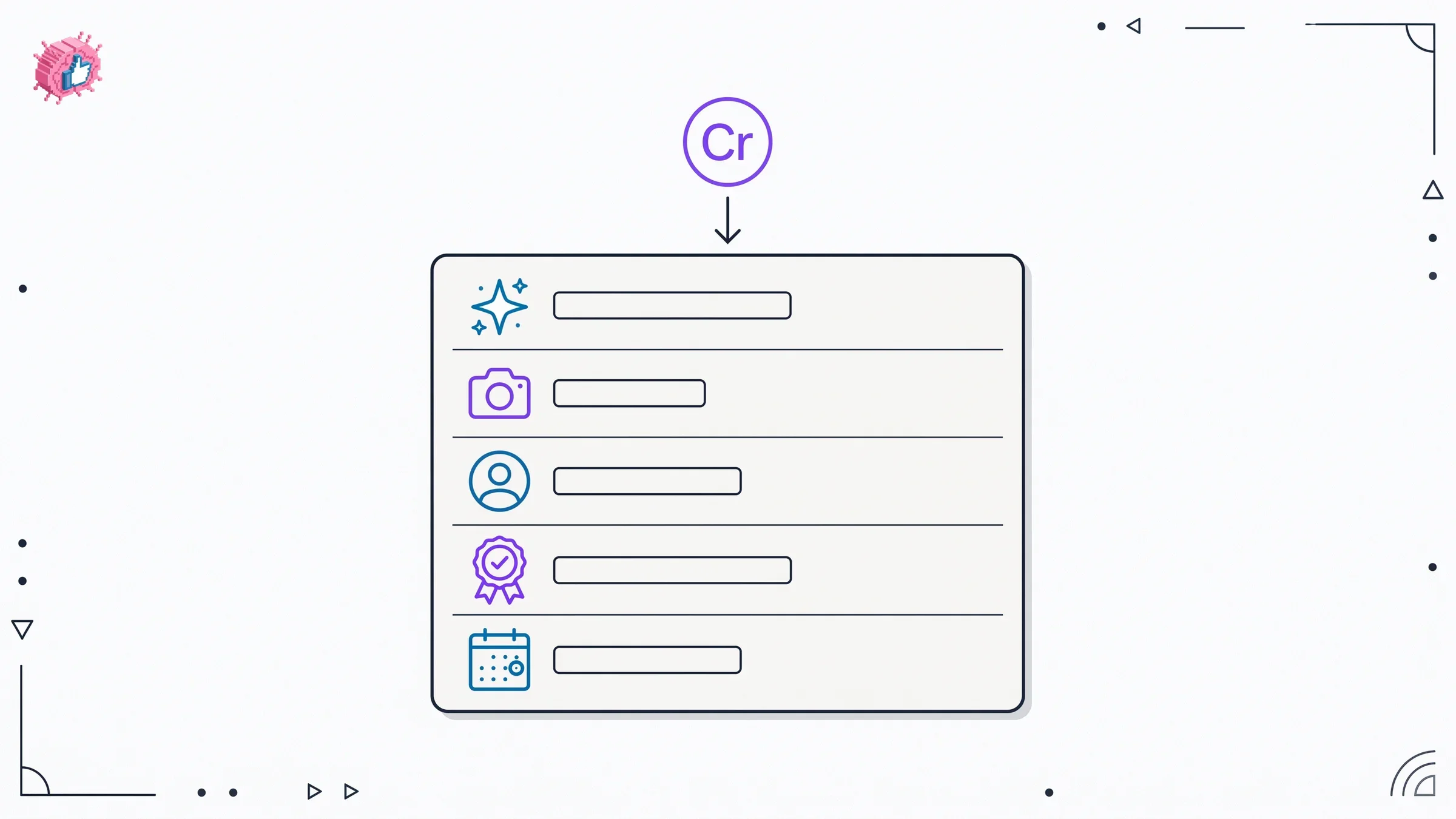
The first row is the one readers actually care about. LinkedIn describes it as "information on whether AI was used to generate or edit any part of the content," which is a narrower statement than most people assume when they see the badge.
Content Credentials vs an AI detector
Content Credentials read a signed label that the creating tool attached to the file, while an AI detector analyzes the content itself and guesses. One reports a fact recorded at creation; the other estimates after the fact. That difference decides how much weight the badge deserves.
| Content Credentials | An AI detector | |
|---|---|---|
| What it reads | A signed label attached by the creating tool | The pixels or text themselves |
| Answers | What made this file, and when | A guess at whether a model made this |
| Can it be wrong | The label is hard to fake, but it can be absent | Yes, in both directions |
| If there is no badge | Tells you nothing either way | Still returns a verdict |
A missing badge is the trap. It does not mean a human made the image. It means no credential reached LinkedIn, which happens for ordinary reasons: the tool never wrote one, or the file passed through an app that did not carry it forward.
Automate your LinkedIn for 30 days
Where Content Credentials show up in practice
You are most likely to meet the badge in five places on LinkedIn.
- Images generated in ChatGPT. OpenAI began adding C2PA metadata to all images created and edited by DALL-E 3 in ChatGPT and the OpenAI API, so a picture straight out of ChatGPT usually arrives carrying one.
- Edited photography, where an editor that supports the standard records that a real camera shot the original and that edits followed.
- Client work, where a credential doubles as a receipt for what was produced and by which tool.
- Headshots, which is where the badge gets personal: an AI headshot generator may label its output as AI-generated on the photo you use as your professional face.
- Carousels and video, which inherit whatever the source files carried into a carousel maker or a video post.
What Content Credentials cannot do
A Content Credential proves where a file came from. It does not prove the file is honest, and it is not present on most AI content. The badge is narrower than its reputation, in four specific ways.
A credential says nothing about whether the content is true. It records provenance and integrity: what made the file and whether it changed since. A perfectly credentialed image can still make a false claim.
Coverage is also partial, and LinkedIn says so directly: "Although it's not yet possible to identify and label all AI-generated and modified content, we're continuing to learn and assess feedback."
Credentials can also be removed. OpenAI's own write-up on provenance puts it plainly: "People can still create deceptive content without this information (or can remove it), but they cannot easily fake or alter this information, making it an important resource to build trust." That asymmetry is the whole point. Forging a credential is hard. Stripping one is not.
The last limit is fragility in transit. A credential embedded in a file can get separated from that file as it moves around the internet. The C2PA specification builds a recovery path for exactly this case, called a soft binding: "a content identifier that is either (a) not statistically unique, such as a fingerprint, or (b) embedded as an invisible watermark in the identified digital content." Soft bindings let content "be matched even if the underlying bits differ," and a fingerprint "could be used to search a database to recover the asset with an intact C2PA Manifest." The standard would not need that machinery if embedded credentials always survived the trip.
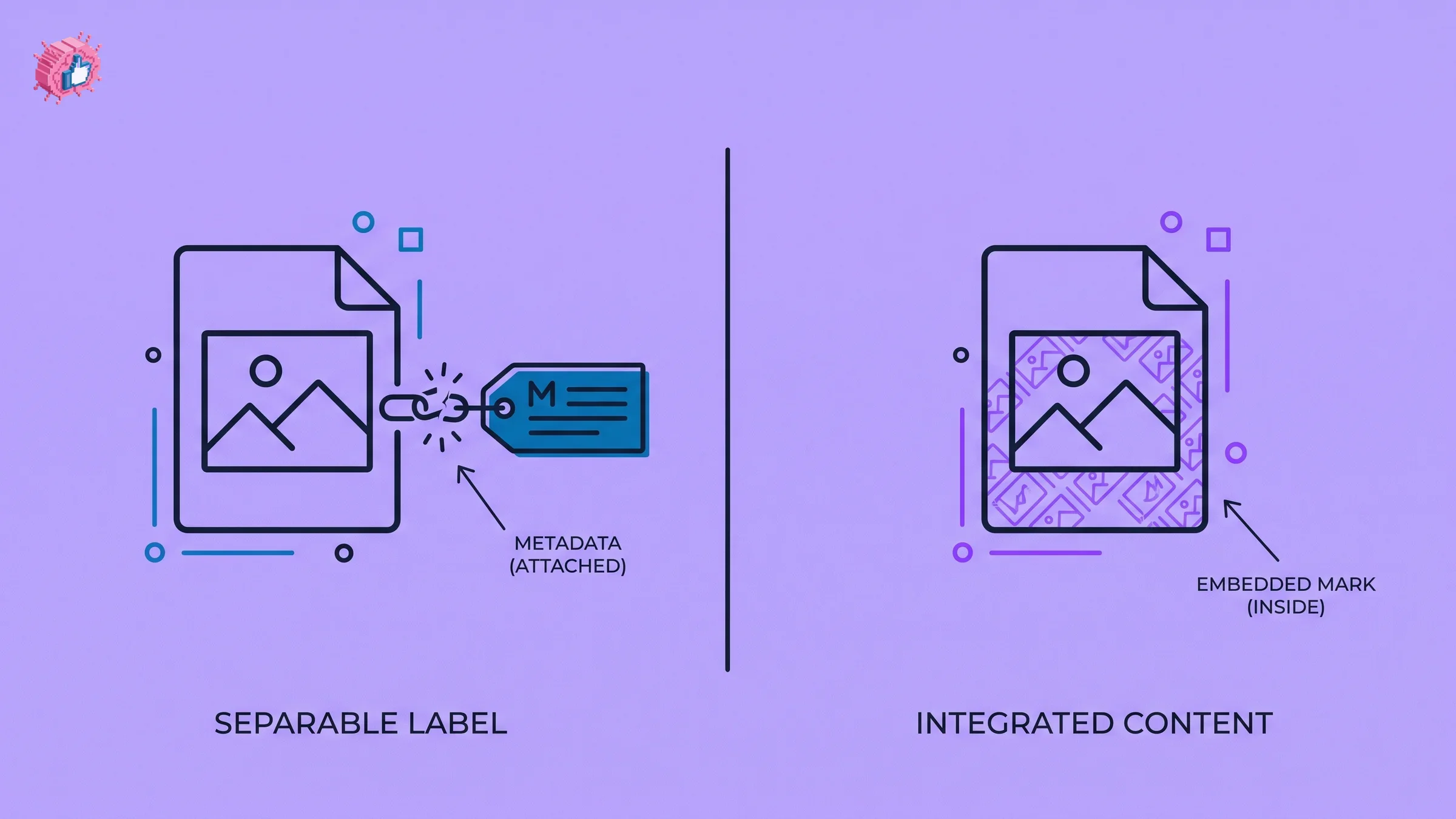
Practically: screenshot a credentialed image and you have made a new file with no credential. That is not a loophole anyone needs to discover. It is just how the format works.
What this means for you
If you post on LinkedIn, three things follow.
Assume the label is visible. If you generate an image in a tool that signs its output, readers can see it was AI-generated, so post on that assumption rather than being surprised later. The reputational cost of obvious AI content on LinkedIn is already real, and a badge makes the question concrete.
Do not read a missing badge as proof of anything. Most images on LinkedIn today carry no credential at all, genuine photographs included.
And do not fight the label. Stripping a credential to hide AI involvement is a bad trade: it risks far more than it saves, and the honest version performs fine anyway. Readers on LinkedIn have made peace with AI-assisted work. What they punish is generic work, which is a problem of substance rather than tooling, and it shows up in reach and impressions long before anyone checks a badge.
The useful framing is that Content Credentials are about disclosure, not permission. Nothing about the badge stops you from posting. It changes what your audience knows while they read.
That puts the weight back where it already was: on whether the post is worth reading. Whether you draft it yourself, use a LinkedIn post generator, or work from an analysis of your own writing style, the judgment readers make is about the thinking in the post. A credential on the image is a footnote next to that, which is also why the 2026 algorithm changes and plain personal brand fundamentals still decide more of your outcome than any badge does.
FAQ
What does the Cr icon on a LinkedIn image mean?
It means the file carries a C2PA Content Credential. Click it to see which app or device made the content, who created it, who signed the credential, when, and whether AI was used to generate or edit any part of it.
Does LinkedIn detect AI images automatically?
No. LinkedIn reads a credential that the creating tool attached to the file. It does not analyze the image to judge whether it looks AI-generated, and it states that it is not yet possible to identify and label all AI-generated and modified content.
Will my AI-generated image get a Content Credential on LinkedIn?
Only if the tool that generated it wrote one into the file and the credential survives until upload. Images from ChatGPT generally carry C2PA metadata. Many other tools do not write one.
Does a Content Credential hurt my reach?
There is no published evidence that the badge itself affects distribution, and LinkedIn has not said it is a ranking input. Treat it as a transparency feature rather than a penalty.
Can Content Credentials be removed?
Yes. Credentials can be removed, and taking a screenshot produces a new file without one. What is difficult is faking or altering a credential, which is why the presence of one carries more weight than the absence of one.
Does a missing badge mean the image is a real photo?
No. Most LinkedIn images carry no credential at all. Absence tells you nothing about how the content was made.
Who is behind the C2PA standard?
The Coalition for Content Provenance and Authenticity, whose steering committee includes Adobe, Amazon, the BBC, Google, Meta, Microsoft, OpenAI, Publicis Groupe, Sony, TikTok, and Truepic.
Should I disclose AI use in my posts if the badge already shows it?
The badge only labels images and video, not your written copy, and only when a credential is present. If disclosure matters for your audience or your client work, say it in the post rather than relying on an icon your readers may never click. For agencies handling this across accounts, LinkedIn for agencies covers the workflow side.
Automate your LinkedIn for 30 days
ViralBrain plans, writes, and schedules your LinkedIn content, using official LinkedIn APIs so your account stays safe.
- Official LinkedIn APIs, no risk of ban
- You approve every post before it goes live
- Cancel anytime
Keep reading
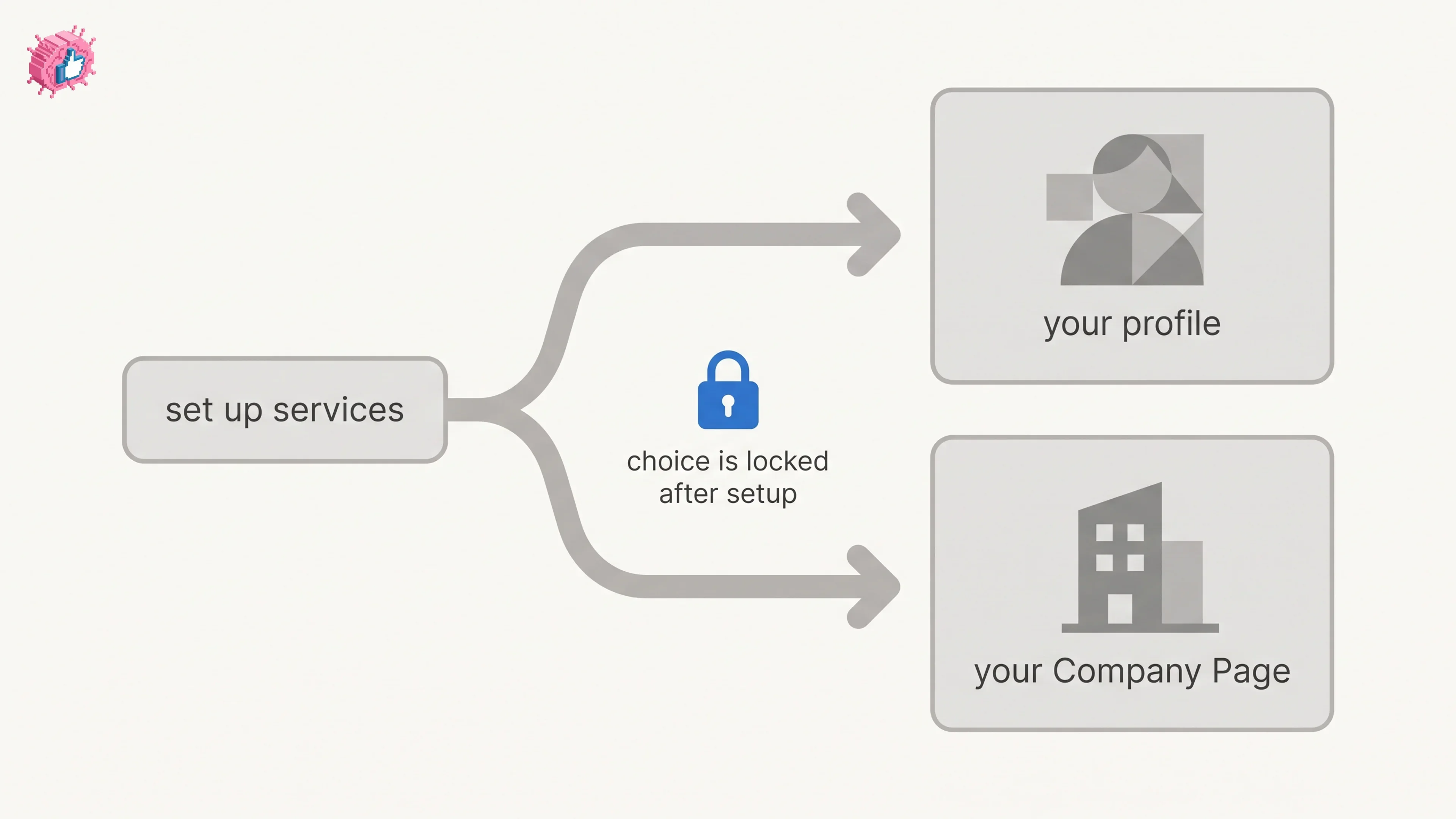
LinkedIn Service Page: setup, pricing, and the one-way choice
LinkedIn Service Pages are free for freelancers and consultants, but choosing profile or Company Page is locked once set. Setup steps and Premium limits.
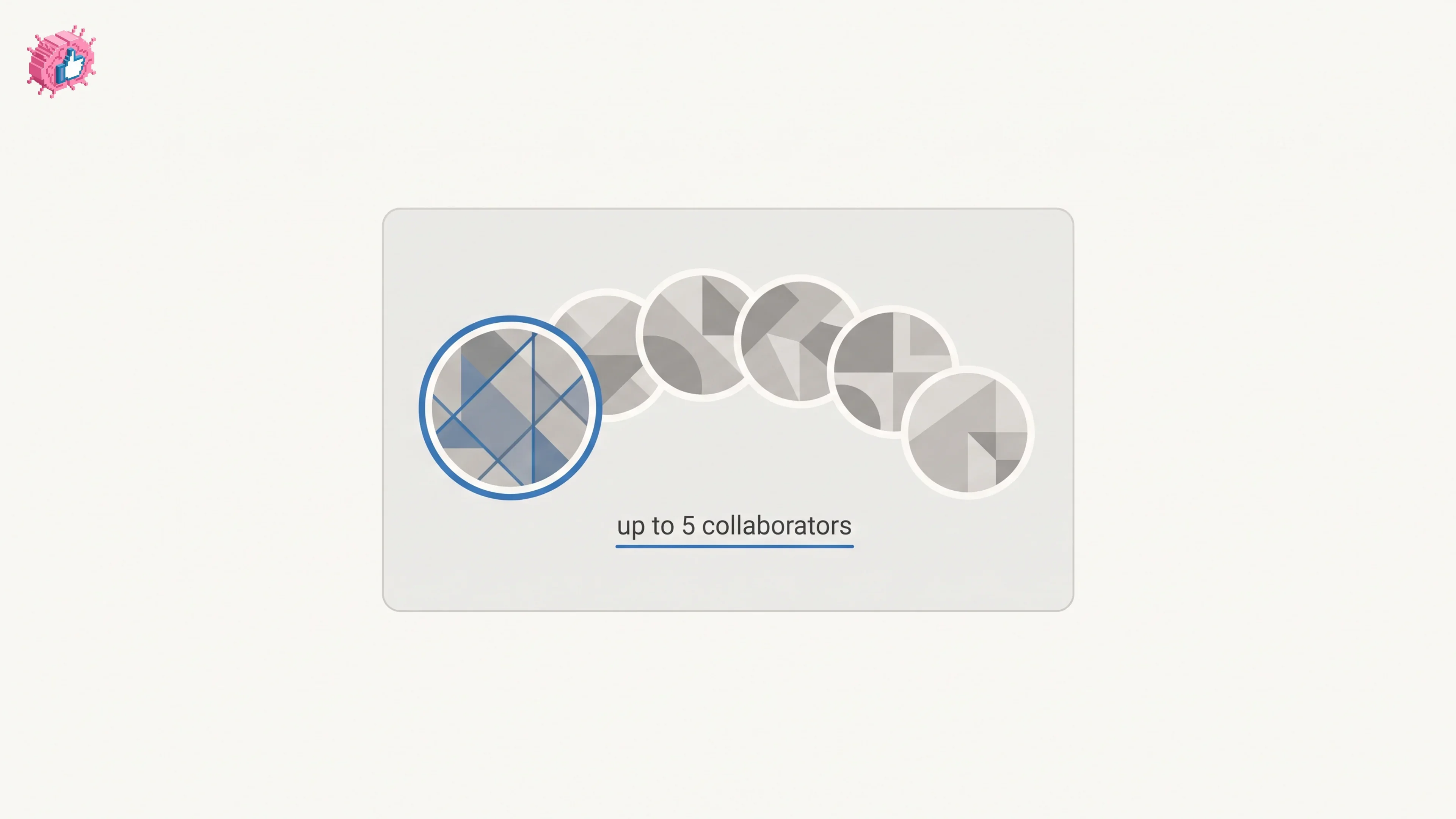
LinkedIn collaborative posts: how they work and who can use them
LinkedIn announced collaborative posts globally in July 2026, but help still limits creation to early access. How to add collaborators, and the limits.
How to become a LinkedIn Top Voice: what LinkedIn actually says
LinkedIn Top Voice is invite-only and the gold Community badge was retired in October 2024. The five selection factors, and the nomination form.