

The LinkedIn Algorithm in 2026: What Changed
The LinkedIn algorithm in 2026 rewards interest graphs, comments at 15x like weight, and a 3-8 hour momentum window. Here is what changed and how to win.
If your LinkedIn impressions look like they fell off a cliff in the last 18 months, you are not imagining it. Average impressions per post are down 63 to 66% since 2023, but engagement per post has actually climbed 12 to 39% in the same window. That contradiction is the whole story of the linkedin algorithm news in 2026: smaller audiences, deeper attention, and a completely different scoring model under the hood.
This piece is a quarterly snapshot of what the linkedin algorithm 2026 rewards, what it punishes, and which post patterns still work. We pair the latest public guidance from LinkedIn engineers and major SEO sources with our own dataset: 30,360 LinkedIn posts from 968 active hero creators, 653 of them viral, snapshot May 2026.
You will get the four shifts that matter, the three ranking signals reach now hangs on, the format hierarchy in numbers, and the patterns that still hit even in a tighter feed.
Automate your LinkedIn for 30 days
The headline change: from social graph to interest graph
For most of LinkedIn's history, the feed was a social graph. If you connected with someone, you saw their posts. The algorithm fan-out was wide, impressions were cheap, and engagement rates looked thin because reach was inflated.
In 2026, LinkedIn has effectively completed its shift to an interest graph. The feed now ranks posts by how relevant a topic is to a viewer's behavior, not by who follows whom. Connections are still a signal, but they are no longer the primary one. SourceGeek's 2026 update and Postiv's definitive 2026 guide both report the same direction of travel: relevance and dwell time matter more than the connection edge.
What this looks like in your stats:
- Impressions per post are down 63 to 66% vs 2023 baselines on most accounts
- Engagement rate per post is up 12 to 39% because the audience that does see the post is more aligned
- A post that "flops" in the first hour can still land later if the interest signal is strong
- Niche, specific content beats broad generalist content (the algorithm now has the surface area to find your audience)
For practical purposes: stop measuring success by impressions alone. The number is structurally smaller. Engagement rate, comment depth, and follower growth from a post are the metrics that survived the 2023 to 2026 reset.
Golden Hour is dead. Welcome to the Momentum Model (3 to 8 hours)
The old "Golden Hour" rule said the first 60 minutes after publishing decided everything. Hit a target like-and-comment count in that window, or your post got buried. It is also why the best time to post on LinkedIn still matters: publishing into an active window is how you earn that early engagement.
In 2026, that 60-minute test has been replaced by what GrowLeads and Dataslayer both call the Momentum Model: a 3 to 8 hour evaluation phase where the algorithm watches how engagement accumulates, decays, or compounds before deciding how far to distribute the post. This is more forgiving in three ways:
- Slow-starting posts get a second chance. A thoughtful long-form post that takes 90 minutes to gather steam is no longer dead on arrival.
- Comment quality is weighted by recency. Comments arriving in hour 4 still help reach if they spark replies.
- You can post outside peak hours and recover. The 3 to 8 hour window means a 6 a.m. post can still hit its peak distribution at lunch.
The downside: the model also catches artificial momentum more easily. Pod-driven engagement that fires in minute 5 and dies in minute 30 now reads as suspicious instead of strong. The algorithm wants a natural curve, not a spike.
What changes for you:
- Stop obsessing over the first 60 minutes
- Reply to early comments slowly and conversationally to extend the curve
- Schedule with the best time to post on LinkedIn tool, but accept that "best time" is now a 3 to 8 hour window, not a 60-minute slot
- Engagement pods are riskier than ever; an unnatural curve is now a negative signal
The 3 ranking signals that decide reach in 2026
Strip away the marketing language from LinkedIn's product updates and you are left with three core signals that determine whether your post reaches 200 people or 200,000.
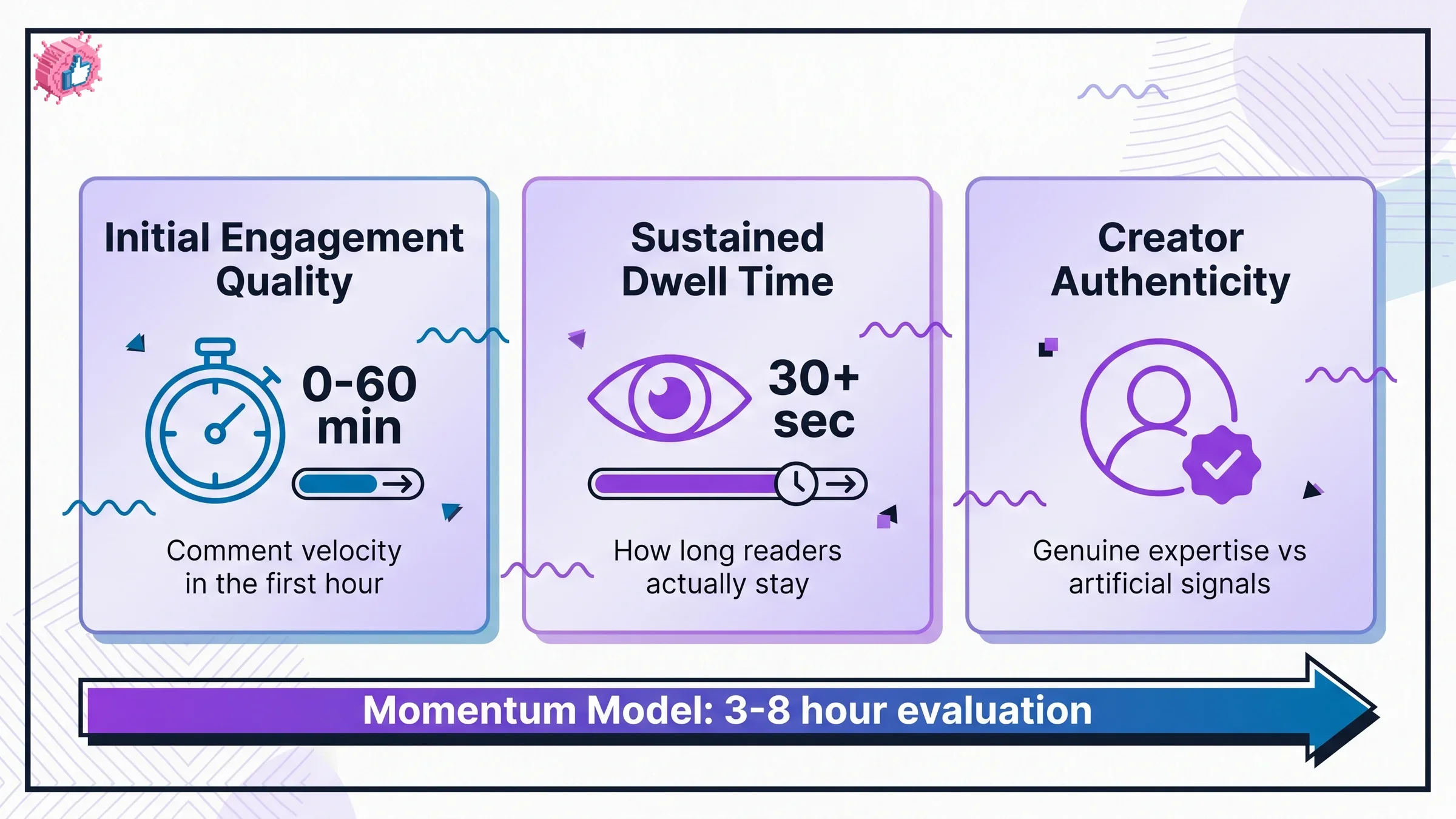
1. Initial engagement quality (first hour comments)
The algorithm cares less about how many likes you get and a lot more about how many comments you get, especially in the first hour. Per Dataslayer's February 2026 analysis, comments now carry 15 times the algorithmic weight of likes. A post with 10 comments and 50 likes will outperform a post with 5 comments and 500 likes.
What counts as quality comments:
- Multi-sentence replies (not "Great post!")
- Replies that spark sub-threads
- Comments from outside your immediate network
- Comments containing keywords related to your topic (interest graph reinforcement)
2. Sustained dwell time (30+ second threshold)
Dwell time is how long someone's screen is parked on your post. The 2026 threshold is roughly 30 seconds. If a viewer spends 30 or more seconds on your post, the algorithm reads that as strong interest and pushes the post wider. If they scroll in under 5 seconds, that is a kill signal.
This is why long-form text and native documents outperform short text posts. They give viewers a reason to stop scrolling.
3. Creator authenticity (genuine expertise vs artificial signals)
LinkedIn has gotten better at detecting artificial patterns: generic AI-written posts, pod engagement, and templated thread structures with no personal voice. Authenticity signals the algorithm now reads:
- First-person specifics (names, numbers, dates)
- Reply patterns that match your historical voice
- Posting frequency consistent with a real human
- Comment behavior on other people's posts (you should be active in feeds, not just publishing)
| Ranking signal | What it measures | How to optimize |
|---|---|---|
| Initial engagement quality | First-hour comment volume and depth | Ask a specific question, reply slowly, write content that triggers stories |
| Sustained dwell time | Average seconds per viewer (30+ is the threshold) | Use 900-1300 character posts, native documents, or carousels |
| Creator authenticity | Specificity, voice consistency, network behavior | Use first-person details, comment on others daily, avoid generic AI output |
Want to predict which of these signals your draft will fire on? Run it through the viral score checker before you publish. See our full LinkedIn algorithm guide for the deeper mechanics.
What is still working: format performance in 2026
Not all post types are treated equally. The algorithm has format-level priors built in, and they have shifted hard since 2024. Socialinsider's 2026 LinkedIn benchmark report breaks engagement rate down by format:
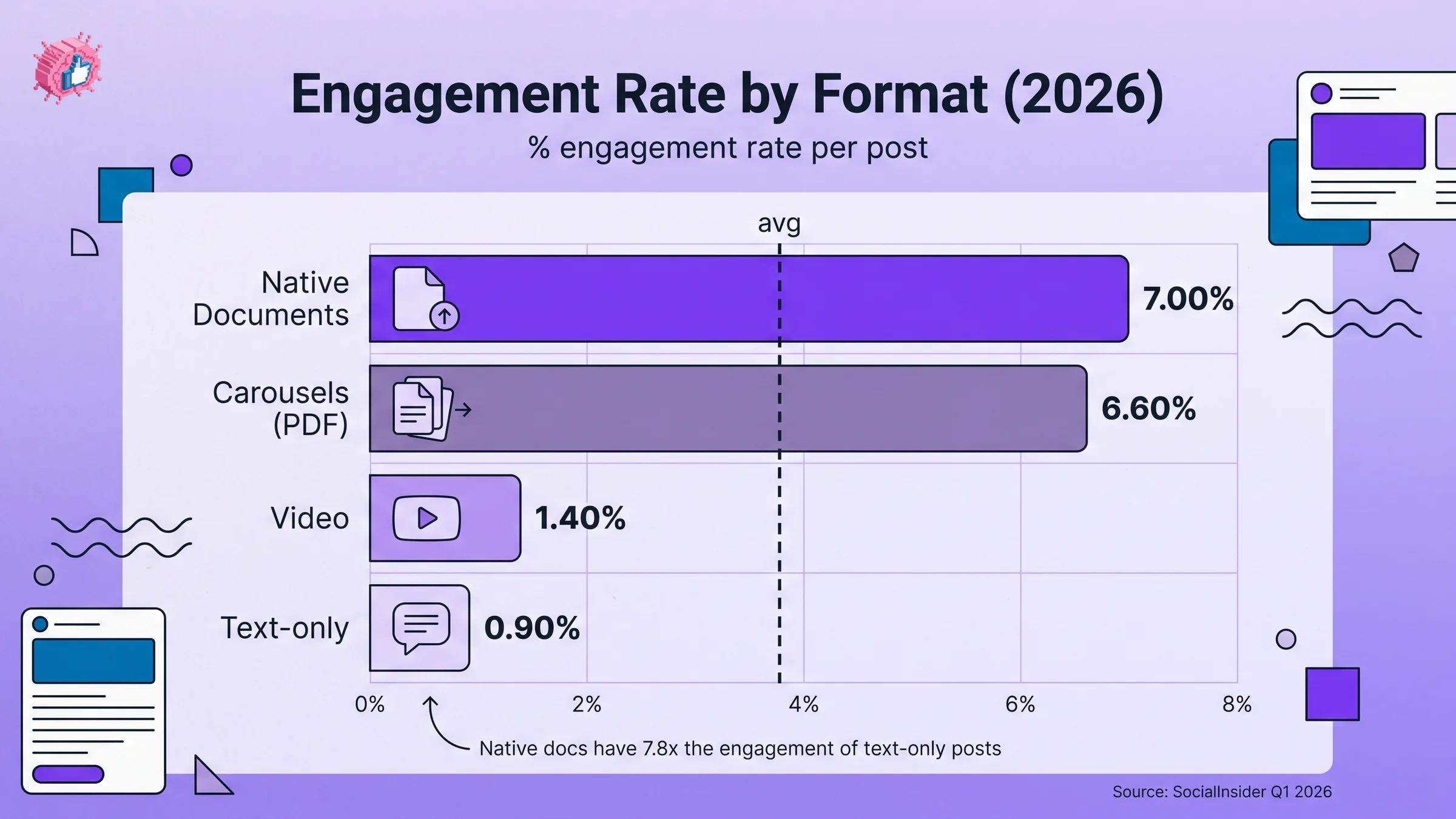
| Format | Avg engagement rate | Why it works (or does not) |
|---|---|---|
| Native documents (PDF carousels) | 7.00% | Long dwell time, swipeable, professional context |
| Image carousels | 6.60% | Multi-slide retention, visual variety |
| Text-only posts | 0.90% | Short dwell time unless 900+ characters with strong hook |
| Video | 1.40% | Surprisingly low; LinkedIn video discovery is still weak |
| Polls | 2.00 to 3.00% | Easy interaction, but reach plateau is low |
The headline finding: native documents are the highest-performing format on LinkedIn in 2026, by a factor of nearly 8x over plain video. If you have not added document carousels to your content mix, you are leaving the single biggest distribution lever unpulled. A LinkedIn carousel generator turns a topic into a document carousel without the design overhead.
But format alone does not save a weak post. Our analysis of 30,360 posts across 968 hero creators shows engagement varies massively within every format. The top performance tier (EXCEPTIONAL) hits 29.17% engagement rate. The bottom tier (BELOW_AVG) sits at 0.30%. That is a 100x spread, almost entirely driven by hook quality, length, and authenticity, not format.
| Performance tier | Avg engagement rate | Multiplier vs baseline | % of corpus |
|---|---|---|---|
| EXCEPTIONAL | 29.17% | 6.32x | 3.6% |
| HIGH | 4.51% | 2.72x | 8.9% |
| ABOVE_AVG | 2.36% | 1.32x | 16.2% |
| AVERAGE | 1.03% | 0.55x | 52.8% |
| BELOW_AVG | 0.30% | 0.19x | 19.7% |
Source: ViralBrain analysis of 14,095 LinkedIn posts with full analytics, snapshot May 2026.
The takeaway: format is a multiplier, not a guarantee. A native document with a weak hook still flops. A 1,200-character text post with a strong stat hook can still hit EXCEPTIONAL tier. Compare your own numbers against the LinkedIn engagement benchmarks to see which tier you are sitting in.
Hook patterns that beat the algorithm in 2026
Inside the 3 to 8 hour Momentum Model, your hook is what decides whether viewers keep reading or scroll past. The first line is the only thing the algorithm has to work with for the first half-second of dwell time.
We pulled hook engagement lift across all 30,360 posts in our dataset. The result is the most counterintuitive finding in this entire analysis:
| Hook type | % of posts using it | Avg engagement lift |
|---|---|---|
| Direct (declarative statement) | 77.76% | 1.45x |
| Story ("Last year I...") | 7.06% | 1.51x |
| Question ("Why do most posts fail?") | 6.15% | 1.04x |
| Stat ("87% of LinkedIn posts get under 300 views") | 4.24% | 1.67x |
| Quote | 2.19% | 1.25x |
| Contrarian ("Stop posting daily") | 1.38% | 1.03x |
| Imperative ("Read this now") | 1.02% | 0.02x |
| List promise ("3 things I learned") | 0.20% | 1.11x |
Source: ViralBrain analysis of 30,360 LinkedIn posts from 968 active hero creators, snapshot May 2026.
Read that table again. 77.76% of all posts use a direct hook, but stat hooks have 15% more engagement lift. The most-used hook is only the third-best by performance. Stat hooks (4.24% of posts) and story hooks (7.06% of posts) are massively underused relative to their lift.
The other shock: imperative hooks ("Watch this," "Read this," "Click here") return 0.02x lift. They are functionally dead. The algorithm has been trained to recognize and demote them as engagement bait.
If you want to fast-track a better opener, our LinkedIn hook generator draws from this same dataset to suggest stat and story hooks calibrated to your topic.
Automate your LinkedIn for 30 days
Length and structure still matter, but differently
In 2024, the conventional wisdom was "shorter is better." In 2026, that is wrong. The dwell-time signal rewards posts long enough for viewers to spend 30+ seconds reading them.
Our length analysis across the corpus:
| Post length (characters) | Viral rate | Notes |
|---|---|---|
| Under 300 | 1.46% | Below the 2.18% baseline. Too short for dwell-time threshold. |
| 300 to 900 | 2.14% | Roughly at baseline. Generic territory. |
| 900 to 1,300 | 3.07% | Peak performance. Long enough for dwell time, short enough to finish. |
| 1,300 to 2,500 | 2.85% | Still strong. Long-form storytelling works here. |
| 2,500+ | 2.23% | Long-form essays. Niche-dependent but viable. |
The sweet spot is 900 to 1,300 characters, roughly 150 to 220 words. That is long enough to clear the 30-second dwell-time bar but short enough that viewers actually finish.
Structurally, the highest-performing posts in our dataset share a pattern:
- Hook line (under 220 characters, ideally a stat or story)
- Whitespace break
- Body broken into 1- or 2-line paragraphs
- A list or numbered structure in the middle
- A question or comment-bait CTA at the end
This format works because each whitespace break creates a small commitment moment. Viewers keep "voting" to read another line, which extends dwell time without forcing one giant block of text.
Real proof: 4 posts that beat the algorithm in 2026
Numbers without context are easy to dismiss. Here are four real LinkedIn posts from our viral dataset that hit different parts of the 2026 algorithm correctly:
- Anton Osika (Lovable) announcing his $330M raise: 11,576 likes. Stat hook ("$330M Series B"), tight 1,100-character body, founder authenticity signal at maximum.
- Will Guidara on his Oprah show appearance: 6,781 likes. Story hook, first-person specifics, dwell-time-optimal length.
- Yanni Pappas on "real, honest, human" marketing: 5,465 likes. Contrarian hook plus values-driven body, comment-bait CTA that pulled deep replies.
- Tanay Kothari (Wispr Flow) Porsche giveaway post: 5,314 likes and 1,330 comments. Comment-driven distribution at its purest. The 15x comment weight did most of the work.
The common thread: each post fired one or more of the three core signals (initial engagement quality, dwell time, creator authenticity) hard. None of them depended on luck or pod gaming.
If you want a starting structure that mirrors these patterns, the viral post templates library is built from skeletons we extracted from posts like these.
What killed reach in 2026: 3 patterns to stop using
The flip side of "what works" is "what tanks reach." From the same 30,360-post dataset, three patterns consistently underperform in 2026.
1. Sub-300 character posts
These hit a 1.46% viral rate, roughly half the baseline of 2.18%. They are too short to trigger the dwell-time threshold. If you want short, post a poll instead. Polls at least give the algorithm an interaction to count.
2. Pure imperative hooks ("Watch this," "Read this," "Click below")
0.02x engagement lift. Functionally zero. The algorithm has been retrained on this exact pattern as engagement bait, and posts opening with imperatives are demoted before the Momentum Model even starts evaluating.
3. Engagement bait without value
Asking "Agree?" or "Thoughts?" with no setup. The 2026 algorithm reads dwell-time and comment quality, not comment count. A post with 50 one-word comments and 4-second average dwell will lose to a post with 8 multi-sentence comments and 45-second dwell.
There is an honest version of comment bait that still works: ask a specific question that requires a specific answer. "What is the worst LinkedIn advice you ever received, and what did it actually cost you?" pulls long replies. "Thoughts?" pulls scroll.
For the structural antidote to all three, see our companion blog how to write a LinkedIn post that gets noticed which goes deeper into hook construction.
What this means for your next 30 days
The algorithm change is real, but it is not catastrophic. The creators who win in 2026 will follow a smaller checklist than 2023 demanded:
- Drop sub-300 character posts. Aim for 900 to 1,300 characters as your default.
- Lead with stat or story hooks. Direct hooks still work, but stat hooks return 1.67x lift vs 1.45x for direct.
- Add at least one native document or carousel per week. Format multiplier alone gets you a 7x lift over text-only posts.
- Reply to early comments slowly. Stretch the curve across the 3 to 8 hour Momentum Model window.
- Stop using imperative hooks. They are dead.
- Measure engagement rate, not impressions. Impressions are structurally smaller post-2023, but engagement is up.
- Track yourself against the engagement benchmarks tiers: AVERAGE = 1.03%, ABOVE_AVG = 2.36%, HIGH = 4.51%, EXCEPTIONAL = 29.17%.
If you want a draft that already accounts for all of this, the LinkedIn post generator is trained on the same 30,360-post dataset that produced these numbers, with hook suggestions weighted by lift, not popularity. For broader strategic context, the LinkedIn content strategy guide and the how to go viral on LinkedIn guide cover the systems layer.
The interest-graph era is harder for low-effort posting and easier for anyone willing to write specifically. That is the real headline of the 2026 algorithm.
Sources: SourceGeek 2026 LinkedIn Algorithm Update, GrowLeads 2026 Text vs Video Reach Analysis, Dataslayer February 2026 LinkedIn Algorithm Report, SocialBee LinkedIn Algorithm Explainer, Postiv Definitive 2026 LinkedIn Algorithm Guide, Socialinsider 2026 LinkedIn Benchmarks, ViralBrain analysis of 30,360 LinkedIn posts from 968 active hero creators (snapshot May 2026).
FAQ
How does the LinkedIn algorithm work in 2026?
The 2026 algorithm uses an interest graph rather than a social graph, distributing posts based on topical relevance and viewer behavior rather than connection edges. It ranks every post on three core signals: initial engagement quality (first-hour comments, weighted at 15x the value of likes), sustained dwell time (with 30 seconds as the threshold for strong interest), and creator authenticity. The evaluation window is the 3 to 8 hour Momentum Model, not the old 60-minute Golden Hour.
What is the most important LinkedIn algorithm change in 2026?
The shift from social graph to interest graph is the biggest change. It is why average impressions per post are down 63 to 66% since 2023 even as engagement per post is up 12 to 39%. The feed now finds the right audience for each post regardless of who is connected to whom, which means niche, specific content outperforms broad generalist content for almost every creator.
Has the LinkedIn Golden Hour been replaced?
Yes. The 60-minute Golden Hour evaluation window has been replaced by the Momentum Model, a 3 to 8 hour window where the algorithm watches engagement accumulate, decay, or compound before deciding how far to distribute the post. This is more forgiving for slow-starting posts but harder on artificial pod-driven spikes that look unnatural.
How much do comments matter in the 2026 LinkedIn algorithm?
Comments now carry roughly 15 times the algorithmic weight of likes, per Dataslayer's February 2026 analysis. A post with 10 comments and 50 likes will out-distribute a post with 5 comments and 500 likes. Comment quality also matters: multi-sentence replies, sub-threads, and replies from outside your network all amplify the signal beyond simple comment count.
How often does the LinkedIn algorithm change?
LinkedIn ships incremental algorithm tweaks roughly weekly and major model updates two to three times per year. The big 2026 changes (interest graph, Momentum Model, comment weighting) rolled out across late 2025 and early 2026. Minor signal weight adjustments happen continuously, which is why comparing 2024 advice to 2026 reality often gives wildly different results.
What is the best post format for the LinkedIn algorithm in 2026?
Native documents (PDF carousels) lead the pack at 7.00% average engagement rate, followed by image carousels at 6.60%, polls at 2 to 3%, video at 1.40%, and text-only posts at 0.90%. Adding at least one native document or carousel per week is the single largest distribution lever most creators have not pulled. That said, format is a multiplier, not a guarantee. A weak hook still flops in any format.
Should I post daily on LinkedIn in 2026?
Quality outranks frequency in the 2026 algorithm. Posting 3 to 4 times per week with strong hooks, 900 to 1,300 character bodies, and at least one carousel or document will out-distribute daily generic posts. If you can sustain daily quality, do it. If you cannot, drop frequency before you drop quality. Cadence consistency matters more than absolute volume.
Do hashtags still help LinkedIn reach in 2026?
Hashtags have minimal direct algorithmic value in 2026 because the interest graph already does topical classification automatically. Use 1 to 3 hashtags only if they are genuinely topical to your post. Stuffing 10 hashtags is read as a low-quality signal and can suppress reach. Skip hashtags entirely if none feel natural; the algorithm will infer your topic from the post body.
What is the ideal LinkedIn post length in 2026?
The peak performance window is 900 to 1,300 characters, where viral rate hits 3.07% vs the 2.18% baseline in our 30,360-post dataset. Sub-300 character posts only hit 1.46% viral rate because they fail the 30-second dwell-time threshold. Long-form posts above 2,500 characters still work in niche contexts (2.23% viral rate) but are not the default move.
How do I check if my LinkedIn engagement rate is good in 2026?
Compare against the 5-tier breakdown from our analytics dataset: BELOW_AVG sits at 0.30%, AVERAGE at 1.03%, ABOVE_AVG at 2.36%, HIGH at 4.51%, and EXCEPTIONAL at 29.17%. The personal profile global average is 3.85% per Socialinsider. For a quick benchmark on your own profile, see the companion piece on LinkedIn engagement rate benchmarks for 2026.
Does ViralBrain help with the 2026 LinkedIn algorithm changes?
Yes. ViralBrain generates LinkedIn posts using the same 30,360-post dataset and 968-hero corpus that produced the numbers in this article, with hook suggestions weighted by 2026 engagement lift rather than 2023 popularity. The viral score checker predicts how a draft will perform against the 3 ranking signals before you publish. €1 trial is available on the pricing page, and 100+ free tools at /tools/ require no account.
Automate your LinkedIn for 30 days
ViralBrain plans, writes, and schedules your LinkedIn content, using official LinkedIn APIs so your account stays safe.
- Official LinkedIn APIs, no risk of ban
- You approve every post before it goes live
- Cancel anytime
Keep reading
How to Edit a Post on LinkedIn: What You Can Change
Editing a LinkedIn post takes five steps, and on a post you shared only the text can change. LinkedIn's rules on media, previews, Pages and polls.
How to Delete a Post on LinkedIn (Feed, Page, Group)
The four documented steps to delete a LinkedIn post on desktop and mobile, plus Page, group, scheduled and comment deletes, and what happens to engagement
How to Add Skills on LinkedIn: Steps and Limits
How to add skills on LinkedIn on desktop and in the app, the 100 skill cap and its exemption, plus reordering, editing and removing a skill.