

Why LinkedIn Is Full of AI Slop in 2026 (and What Changed)
LinkedIn AI slop now fills the feed because 53.7% of long posts are AI-generated. Here is why it happened and what the 2026 Authenticity Update changed.
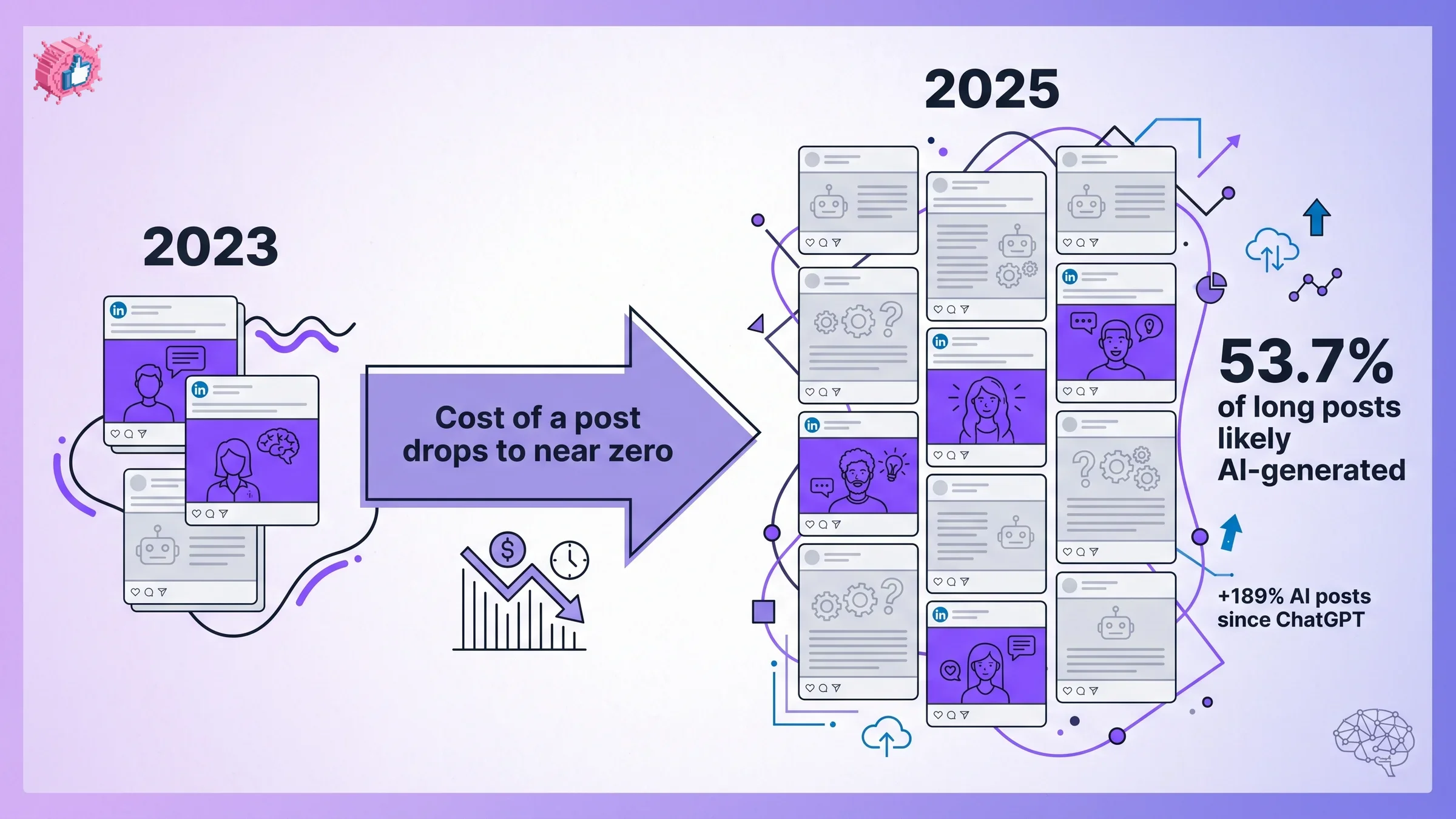
Scroll your LinkedIn feed for ninety seconds and count the posts that could have been written by anyone, about anything, for no one in particular. That is LinkedIn AI slop, and in 2026 it is not a fringe annoyance. It is the median post. An Originality.ai study of long-form posts found 53.7% were likely AI-generated in 2025, up 189% since ChatGPT launched. The feed did not slowly fill with generic content. It tipped past the halfway mark.
This post is not a humanizing checklist and it is not a teardown of why AI generators converge on the same voice. We cover both of those elsewhere. This is the platform-level story: why the feed filled with slop in the first place, what LinkedIn's 2026 Authenticity Update and AI-detection systems actually changed about distribution, and what that means strategically if you want reach in a feed that now actively suppresses generic output. LinkedIn's most recent update, published September 15, 2026, reports that views of content it classifies as AI slop are down 40%, and confirms it is retiring its own "enhance your post" writing feature.
If you have noticed your reach sliding even though your posting habits did not change, this is the context you are missing. The rules moved underneath you.
Automate your LinkedIn for 30 days
Why is LinkedIn full of AI slop?
The honest answer is economics, not laziness. For roughly two years, the platform rewarded volume. More posts meant more surface area, more impressions, more follower growth. Generative AI dropped the marginal cost of a "competent" post to near zero. When the cost of producing passable content collapses, supply explodes. That is the entire mechanism.
Three forces stacked on top of each other:
- Zero marginal cost. A draft that used to take 30 minutes now takes 30 seconds. Rational creators scaled output, and the median quality fell to whatever the base model emits by default.
- The same handful of models. Most AI posts are generated by the same foundation models behind the same wrappers, so they converge on the same cadence, the same openers, the same tidy three-item lists. We break this convergence down in why LinkedIn AI generators sound the same.
- An algorithm that, until recently, could not tell the difference. For most of 2024 and 2025, the feed ranked engagement and recency. It had no authenticity signal. Slop that got a few comments from a pod ranked fine.
The result was predictable. By Originality.ai's count, AI prevalence varies wildly by niche but skews high almost everywhere.
| Industry | Share of long posts likely AI-generated |
|---|---|
| Architecture and design | 100% |
| Wellness and personal development | 92% |
| Tech and AI | 65% |
| Marketing and branding | 61% |
| Career and talent | 58% |
| Leadership and inspiration | 52% |
| Finance and business | 48% |
| Healthcare and medicine | 41% |
| Innovation and strategy | 30% |
| Government and public affairs | 24% |
Source: Originality.ai analysis of 3,368 posts from 99 influential profiles, January to November 2025.
The pattern is clean. Niches built on public trust (healthcare, government, strategy) stayed more human. Niches where "thought leadership" became a content quota (wellness, design, marketing) saturated first. Slop concentrates wherever output is treated as a number to hit.
What the 2026 Authenticity Update actually changed
Here is the strategic pivot most creators have not internalized. The platform stopped tolerating slop, and it did so at the ranking layer, not the policy layer.
In March 2026, LinkedIn shipped what creators now call the Authenticity Update: a rebuild of feed retrieval and ranking around large language model embeddings, replacing the older patchwork of separate ranking models. The same wave of changes targeted engagement bait, legacy automation pods, and external-link spam. Then in May 2026, the company went public about the part that matters most for AI content: a detection layer it describes internally as "AI solving AI."
What that system does, per LinkedIn's own statements and reporting:
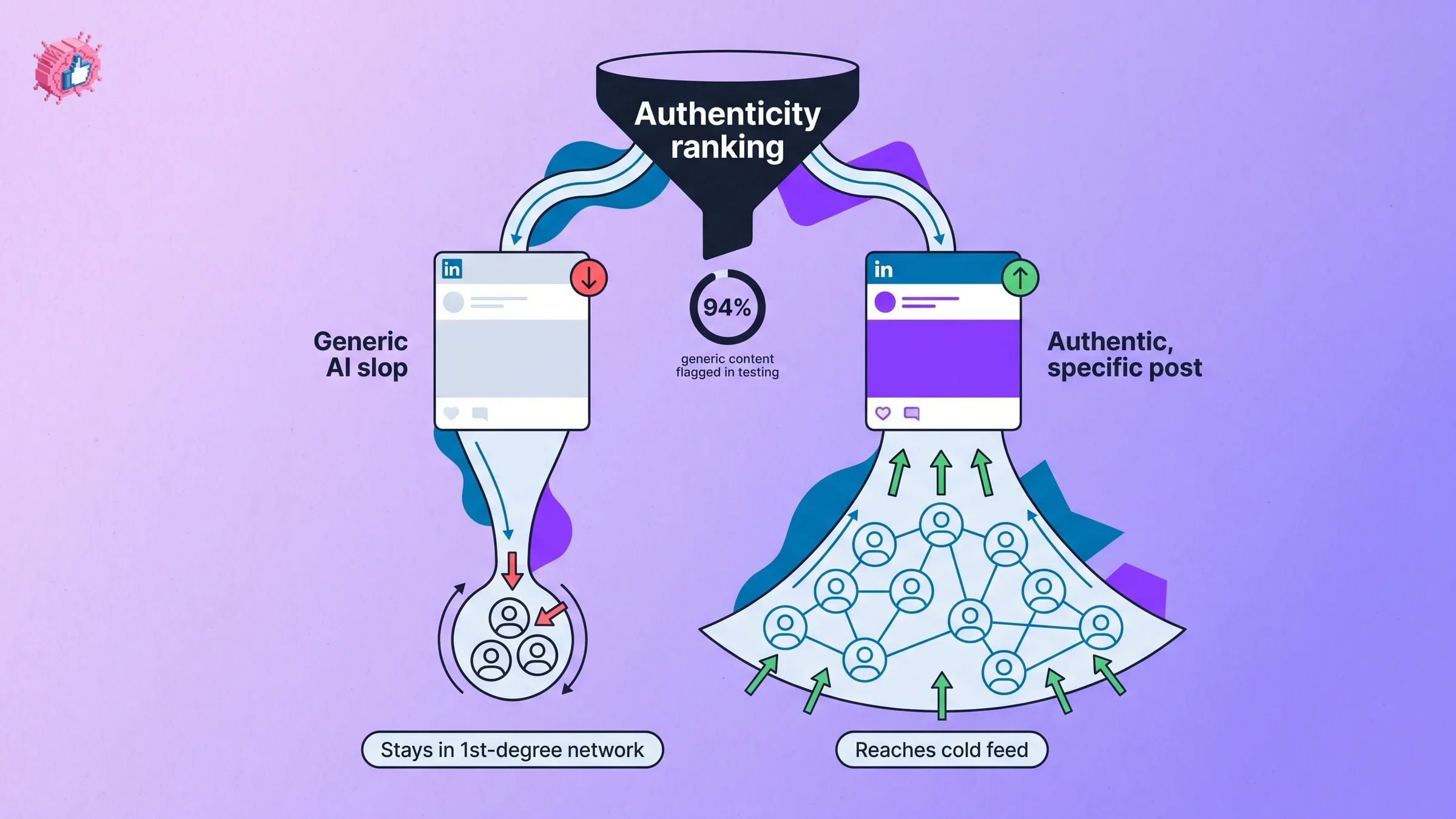
- Flags generic AI output. Posts that "appear to be generated by AI and lack a clear perspective" are explicitly less likely to be distributed widely. In initial testing, LinkedIn says it tagged generic content correctly 94% of the time (a number the company has not let outsiders independently verify).
- Suppresses, does not delete. Flagged posts are not removed. Their reach is depressed, often kept inside the author's first-degree network so they never surface in cold feeds.
- Targets bot comments and bait too. The same system goes after bulk AI comments that just restate the post, and attention-bait video.
LinkedIn VP and Executive Editor Laura Lorenzetti framed it directly: "When AI is overused, especially at scale and in an automated way, it dilutes the valuable insights that real human conversations can spark." Posts, she said, should "represent your voice and your perspectives."
There is an important nuance creators get wrong. The system is not a magic "AI detector" in the forensic sense. It does not need to prove a model wrote your post. It scores whether the post reads as generic, perspective-free, and templated, which correlates with unedited AI output but is really a quality signal. The practical effect is the same: ship raw AI and your reach gets throttled. For the full ranking picture, our LinkedIn algorithm guide maps how authenticity now sits alongside relevance and conversation value.
What LinkedIn changed in September 2026
On September 15, 2026, LinkedIn published a progress report on its AI slop crackdown, and the headline figure is a 40% drop in views of content its systems classify as AI slop. That report is the freshest first-party account of how the Authenticity Update is being enforced, and it moves the enforcement story from something creators inferred to something the platform documented.
| What changed | What LinkedIn reported |
|---|---|
| A "Seems like AI slop" report button | More than one million members used it in the first two weeks after its August launch |
| Distribution of flagged content | Views of content classified as AI slop down 40%, credited to recent efforts in general rather than to any single feature |
| Author-side visibility | The feedback signal is starting to reach authors through post analytics, as a tip shown once a post passes a threshold of member reports |
| The "enhance your post" writing tool | Being replaced by tools that proofread and improve clarity without changing a member's voice |
| Backend classifiers | Expanded to spot AI slop and limit how far it gets distributed |
| Automation defenses | Hundreds of thousands of automated comment attempts caught daily, and billions of automated actions blocked in recent months |
Source: LinkedIn Pressroom, "How LinkedIn is Continuing to Tackle AI Slop", September 15, 2026.
Treat the 40% the way you should treat the 94% detection figure above. LinkedIn has not published the baseline, the measurement window, or how it separates the effect of the report button from the classifiers that were already running. This is the platform grading its own work. It is still worth reading closely, because it tells you what the platform is optimizing for.
The definition matters more than the numbers, because it is the standard the classifier is built around. LinkedIn put it in writing:
"AI slop" includes low-effort, likely AI-generated content that may sound polished on the surface but lacks a clear point of view, unique perspective, or substance.
Read that closely. Nothing in it turns on whether a model touched your draft. It turns on whether the post carries a point of view and adds something, rather than existing to game attention. That is the same quality signal the ranking rebuild has been scoring since March, which our breakdown of LinkedIn's 360Brew ranking model goes into in more depth.
LinkedIn is replacing "enhance your post" with proofreading
LinkedIn is retiring "enhance your post", its one-click AI rewrite button, and replacing it with tools that proofread and improve clarity without changing a member's voice. In LinkedIn's own words, the swap reinforces "the distinction between AI assistance and AI slop."
For anyone who writes on LinkedIn, this is the most consequential line in the September update, and it got the least coverage.
Think about what that button did. It took your draft and handed back a smoother, more generic version of it, which is the exact output the classifier now suppresses. The platform shipped a feature that manufactured the problem, then built a detection layer to catch the result. Retiring it closes that loop. What replaces it is deliberately narrower: fix the typos, tighten the clarity, leave the voice alone.
The strategic read is simple. LinkedIn has now drawn the line publicly, and it drew it exactly where this post has been arguing it sits. AI assistance that preserves your voice is fine. AI generation that replaces your voice is what gets throttled. The platform is no longer neutral about which kind of tool you write with.
Two practical notes. The change is in progress rather than finished, so you may still see the old feature for a while. And the replacement does not do the part that actually clears the authenticity bar, which is putting a real opinion and real specifics into the draft. Proofreading a generic post gives you a clean generic post, and the feed scores it the same way.
Slop signals vs authentic signals
If the feed is now scoring for "perspective," it helps to know concretely what each side looks like. These are the patterns reporting and LinkedIn's own descriptions point to, mapped against what survives.
| Slop signals (suppressed) | Authentic signals (rewarded) |
|---|---|
| Generic openers ("In today's fast-paced world") | A specific number, moment, or claim in line one |
| "It's not X, it's Y" symmetry repeated across accounts | A stated opinion someone could disagree with |
| Even sentence length, hypnotic rhythm | Varied rhythm, short lines next to long ones |
| Tidy three-item lists in every post | Uneven structure, real examples, named specifics |
| Templated frameworks copied between profiles | First-person experience the model could not invent |
| Bulk comments that restate the post | Replies that add a counterpoint or a detail |
| No clear point of view | A clear, sometimes inconvenient, position |
The left column is what the AI-slop detection inside most quality-scoring tools is trained to catch, and it is what LinkedIn's own classifier is reaching for. The right column is not "better writing" in a literary sense. It is writing that proves a specific human with a specific stake was present.
Automate your LinkedIn for 30 days
Is there an AI-generated LinkedIn posts penalty?
Yes, but be precise about what the penalty is. It is not account removal, not a strike, not a label on your post. The penalty is distribution. A flagged post stays in your first-degree network and dies there, which for most creators means a fraction of their normal reach with no obvious error message to explain it.
That is what makes it dangerous, though September 2026 added a partial exception. If enough members report a post as AI slop, LinkedIn says the author may now see a tip in post analytics. Below that threshold there is still no notification. Your impressions just sag, you assume the algorithm "changed," and you keep feeding it the same slop. Three consequences follow:
- Reach decay looks like bad luck. Because suppression is mostly silent, and the post analytics tip only fires once enough members report a post, creators rarely connect a reach drop to the authenticity score. They blame timing or frequency instead of the input.
- Volume strategies invert. Posting more generic content used to grow you. Now it trains the classifier to associate your account with low-perspective output, which can drag your baseline down.
- The human-written premium is real and measurable. Originality.ai found human posts outperformed AI posts in 7 of 11 industries, including a roughly 80% engagement edge in innovation and strategy and 73% in marketing. Slop does not just fail to win. In most niches it loses to a human typing.
The exception worth noting honestly: in leadership and inspiration content, Originality.ai found AI posts outperformed human ones by 75% per post. That niche rewards format over substance, for now. It is the outlier, not the rule, and it is exactly the kind of saturated category the Authenticity Update is built to correct next.
What the feed rewards vs penalizes now
The cleanest way to hold the shift in your head is a before-and-after on what moves the ranking.
| Ranking input | Pre-2026 feed | Post Authenticity Update |
|---|---|---|
| Raw posting volume | Rewarded reach | Neutral to negative if quality is low |
| Engagement-pod comments | Boosted distribution | Detected and discounted |
| Generic AI drafts | Ranked on engagement alone | Suppressed to first-degree network |
| Perspective and specificity | Not directly scored | Core authenticity signal |
| Dwell time and saves | Lightly weighted | Heavily weighted as quality proxy |
| Bulk AI comments | Counted as engagement | Flagged, can hurt the parent post |
| Member "seems like AI slop" reports | Did not exist | Feed the classifiers, and can surface a tip in your post analytics |
The takeaway is not "stop using AI." It is that the feed now grades the output, not the effort. A human-sounding, perspective-rich post drafted with AI assistance beats a raw AI dump every time, because the classifier and the reader are scoring the same thing: did a real person with a real view show up. Our guide on how to go viral on LinkedIn covers the structural side of clearing that bar.
The strategic response: voice over volume
So what do you actually do in a feed that suppresses slop? The losing move is to keep optimizing for output and hope. The winning move is to invert the ratio: fewer posts, each one carrying a point of view the algorithm now rewards.
That does not mean abandoning AI. It means changing what you feed it and what you ship. The tactical version of this is its own playbook, which we wrote up in how to make AI LinkedIn posts sound human: the em dash sweep, injecting specifics, planting one opinion per post. Read that for the edit-level mechanics. The strategic version is three decisions:
- Treat AI as a first draft, never a final post. The Authenticity Update penalizes unedited output specifically. The fix is a humanizing pass on every draft, every time.
- Start from your own voice and real data, not a blank prompt. A generic prompt pulls the base model's default style, which is precisely what gets flagged. Generation grounded in your actual writing patterns and what performs in your niche starts the draft closer to "authentic" and gives the classifier less to catch.
- Score before you ship. You cannot see your own slop tells after staring at a draft. Running it through a quality check first catches the generic patterns before the feed does.
This is the honest case for a voice-matched approach, and where ViralBrain sits. The platform generates from your real writing plus a dataset of 30,360 LinkedIn posts from 968 hero creators, 653 of them classified viral, so the LinkedIn post generator starts from patterns that perform rather than the base-model average, and the viral score checker flags weak, generic, or low-perspective drafts before you publish. It is not a slop machine with a faster button. The point is to ship fewer posts that read as yours, which is the only thing the 2026 feed reliably rewards. If you want to see where the bar sits for your niche, check your reach against real LinkedIn engagement benchmarks before you judge a post.
What this means for you
- Stop blaming the algorithm for a quiet reach drop. If your impressions sagged in 2026 without a habit change, check your inputs. Silent suppression of generic content is the most likely cause, and there is no error message to tell you.
- Cut volume, raise perspective. Three posts a week with a real opinion will out-distribute seven generic ones now. The math flipped with the Authenticity Update.
- Run every AI draft through a humanizing pass. The penalty targets unedited output. Add specifics, an opinion, and varied rhythm before you post. The how to make AI LinkedIn posts sound human playbook is the checklist.
- Score drafts before publishing. Run a slop-detection style check to catch generic tells while you can still fix them, not after the feed has buried the post.
- Build a strategy, not a posting quota. Our LinkedIn content strategy guide covers how to plan for perspective and consistency together. When you want the full workflow, ViralBrain pricing lays out the plans and the 7-day trial for €1.
The feed did not turn hostile to AI. It turned hostile to slop. Those are different problems, and the creators who understand the difference are the ones whose reach is going up while everyone else wonders what they did wrong.
Sources: Originality.ai LinkedIn AI study (2025), Originality.ai long-post AI analysis, The Decoder on LinkedIn's AI slop crackdown (May 2026), Entrepreneur: LinkedIn is fighting back against AI slop, Fast Company: LinkedIn declares war on AI slop (2026), LinkedIn Pressroom: How LinkedIn is Continuing to Tackle AI Slop (September 15, 2026), LinkedIn Help Center: Share feedback on AI slop, LinkedIn Help Center: Best practices for content created with the help of AI.
FAQ
Why is LinkedIn full of AI slop?
Because generative AI dropped the cost of producing a passable post to near zero, and for two years the feed rewarded volume without scoring quality. By 2025, 53.7% of long-form LinkedIn posts were likely AI-generated, a 189% jump since ChatGPT launched. The supply of generic content exploded faster than the platform's ability to filter it.
What is the LinkedIn Authenticity Update?
It is the 2026 rebuild of LinkedIn's feed ranking around language-model embeddings, paired with a detection system that flags generic, perspective-free content and reduces its reach. It also targets engagement-bait, automation pods, and bulk AI comments. The shift moved authenticity from a policy talking point to an actual ranking signal.
Is there a penalty for AI-generated LinkedIn posts?
Yes, but it is distribution suppression, not removal. Posts flagged as generic AI output get kept inside your first-degree network and never surface in cold feeds. There is no notification, so the penalty usually shows up as an unexplained reach drop rather than a warning.
Can LinkedIn actually detect AI-generated posts?
LinkedIn does not claim to forensically prove a model wrote your post. Its system scores whether content reads as generic, templated, and perspective-free, which correlates with unedited AI output. The company says it tagged generic content correctly 94% of the time in testing, though that figure is not independently verified.
What is the "Seems like AI slop" button?
It is a report option LinkedIn rolled out in August 2026 that lets members flag a post or comment as AI slop from the More menu in its top right corner. More than one million members used it in the first two weeks, and those reports feed LinkedIn's content classifiers. If a post collects enough reports, the author may see a tip about it in post analytics.
Does using AI mean my LinkedIn posts will be penalized?
No. The penalty targets unedited, generic output, not AI assistance itself. A post drafted with AI and then humanized with real specifics, a clear opinion, and varied rhythm reads as authentic to both the classifier and the reader. The fix is a humanizing pass on every draft before you publish.
What is a LinkedIn AI slop detector?
It is a tool that scores a draft for the patterns associated with generic AI writing: hollow openers, "it's not X, it's Y" symmetry, even rhythm, and no point of view. Running a draft through a viral score checker before posting catches those tells while you can still fix them.
How do I make my LinkedIn posts sound human in 2026?
Add what a model cannot invent: a real number, a named moment, one opinion someone could disagree with, and varied sentence length. Start the draft from your own voice rather than a blank prompt so there is less generic phrasing to remove. The detail-level steps, including the em dash sweep, are in our how to write a LinkedIn post guide.
Is AI content always worse than human content on LinkedIn?
Not universally. Originality.ai found AI posts outperformed human ones in leadership and inspiration content, a niche that rewards format over substance. But human-written posts won in 7 of 11 industries, including roughly 80% higher engagement in innovation and strategy. In most niches, a human point of view still beats slop.
Will posting more help me beat the AI slop problem?
No, and it can backfire. Since the Authenticity Update grades quality, flooding the feed with generic posts can train the classifier to associate your account with low-perspective content and drag your baseline down. Fewer posts with a real opinion now out-distribute high-volume generic output.
Automate your LinkedIn for 30 days
ViralBrain plans, writes, and schedules your LinkedIn content, using official LinkedIn APIs so your account stays safe.
- Official LinkedIn APIs, no risk of ban
- You approve every post before it goes live
- Cancel anytime
Keep reading
How to Make AI LinkedIn Posts Sound Human (2026 Playbook)
How to make AI LinkedIn posts sound human in 2026. A practical playbook of edits to humanize AI content, kill the AI tells, and beat the slop problem.
Supergrow Alternatives: 5 Better LinkedIn AI Tools in 2026
Looking for Supergrow alternatives? Compare the 5 best LinkedIn AI tools in 2026: ViralBrain, Taplio, AuthoredUp, EasyGen, and Postdrips on pricing, features, and content quality.

Best MCP Servers for Marketers: 7 Worth Installing in 2026
Over 10,000 MCP servers exist. Marketers need about six. Here are 7 MCP servers worth installing, what each actually does, and what they really cost.