
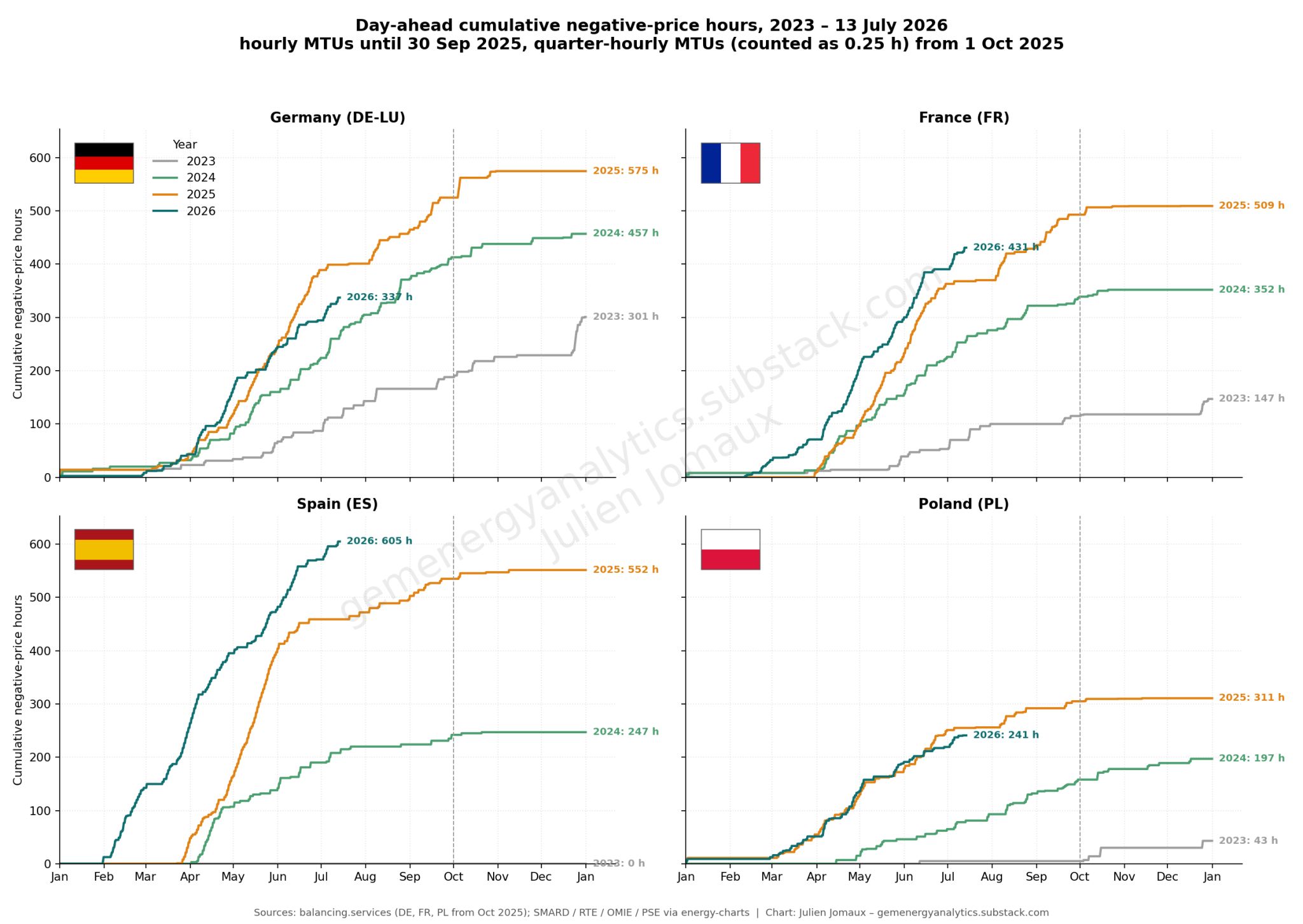
Evolution of the number of hours with negative prices in Germany, France, Spain, and Poland. So far, Germany is having less negative prices in 2026 than last year, while France and especially Spain…
301131521 viral
Energy Markets3 months ago
LinkedIn Content Strategy & Writing Style
1 person tracking this creator on ViralBrain
This creator positions themselves as a specialist in European electricity-market design, translating complex balancing mechanisms into practical insight for traders, analysts, and policymakers. Their content centers on PICASSO, aFRR merit orders, CBMP, reBAP, imbalance pricing, and German market developments, using dense visual analysis, historical comparisons, and unusually granular datasets - including millions of four-second prices. What distinguishes them is the ability to turn technical anomalies into memorable explanations, such as the “NRV Pokémons,” without losing analytical rigor. Their work sits at a compelling intersection of quantitative market analysis, market-design critique, and trader behavior, showing how formulas and incentives shape real system outcomes.
22.3K
4.4K
79
37
1
Evolution of the number of hours with negative prices in Germany, France, Spain, and Poland. So far, Germany is having less negative prices in 2026 than last year, while France and especially Spain…
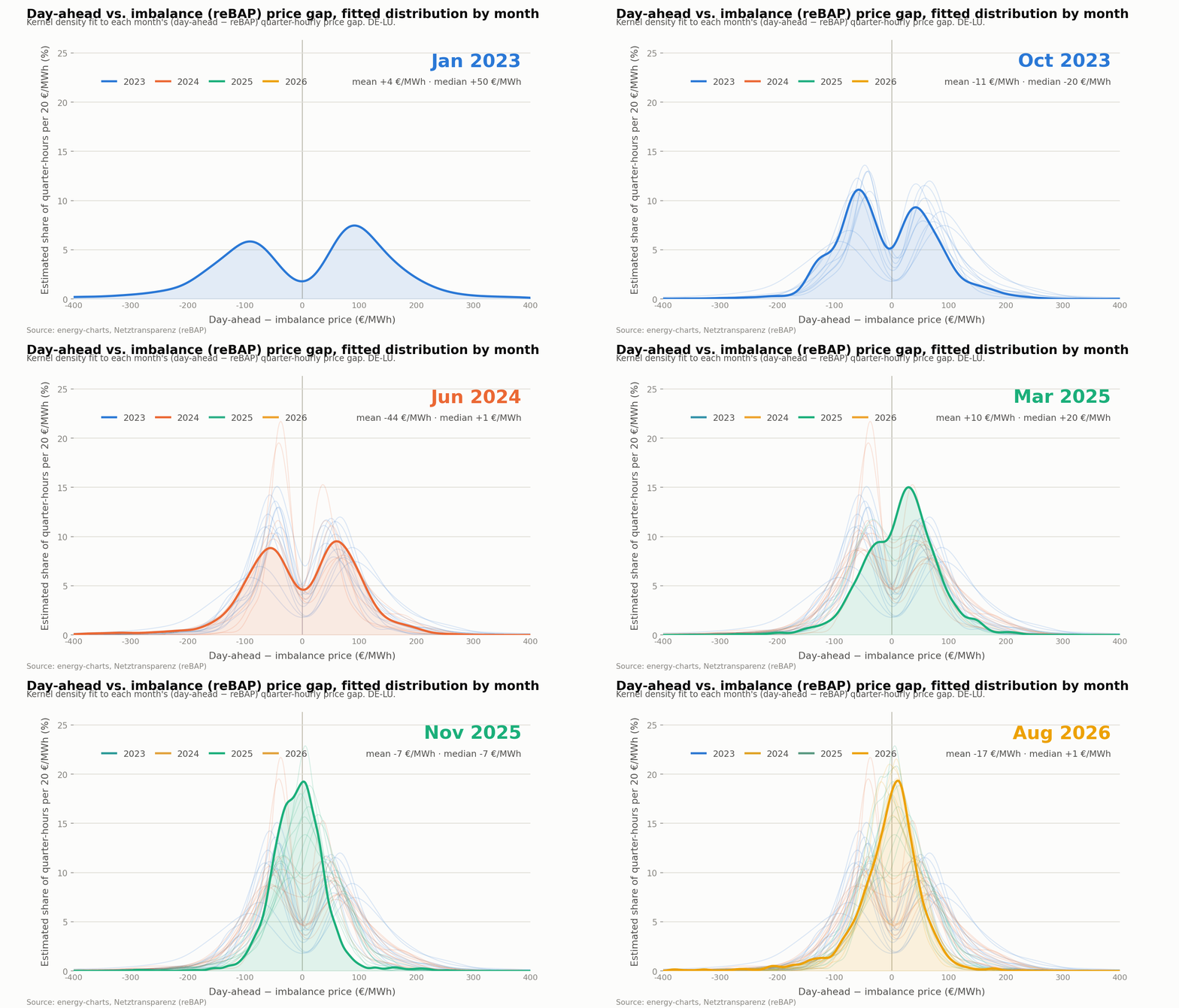
Evolution of the difference between the Day-ahead price and the imbalance price (reBAP) in Germany. The distribution is clearly shifting towards the center. Several reasons (not exhaustive): - PIC…
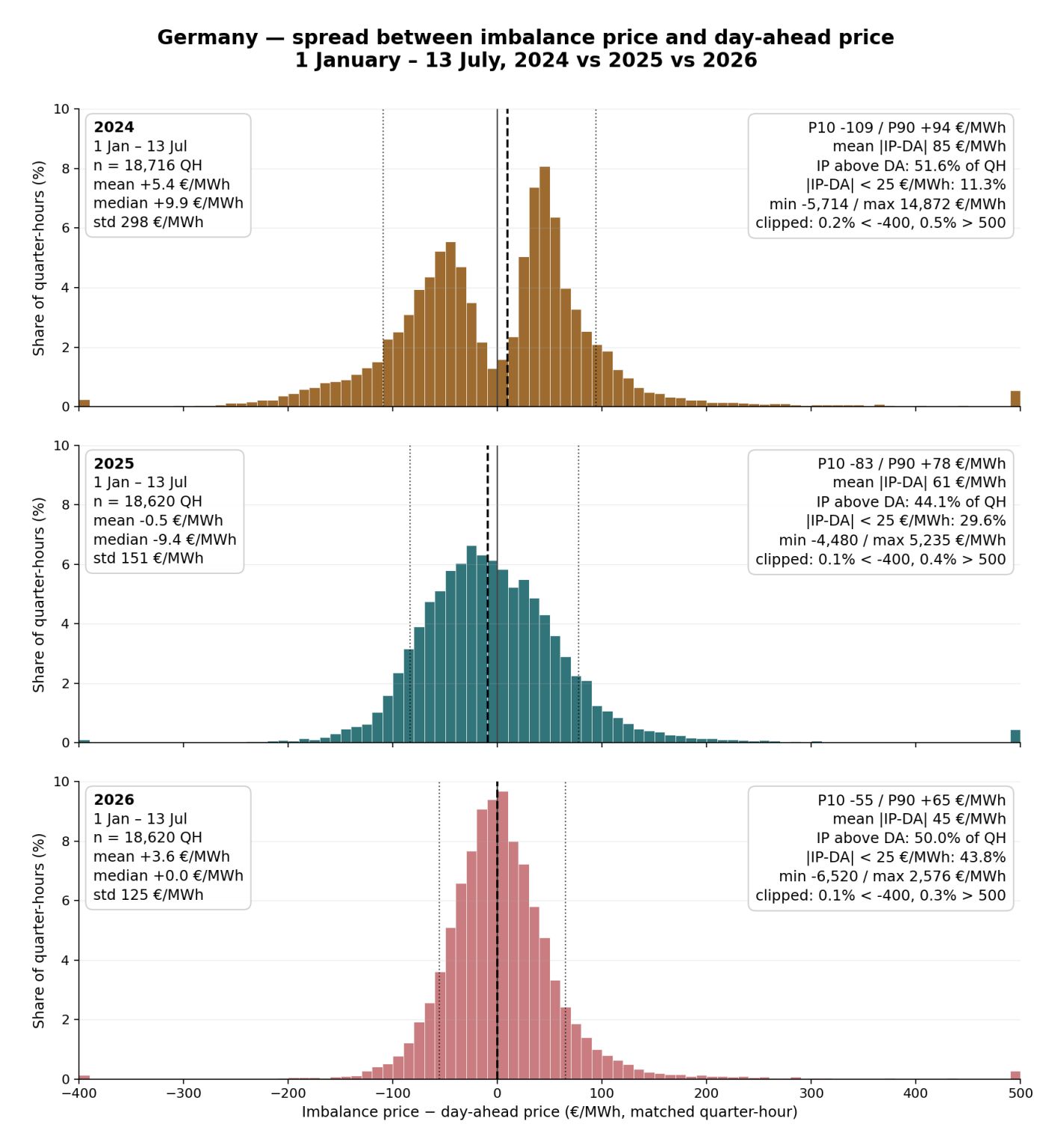
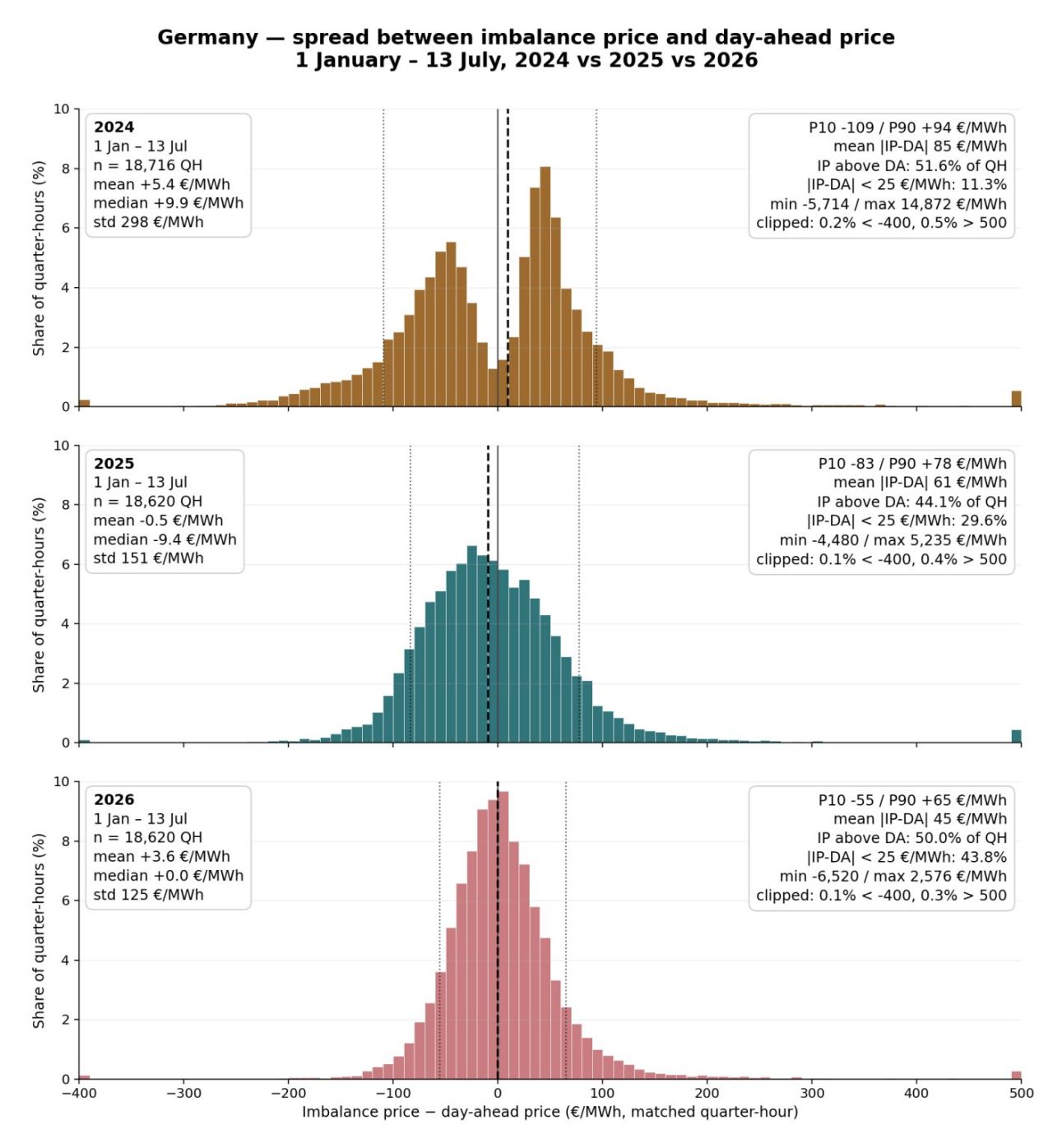
Evolution of the difference between the Imbalance Price (IP) and the day-ahead Price in Germany (period 1 January to 13 July, for 2024 to 2026). As we can see the difference is getting smaller due to…
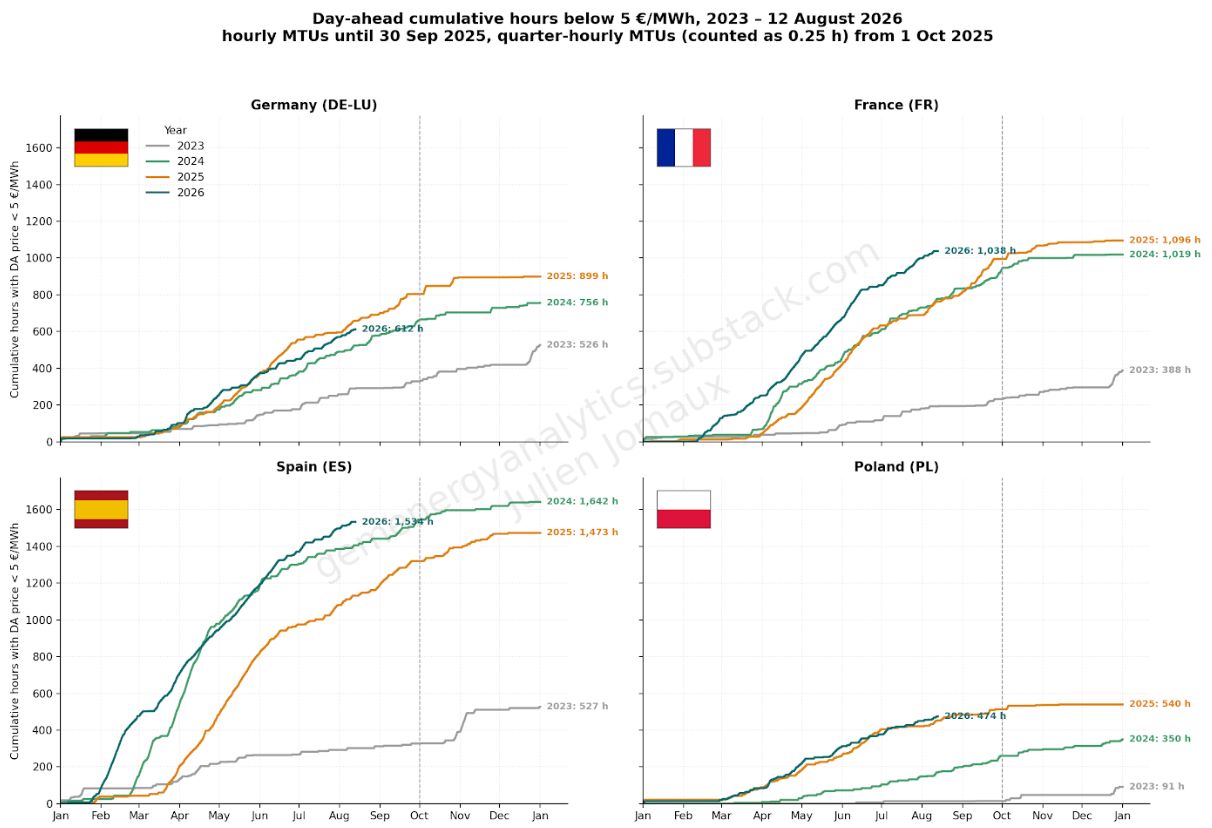
Cumulative number of hours with day-ahead prices below 5 €/MWh in Germany, France, Spain, and Poland. Up to today, in 2026, Spain has the most hours with cheap prices (<5 €/MWh), and roughly tracks…
Julien Jomaux, who tracks the energy sector and European electricity markets, points out that the gap between the Imbalance Price and the day-ahead price in Germany (Jan to Jul, 2024-2026) is narrowin…
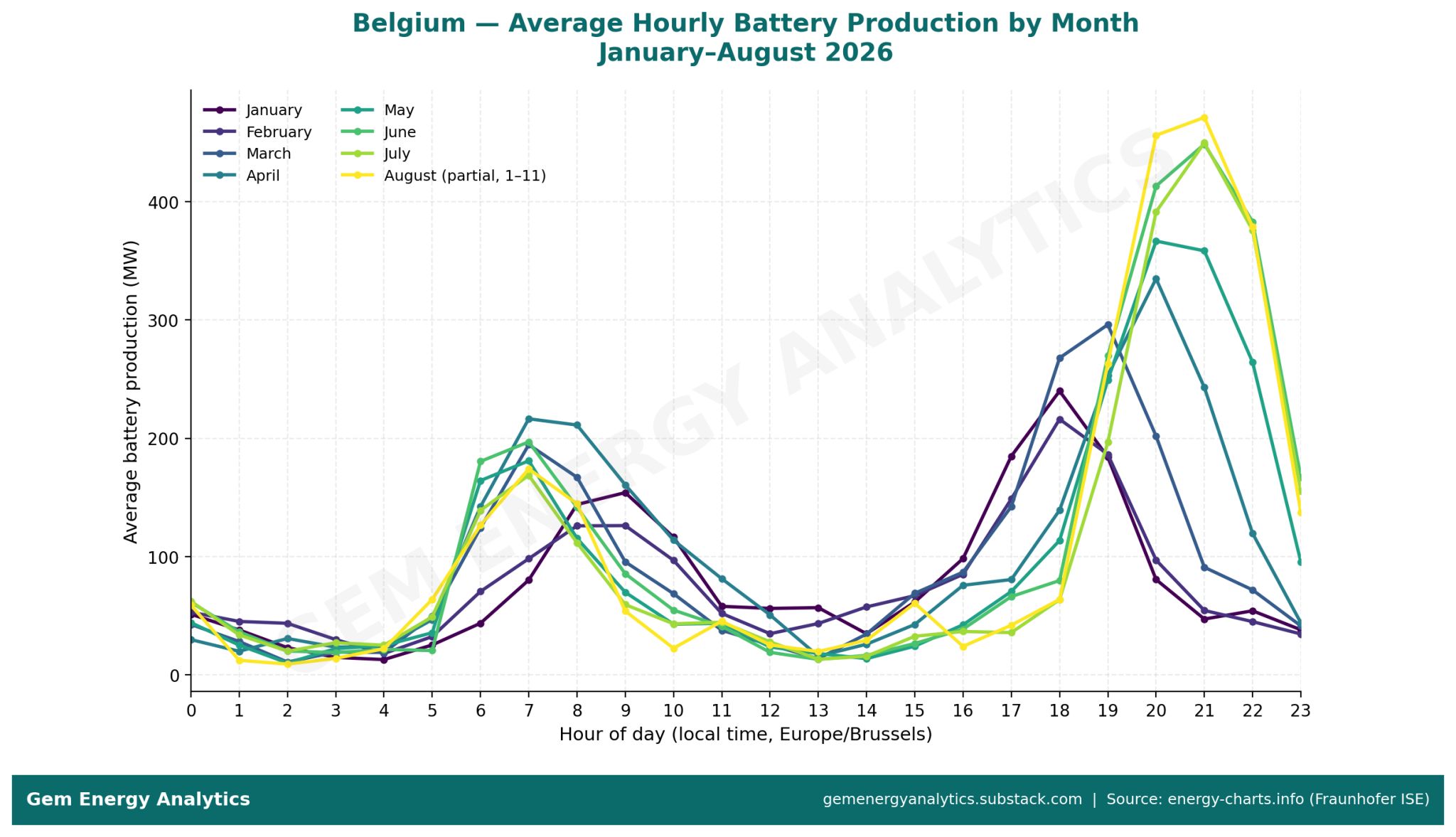
Hourly average injection from batteries in Belgium per month for this year. Data from Energy-Charts (most probably not incoporating all batteries). We can see the clear double peak patterns, direc…
20.0 posts/week
Posts / Week
1
Total Posts Analyzed
HIGH
Posting Frequency
78.8%
Avg Engagement Rate
STABLE
Performance Trend
140
Avg Length (Words)
HIGH
Depth Level
ADVANCED
Expertise Level
92/10
Uniqueness Score
YES
Question Usage
0%
Response Rate
Writing style breakdown
<start of post>
⚡️ Meet the “NRV Pokémons” - a strange incentive hidden in former Germany’s imbalance-price formula ⚖️
Sometimes, you can only see a market-design problem when you zoom in far enough.
I recently looked at German reBAP (=imbalance price) vs. NRV around the zero-imbalance point, using several years of quarter-hourly data.
And something quite remarkable appeared.
Before June 2022, when the NRV was only slightly negative, the imbalance-price formula could end up with a very small denominator.
The result?
👉 The closer the system got to balance, the more extreme the negative imbalance price could become – especially when the NRV was crossing 0 during a MTU – i.e. when activations in both directions were present. (This was at some point also partly mitigated by the AEP2 & later on the AEP20 mechanism for low NRV-value – the so-called industry compromise, but obviously not fully).
In other words: a system almost balanced could create extreme negative prices.
That is what some traders started calling them the “NRV Pokémons”. 😄
🧩 The good news: this has been fixed!
Following the implementation of the different Module 1, 2 and 3 changes after the Imbalance settlement harmonisation methodology (ISHM), the pricing logic has fundamentally changed.
The imbalance price now looks only at the activations in the same direction as the NRV, rather than creating this cross-direction denominator effect.
The old “Pokémon” behaviour has therefore largely disappeared.
And the data shows a very clear structural break around June 2022.
💡 The lesson for future market design
Traders follow the spread.
You can tell traders to behave in a certain way through regulation, contracts or market conventions.
But if the economics say something different, traders will follow the economics.
That's why, when designing balancing markets, you really don't want to create arbitrage opportunities by design.
If the formula rewards a behaviour that goes against the physical needs of the system, market participants will rationally exploit it.
And that can turn a perfectly rational trading strategy into a collectively inefficient outcome.
🙏 Thanks to Julien Jomaux for the inspiration and to Pierre-Benjamin F. for coming up with the excellent name “Pokémons” back in the days.
</end of post>
Sign in to unlock the full writing analysis
Free tools to help you write, score, and benchmark in the same style.
Other creators worth studying alongside .

Elena Verna
Growth at Lovable
116 Viral Score

Michael Jackson 🦡
Venture Capitalist
27 Viral Score

Codie A. Sanchez
Investing millions in Main St businesses & teaching you how to own the rest | HoldCo, VC, Founder | NYT best-selling author
44 Viral Score
Walid Boulanouar
hire claude code operator to run your company
30 Viral Score

Laurent Brouat
🧠 Je décode le marché du recrutement | Fondateur Les Talents Narratifs | Newsletter, Guides & Événements | Retrouvez mes analyses du recrutement sur LA newsletter 👇👇
55 Viral Score

Diane Massé
Talent Acquisition Specialist
193 Viral Score
ViralBrain plans, writes, and schedules your LinkedIn content, using official LinkedIn APIs so your account stays safe.
Write like this creator.