
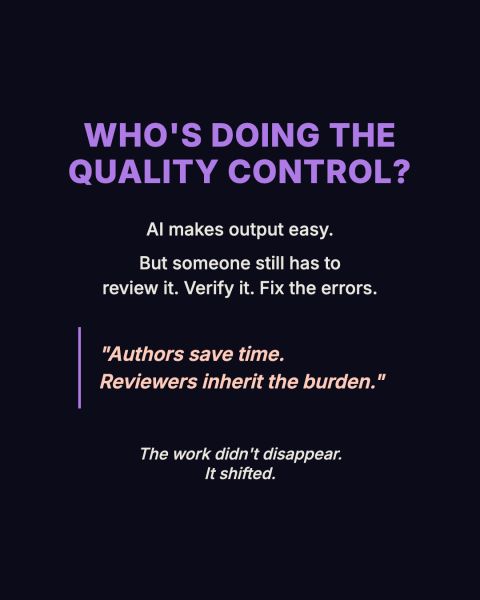
If you've rolled out AI tools and something still feels off, you're not alone. Here's what I keep seeing: The person using AI saves time. But someone still has to review the output. Verify it. Fix…
30390100 viral
AI10 months ago

LinkedIn Content Strategy & Writing Style
Stuck on AI? I help mid-sized companies go from paralyzed to pilot in 5 days | Speaker & Advisor
4 people tracking this creator on ViralBrain
Damian Nomura positions himself as a high-velocity pragmatic advisor who bridges the gap between executive paralysis and operational execution. His content strategy centers on the invisible AI implementation, arguing that the greatest ROI comes from using AI as a development tool to build custom software rather than forcing teams to adopt complex new interfaces. He distinguishes himself by rejecting the "flashy chatbot" hype in favor of a 5-day pilot model that prioritizes working software over lengthy consulting cycles. This intersection of technical advisory and rapid prototyping allows him to frame AI not as a training burden, but as a way to fix structural bottlenecks and reduce the overhead of scaling teams.
1.6K
1.2K
46
5.4
587
1
If you've rolled out AI tools and something still feels off, you're not alone. Here's what I keep seeing: The person using AI saves time. But someone still has to review the output. Verify it. Fix…
88% of enterprises are experimenting with AI. But only 33% have deployed it across their organizations. What's stopping them? Not the technology. Not the budget. Not the talent. Something nobody wa…
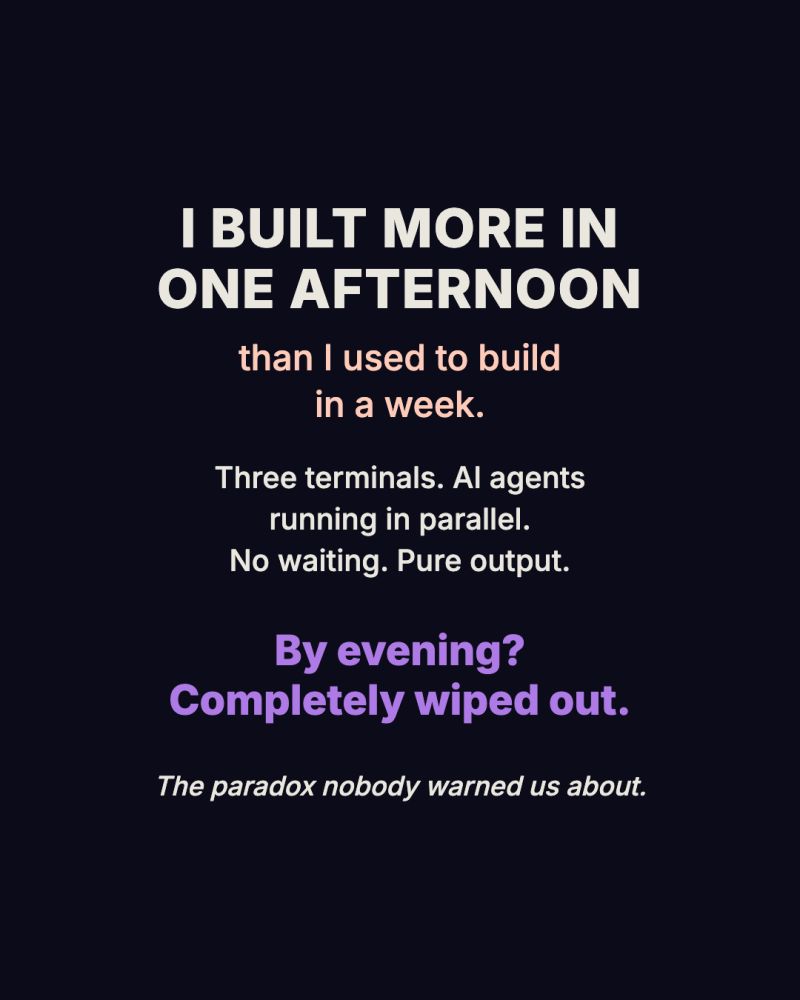
I built more in a single afternoon than I used to build in a week. Three terminal windows open. AI agents running in parallel. Task one running. Task two in progress. Task three queued up. No waitin…
AI was supposed to give us more time. Instead, it just raised the bar. Wharton researchers call this "the efficiency trap." Here's how it works: → You complete a project in 3 days instead of 5 → G…
96% of executives expect AI to boost productivity. 77% of workers say it's actually decreased theirs. That's not a gap. That's a chasm. And get ready to find out what makes it even worse: Workers…
96% of executives believe AI will boost productivity. Belief isn't a strategy. Here's the uncomfortable truth: → Nearly half of employees don't know how to achieve the AI gains their employers expe…
5.4 posts/week
Posts / Week
1.4 days
Days Between Posts
1
Total Posts Analyzed
HIGH
Posting Frequency
45.9%
Avg Engagement Rate
INCREASING
Performance Trend
230
Avg Length (Words)
HIGH
Depth Level
ADVANCED
Expertise Level
8.5/10
Uniqueness Score
YES
Question Usage
0.8%
Response Rate
Writing style breakdown
The writing is professional yet conversational.
It is strongly informative and analytical, with a persuasive undercurrent.
Tone is direct, calm, and authoritative, but never aggressive.
It often feels reflective and thoughtful, but with a clear sense of urgency and stakes.
The voice is grounded and pragmatic: heavily anchored in concrete examples, research, and business reality.
Vocabulary is accessible (no dense jargon without explanation).
Sentences are clean and grammatically correct, but not stiff.
Occasional casual phrases (“you’re not alone,” “get ready to find out,” “what would you build”) keep it human and relatable.
No slangy internet language, no memes, no emojis.
The writer sounds like an executive advisor or senior consultant speaking plainly to other professionals.
Energy: measured but persistent. Not hyper or breathless; more like “quiet urgency.”
Slightly concerned, but not alarmist.
Empathetic, especially toward workers / middle managers / people feeling overwhelmed.
Confident and steady, never panicked.
Exposing paradoxes (AI makes you faster, and that speed can consume you).
Highlighting gaps (between executives and workers, belief and strategy, tools and skills).
Validating the reader’s feelings (“If you've rolled out AI tools and something still feels off, you're not alone.”).
Rhetorical questions (“What’s stopping them?”, “Where do you see yourself in this shift?”, “Why?”).
Short, declarative punch lines (“Belief isn't a strategy.” “All liabilities now.” “The economics have inverted.”).
Parallel structures and repetition (“Not the technology. Not the budget. Not the talent.”).
Paradoxes and inversions (“The same resources that helped large companies win for decades are now anchoring them to the ocean floor.”).
Direct audience engagement: asking the reader how they’re doing, what they would build, how they’re handling something.
Credibility via references to research and statistics.
Common device: state a conventional belief, then invert it with a concise twist.
Example: “AI was supposed to give us more time. Instead, it just raised the bar.”
Heavy use of second person (“you”) to directly address reader’s situation and decisions.
Personal anecdotes (burnout story, three terminals open).
Offers of help (“I help companies…”, “I work on exactly this…”, “I wrote the full breakdown…”).
Third person used for describing companies, executives, workers as groups.
Clear direct commands when appropriate: “Drop a comment.” “DM me.” “Follow me…”
Balanced with softer prompts: “How are you handling this?” “Where do you see yourself in this shift?”
Often phrased as “Here’s what I keep seeing,” which implies authority but also humility.
Names uncomfortable truths.
Stays respectful and empathetic.
Anchors everything in outcomes, tradeoffs, and action.
Sign in to unlock the full writing analysis
Free tools to help you write, score, and benchmark in the same style.
Other creators worth studying alongside Damian Nomura.

Steve Nouri
The largest AI Community 14 Million Members | Advisor @ Fortune 500 | Keynote Speaker
3 Viral Score
Aravind Srinivas
Cofounder, President & CEO, Perplexity
24 Viral Score

Jason Fairchild
Co-Founder and CEO at tvScientific
103 Viral Score
Fabrice Courdesses
Co-Founder & CEO of VideoRunRun | Data-Driven Creative Intelligence Platform for Video Ads Performance
10 Viral Score

Nicolas JAIMES
Founder of Open Garden
117 Viral Score

Richard Mulholland
Founder: Missing Link and Too Many Robots. We help companies be a threat to the future (before the future threatens them)
31 Viral Score
ViralBrain plans, writes, and schedules your LinkedIn content, using official LinkedIn APIs so your account stays safe.
Write like Damian Nomura.