
Highly reliable people are rarely interesting. Very interesting people are rarely reliable.
7.0K336153
Personal Development12 months ago

LinkedIn Content Strategy & Writing Style
1 person tracking this creator on ViralBrain
Kunal Shah positions himself as a philosopher-operator who decodes the psychological underpinnings of wealth, leadership, and consumer behavior. His content strategy centers on counter-intuitive observations that challenge conventional corporate wisdom, often utilizing pithy, aphoristic prose to highlight the friction between human nature and business scaling. He is notable for his ability to bridge the gap between high-level venture capital insights and raw human psychology, moving beyond mere tactical advice to explore the behavioral economics of success. By intersecting his role as a fintech founder with a deep curiosity about cognitive biases, he provides a unique value proposition that treats company building as a rigorous study of human incentives rather than just a series of operational milestones.
0
0
4.2K
0.7
1
Highly reliable people are rarely interesting. Very interesting people are rarely reliable.
People love escalating small issues to leaders who are easily distracted. Focussed leaders grow more mature teams by asking them to fend for themselves versus be their rescuer all the time.
Congrats team Pine Labs. 17 years to achieve this overnight success. Well done. Was an honor to be on your board. Amrish Rau Shailendra J Singh

It’s harder for older people to remain creative as they lose the ability to look at things from a brand new perspective. Most innovation comes from young people or young companies run by young peopl…
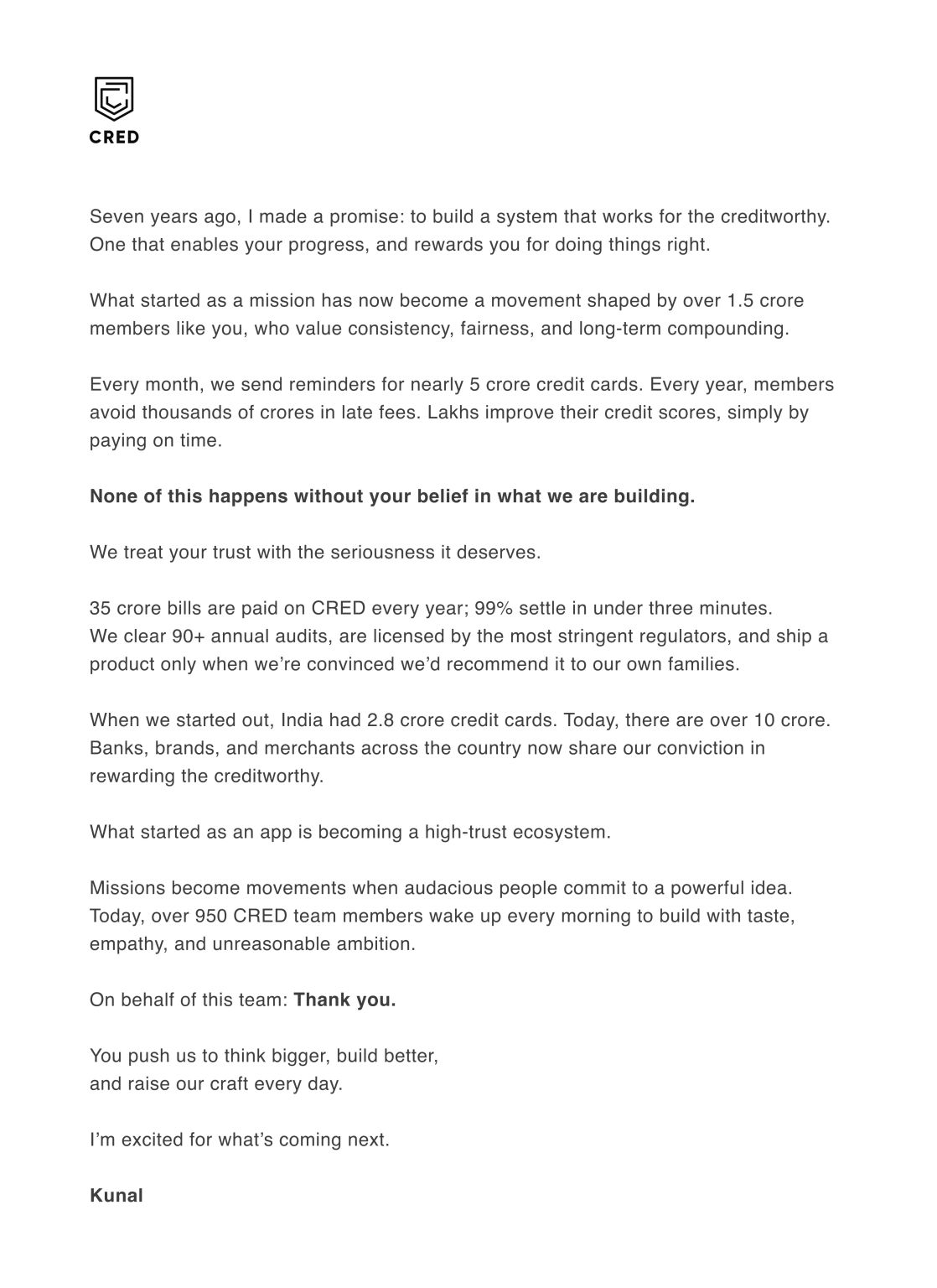
A big thank you on behalf of everyone at CRED as we turn 7. 🙏
Extraordinary execution over years with extraordinary attention to detail on every aspect. Kudos team Groww It’s time to Groww.

0.7 posts/week
Posts / Week
11 days
Days Between Posts
1
Total Posts Analyzed
LOW
Posting Frequency
8.5%
Avg Engagement Rate
STABLE
Performance Trend
30
Avg Length (Words)
MEDIUM
Depth Level
ADVANCED
Expertise Level
7.5/10
Uniqueness Score
NO
Question Usage
0.3%
Response Rate
Writing style breakdown
The style is concise, minimalistic, and highly distilled. Every post feels like a compressed insight or a sharp one-liner rather than an essay.
The voice is professional but not stiff, conversational but not chatty. It leans toward reflective, philosophical, and observational.
Overall tone: thoughtful, controlled, and confident. No melodrama, no emotional oversharing.
It is not poetic in an ornate way, but it can be aphoristic: sentences often read like quotes or maxims.
Persuasion is subtle: instead of directly telling the reader what to do, the writer states truths and lets the reader infer the lesson.
Midway between formal and casual.
Grammar is mostly correct but occasionally relaxed (sentence fragments, missing commas).
Vocabulary is simple and accessible – no jargon unless related to the startup context (founders, power users, scale, etc.).
Energy level is low-to-medium but very focused.
Tone is calm, matter-of-fact, and detached, even when praising or congratulating.
Posts about companies (CRED, Pine Labs, Groww) show warmth and respect, but still with restraint. No exaggeration, no gushing.
Posts about human behavior, founders, leaders, or employees carry a quiet sharpness – observational, sometimes blunt.
Highly reliable people are rarely interesting. / Very interesting people are rarely reliable.
Anything long-term demands time and attention. / Yet we live in a world that kills both.
No wonder wealth, health, relationships, and businesses feel harder to build than ever.
Aphoristic style: many sentences can stand alone as quotable lines.
Very few rhetorical questions; instead, the style prefers statements that imply the question.
Little to no explicit humor; when present, it is extremely dry (e.g., “17 years to achieve this overnight success.”).
Direct engagement with specific people or teams via names, but not with the general audience via “you.”
Very frequent: people, founders, employees, leaders, young people, older people.
Rare: “you”; the sample mostly avoids addressing the reader directly.
We” appears only when speaking about humanity or society in general (“Yet we live in a world…”).
The posts talk about “them” or abstract groups instead of “you,” which makes the tone more observational than coaching.
It’s time to Groww.” is a tagline-like imperative.
The style prefers declarative observations over direct instructions or suggestions.
Sign in to unlock the full writing analysis
Free tools to help you write, score, and benchmark in the same style.
Other creators worth studying alongside Kunal Shah.
Unknown
Unknown
Unknown
Unknown

Clément Predo
Votre partenaire IA | Automatisations, Formations, Conférences, Productions | Co-Founder @Axem IA
22 Viral Score

Alex Wang
Learn AI Together - I explain practical AI, real workflows, and where AI is actually going. Follow me and let’s grow together.
20 Viral Score
Théophile Burnet ⚡️
Partenaire IA des entreprises | Je vous accompagne avec ma méthode AFD : audit, formation, déploiement (+30 clients) | +11 000 lecteurs sur ma newsletter 👇
67 Viral Score

Matthew Skelton
CEO at Conflux | Co-author of ‘Team Topologies’ and ‘Adapt Together’ | Exec Advisory | Operating Models | Capability Design
40 Viral Score
ViralBrain plans, writes, and schedules your LinkedIn content, using official LinkedIn APIs so your account stays safe.
Write like Kunal Shah.