
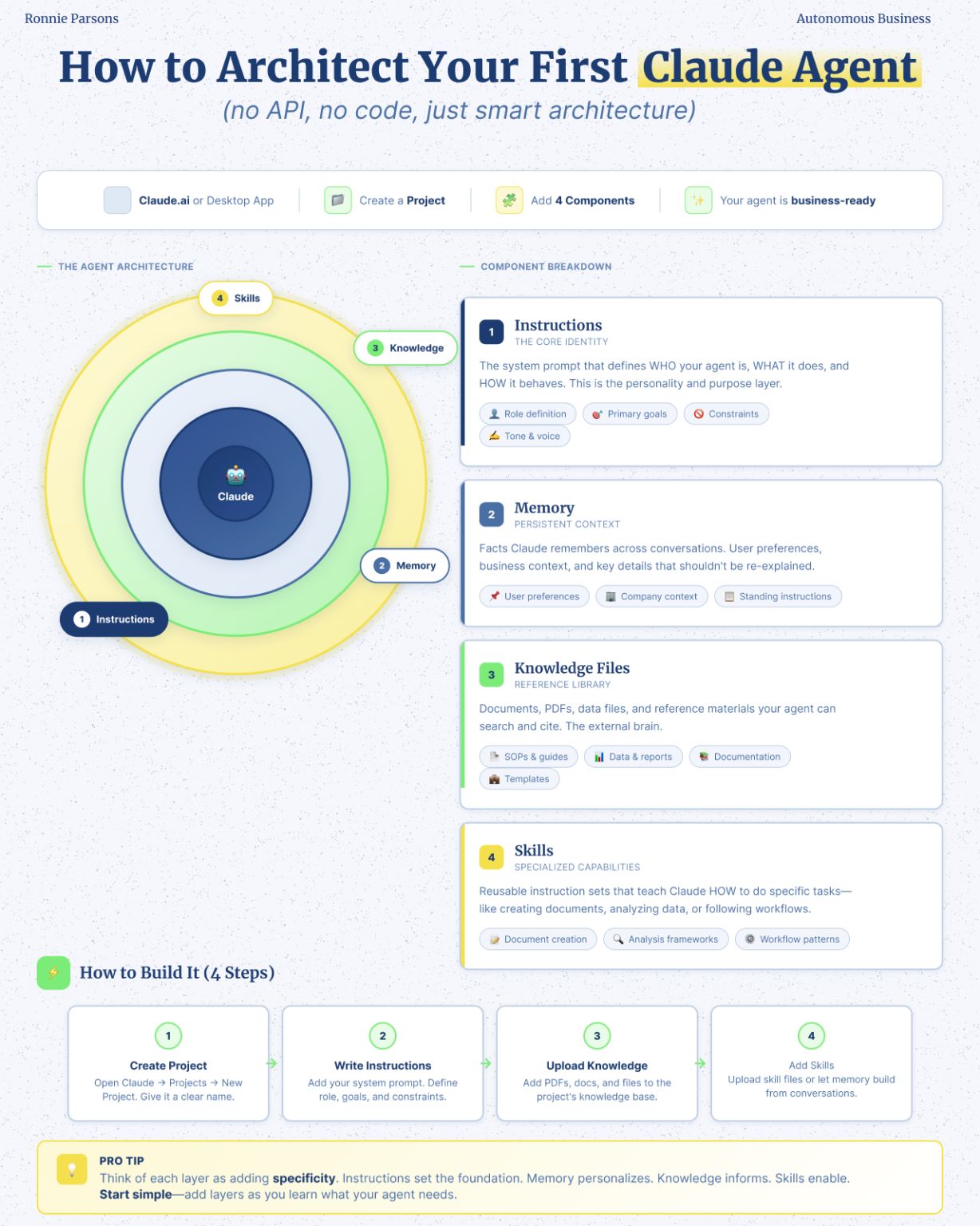
Most founders think building AI agents requires technical skills they don't have. (hint: it doesn't) I hear this constantly. "I'm not a developer." "I don't know how to use APIs." "I can't write cod…
1531474100 viral
AI10 months ago

LinkedIn Content Strategy & Writing Style
Helping solo founders build thriving businesses with AI | Community & Implementation | Founder @ Mode Lab & Mighty AI Lab
1 person tracking this creator on ViralBrain
Ronnie Parsons positions himself as an architect of autonomous systems, moving solo founders away from the "learning trap" of endless courses toward immediate operational capacity. His content strategy centers on the critical distinction between mere automation and true business autonomy, frequently using Claude-specific frameworks to demonstrate how to build reusable AI skills rather than fragmented projects. He is notable for his "anti-technical" stance, arguing that the bottleneck for founders isn't a lack of coding ability but a failure in architectural thinking and task prioritization. By blending high-level systems design with radical transparency about his own implementation failures, Parsons offers a pragmatic value proposition: reclaiming 20+ hours a week through strategic deployment rather than technical mastery.
6.9K
4.6K
81
4.9
243
1
Most founders think building AI agents requires technical skills they don't have. (hint: it doesn't) I hear this constantly. "I'm not a developer." "I don't know how to use APIs." "I can't write cod…
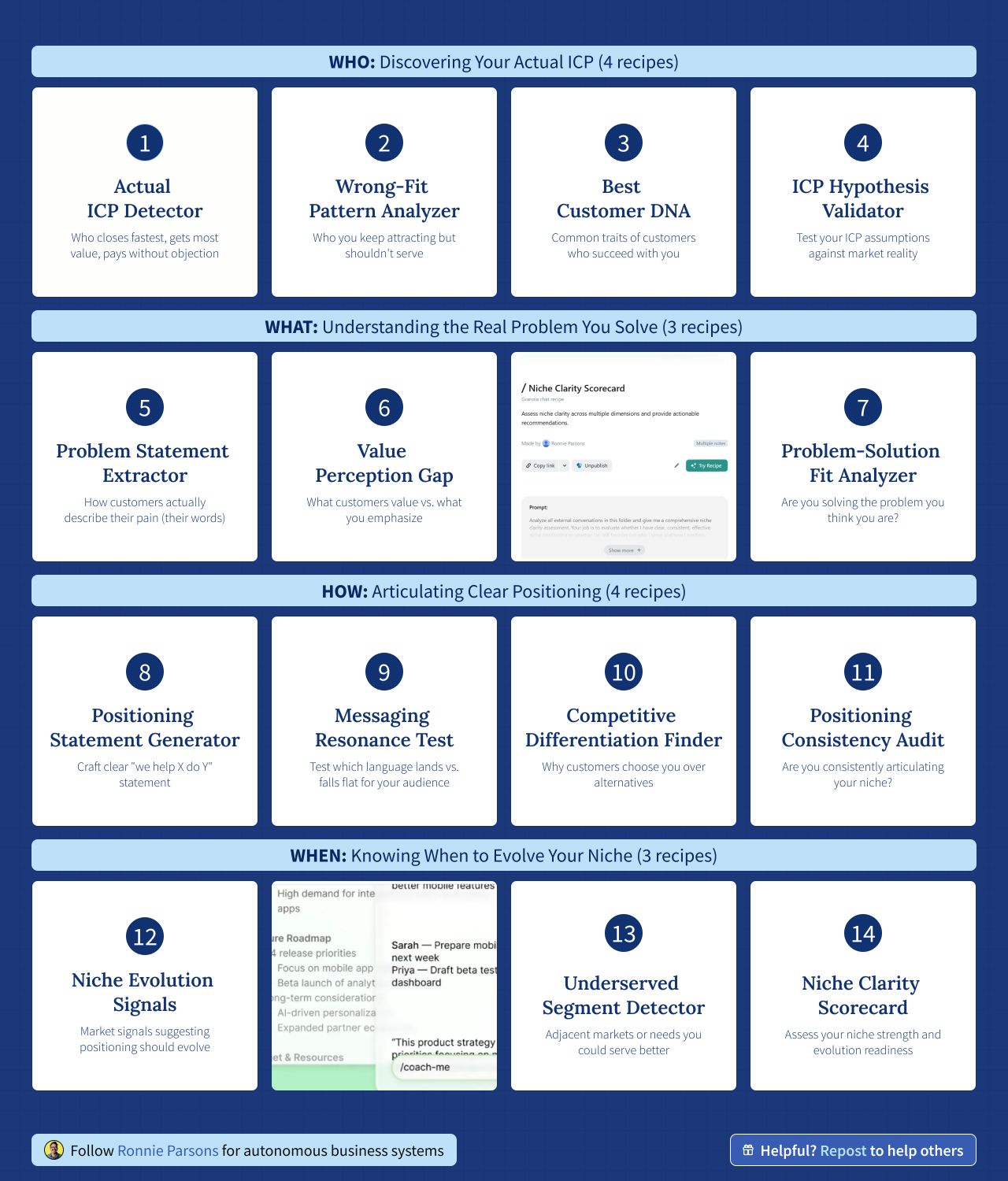
I just spent 12 hrs designing my niche research system → Comment NICHE and I'll DM it to you It's 14 Granola Recipes purpose-built for solo founders Taken directly from • My 250 Granola conversati…
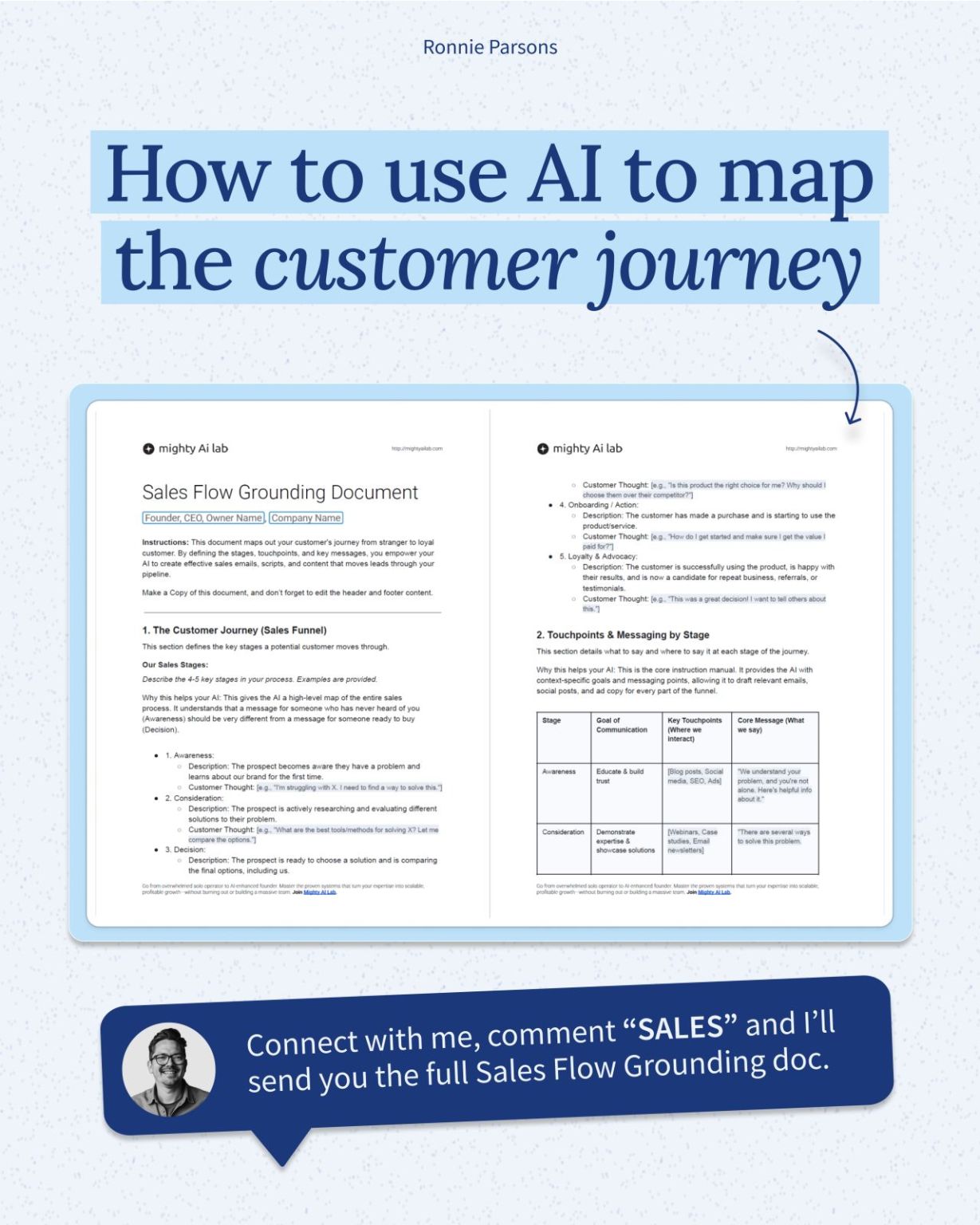
Here's how to prompt Claude to write follow-ups that move deals forward👇 The complete Claude Sales Flow Guide: → How you get it 1. Connect with me 2. Like this post 3. Comment "SALES" 𝗪𝗵𝗮𝘁…
Google just handed 650M people autonomous AI agents. And most founders have no idea it happened. While "AI consultants" are billing $15K for strategy decks. Here's what actually changed yesterday:…
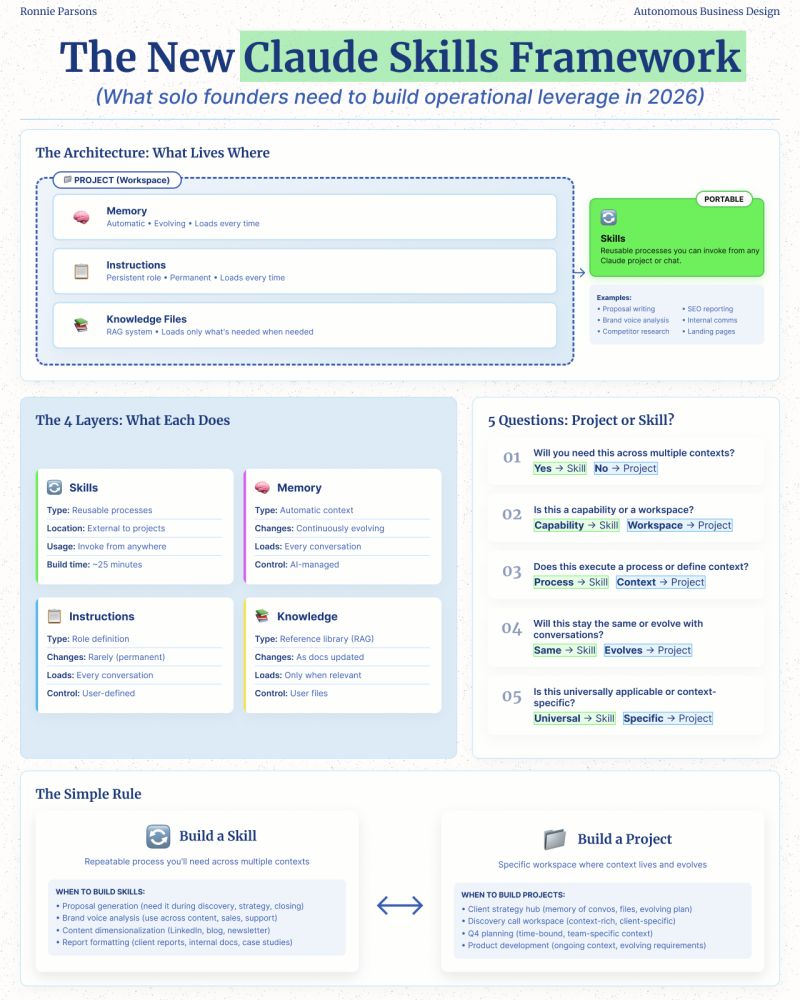
I used to have a dedicated Claude project for proposal writing. Now I use Claude skills. Here’s why. Every time I needed to create a proposal, I'd use a project. All my templates, pricing structure…
Friday drop. What did you build this week that you're most proud of? (Doesn't have to be perfect. Just proud.) I'll go first: Spent Wednesday helping a community member finally find her brand voice…
4.9 posts/week
Posts / Week
1.6 days
Days Between Posts
1
Total Posts Analyzed
HIGH
Posting Frequency
5%
Avg Engagement Rate
INCREASING
Performance Trend
350
Avg Length (Words)
HIGH
Depth Level
ADVANCED
Expertise Level
8.5/10
Uniqueness Score
YES
Question Usage
0.6%
Response Rate
Writing style breakdown
Tone is professional but very conversational, aimed at founders and solo operators.
Voice is authoritative and expert, but grounded and empathetic (“I was that founder.”).
Style is highly informative and persuasive, with strong emphasis on reframing how the reader thinks.
It feels like a mentor or strategist talking directly to a founder, not like a corporate brand.
Semi-formal: clear, clean language with no slang-heavy casualness, but still relaxed.
Reads like a sharp LinkedIn thought-leadership post: polished, but not academic.
Medium-to-high energy, but controlled and deliberate.
Emotion is channeled through frustration with the status quo and excitement about better systems.
Frequent contrast between pain (overwhelm, wasted time, broken processes) and relief (clarity, leverage, autonomy).
Uses emotional beats strategically: surprise, recognition, then empowerment.
Rhetorical questions: “Which one are you?”, “What level of autonomy do you actually need?”
Pattern interruptions: “All great goals. All wrong starting points.”
Contrast pairs: “Autonomy, not automation”, “deploy vs. learn”, “ideas vs. systems”.
Micro-stories and specific anecdotes (Jeremy, the founder with 24 years of experience, the $12K in courses).
Reframing: “The problem wasn’t the AI. It was picking the wrong battle.”
Name-the-problem lines: “The bottleneck is capacity.”, “That’s the learning trap.”
Here’s what actually stops founders:
Here’s the framework that would’ve saved them 200 hours:
Here’s why education isn’t your problem:
Here’s how to prompt Claude to write follow-ups that move deals forward
Uses specific, tangible numbers and examples: $12K, 6 hours/week, 47 projects, 14 recipes, 240 hours/month, 650M people.
Frequently zooms from individual anecdote to generalizable framework, then back to a concrete outcome.
Heavy use of second-person “you” to directly engage founders.
Share personal failures and shifts.
Signal community/ Lab work (“Inside my community”, “Inside the Lab, we’re already building…”).
I was that founder.
I used to be the same.
Drop ‘CALCULATOR’ below
Comment NICHE and I’ll DM it to you
Join us: https://...
But they’re framed in a helpful, non-pushy way: tied to a valuable resource.
Uses both, but leans toward direct commands for CTAs and practical steps.
Before you automate your next process, ask yourself:
For solo founders…, the question isn’t ‘how do I learn this?’ It’s ‘where’s the system that solves this now…?’
Sign in to unlock the full writing analysis
Free tools to help you write, score, and benchmark in the same style.
Other creators worth studying alongside Ronnie Parsons.

Gal Aga
CEO @ Aligned | Don't Sell; offer 'Buying Process As A Service'
66 Viral Score

68 Viral Score

Jordan Crawford
Get Jordan in Claude Code Now: edge.blueprintgtm.com
26 Viral Score

Patrick Spychalski
Co-Founder @ The Kiln | A 2X Company
154 Viral Score

John Cutler
Head of Product @Dotwork ex-{Company Name}
12 Viral Score

Wouter van Noort
Chef Opinie @ NRC. Minder meningen, meer ideeën. Graag naar opinie@nrc.nl
74 Viral Score
ViralBrain plans, writes, and schedules your LinkedIn content, using official LinkedIn APIs so your account stays safe.
Write like Ronnie Parsons.