
I'm not the only one who's noticed this, I know. Fei Fei Li, known as the "godmother of AI" looks like she's being pushed off the edge of the shot...and maybe at risk of sliding off the beam. If you…

13149311 viral
AI Ethics10 months ago

LinkedIn Content Strategy & Writing Style
Exec @ Charter, CEO @ Work Forward, Publisher @ Flex Index | Advisor, speaker & bestselling author | Startup CEO, Google, Slack | Forbes’ Future of Work 50
2 people tracking this creator on ViralBrain
Brian Elliott positions himself as the premier architect of the modern workplace, bridging the gap between high-level executive strategy and the human-centric realities of the People function. His content strategy centers on the "future of work" triad—flexible work models, AI integration, and leadership capability—using data-backed insights to argue that organizational success is 80% work redesign and only 20% technology. He is notable for his ability to de-weaponize corporate mandates, replacing "return-to-office" pressure with "magnet" strategies that prioritize employee autonomy and measurable outcomes over physical presence. By operating at the intersection of HR advocacy and AI transformation, Elliott elevates the People leader from a back-office administrator to a strategic R&D partner essential for navigating the uncertainty of the next decade.
31.3K
6.7K
73
5.9
31
2
I'm not the only one who's noticed this, I know. Fei Fei Li, known as the "godmother of AI" looks like she's being pushed off the edge of the shot...and maybe at risk of sliding off the beam. If you…
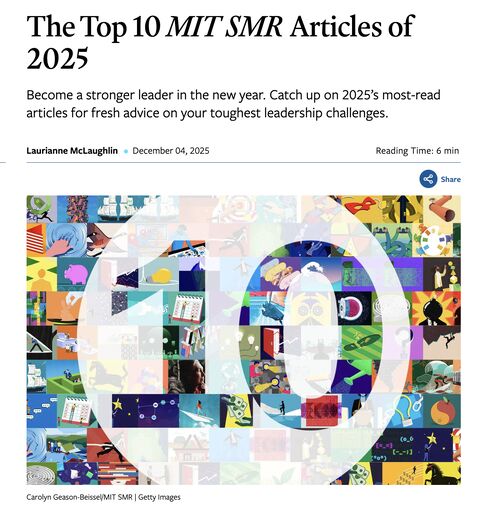
"Hybrid Work Is Not the Problem — Poor Leadership Is" is one of MIT Sloan Management Review's top 10 articles of 2025...and just came out in November! Thanks to our readers, my co-authors Prithwiraj…
Magnets work better than mandates—another win for people-centric leadership. Brian Sherman, CPO at Delta Dental Ins., tested two approaches to getting people back to the office. His team? He mentione…

“Why HR?” I get that a couple times a week. After building startups and leading teams at Google and Slack, why am I focusing on the People function with the team at Charter? HR is often dismissed a…

Uncertainty triggers worse stress than actual pain: people feel more stressed by a 50% chance of getting an electric shock than 100% certainty they'll get one. Uncertainty is piling up on our teams:…

Ethan Mollick argues that HR should be R&D in the age of AI—but AI might also push HR into irrelevance. The orientation and drive of People leaders will determine which direction their teams go, acc…

5.9 posts/week
Posts / Week
1.3 days
Days Between Posts
2
Total Posts Analyzed
HIGH
Posting Frequency
0%
Avg Engagement Rate
STABLE
Performance Trend
230
Avg Length (Words)
HIGH
Depth Level
ADVANCED
Expertise Level
8.5/10
Uniqueness Score
YES
Question Usage
0.5%
Response Rate
Writing style breakdown
Professional, research-based, and credible, but delivered in a warm, conversational tone.
Feels like a thoughtful LinkedIn thought-leadership style: a mix of analysis, commentary, and light storytelling.
Highly informative and explanatory with a subtle persuasive undercurrent (guiding leaders toward people-centric, research-backed approaches).
Not poetic or overly rhetorical; instead, crisp, grounded, and pragmatic.
Often slightly punchy, with short lines used for emphasis and “bottom line” statements.
Semi-formal: professional vocabulary and references (research, experts, data), but accessible and friendly.
Uses contractions (“doesn't,” “won't,” “we’re”), which keep it conversational rather than stiff.
No slang-heavy informality; more “approachable executive” than “buddy.”
Medium-to-high energy: the writing has momentum but is not breathless or hypey.
Tone is engaged, thoughtful, and subtly urgent (“leaders need to be ready,” “the gap has never been wider”).
Emotional range is controlled: concern, optimism, curiosity, and mild frustration with old paradigms, but never outrage or melodrama.
Rhetorical questions (especially at openings and closings: “Does AI mean job losses…?”, “Which path is your organization choosing?”).
Expert name-dropping to build authority (researchers, CHROs, professors).
Concrete stats or research findings for credibility (percentages, comparative metrics like “7X more likely”).
Contrast structures (“magnets vs mandates,” “diminishes vs evolves,” “eliminating toil, not eliminating jobs”).
Short, stand-alone summary lines like “The bottom line:” or “But they need support themselves.”
Occasional light humor and irony, usually subtle (“I guess at least the posing is realistic...”).
Uses quotes from others as anchors for arguments (“For us in HR, the imperative is to demonstrate value creation”).
First-person singular (“I was in a CHRO’s office,” “I get that a couple times a week”) for anecdotes.
First-person plural (“we’re implementing Copilot,” “we know over half of this needs to go away”) when aligning with leadership or teams.
Second-person (“If you’re thinking ahead…,” “If you're spending more time talking about AI than using AI…”) to engage the reader and prompt reflection.
Direct: “Start with why.” “Read on…” “Register here:”
Gentle prompts: “If you’re thinking ahead… we’d love to see you there!” or “Let’s get into the data instead of conjecture!”
Commands are framed as collaborative guidance, not top-down orders.
Sign in to unlock the full writing analysis
Free tools to help you write, score, and benchmark in the same style.
Other creators worth studying alongside Brian Elliott.

Kevin Naughton
Ex-Google Software Engineer | Try Ferryman (FREE) 👇
9 Viral Score

Jess Ramos
⚡️ Data Science & AI Content Creator w/ 500K+ followers | Developer Advocate & Solopreneur | LinkedIn Learning Instructor | Big Data Energy⚡️ | helping you leverage tech & AI
15 Viral Score

Morgan Young
LinkedIn Top Voice, Gen Z • Keynote Speaker • Founder @ Hyphenate Media • LinkedIn Learning Instructor (16K+ Learners) • prev @ Disney, Shopify • SXSW Speaker 2026
16 Viral Score

Khizer Abbas
Growing newsletter with Paid Ads | 2M+ subs driven | Follow to learn about AI
73 Viral Score

Faiq Zafar
LSE | Superhuman AI | xYahooFinance | xNestle
1,952 Viral Score

Dmitrii Vastianov
Co-founder at Banktopus | Antler | B2B Fintech
162 Viral Score
ViralBrain plans, writes, and schedules your LinkedIn content, using official LinkedIn APIs so your account stays safe.
Write like Brian Elliott.