
i studied the stories of the 60 billionaires. 60% of them had a headstart. inherited wealth, connections etc. they had a headstart and they took it. at 21, I dropped out of college. I could do it bec…

1.7K13677 viral
Entrepreneurship6 months ago

LinkedIn Content Strategy & Writing Style
Founder at Social Capital Inc.
1 person tracking this creator on ViralBrain
Vedika Bhaia positions herself as a high-velocity growth architect who bridges the gap between raw AI capabilities and tangible business outcomes. Her content strategy centers on deconstructing "insane" business models and marketing masterclasses, often using a "hook-to-value" framework that translates complex tech trends into relatable Indian consumer contexts. She is notable for her radical transparency regarding unfair advantages and privilege, openly discussing how her safety net allowed her to scale Social Capital Inc. and The Growth Square. Vedika’s work represents a sophisticated intersection of no-code entrepreneurship and distribution infrastructure, where she advocates for platform-native depth over generic social media management to help generational companies achieve "Apple-level" viral launches.
315.1K
13.3K
679
3.7
27
1
i studied the stories of the 60 billionaires. 60% of them had a headstart. inherited wealth, connections etc. they had a headstart and they took it. at 21, I dropped out of college. I could do it bec…
EDIT: check the prompt here: https://acesse.one/ftqd1ba people on instagram are earning $100k from AI creators that don't exist. i made one from scratch in 15 minutes. the results are insane (giveawa…

if you're a freelancer or run an agency, i just have one advice for you: if you obsess over acquiring more and more customers, you'll lose them to competitors who obsess over keeping them. Let me expl…

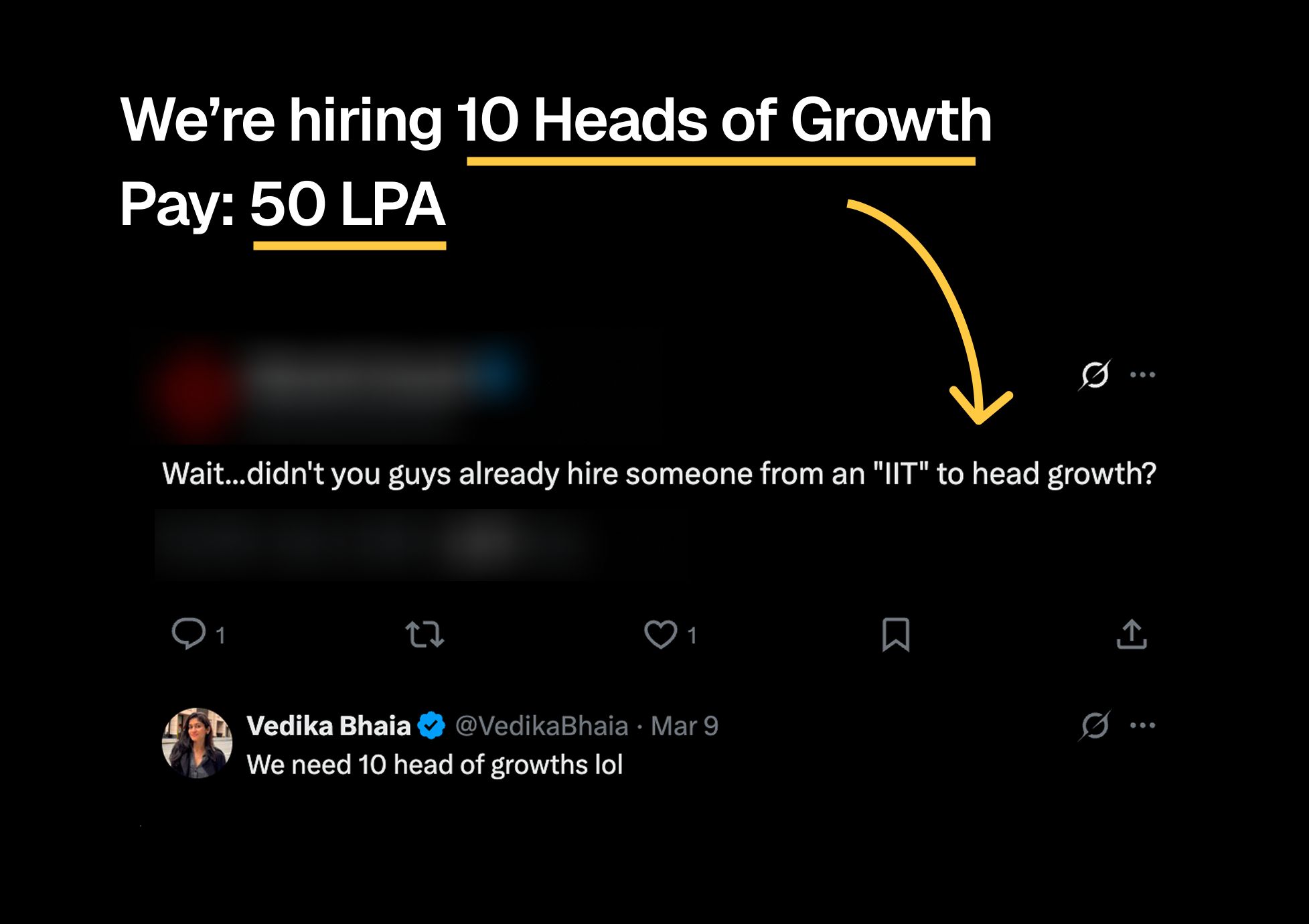
We are ready to pay 50 LPA for a Head of Growth. The role has been open for 6 months. Simple reason: we need 10 of you. Every Fortune 500 launching something this decade needs an Apple-level launch o…
someone spent $10,000 to prove that billboards don't work. they set up AI cameras to track every person who walked past it. what they found should scare every brand still buying hoardings. they ren…
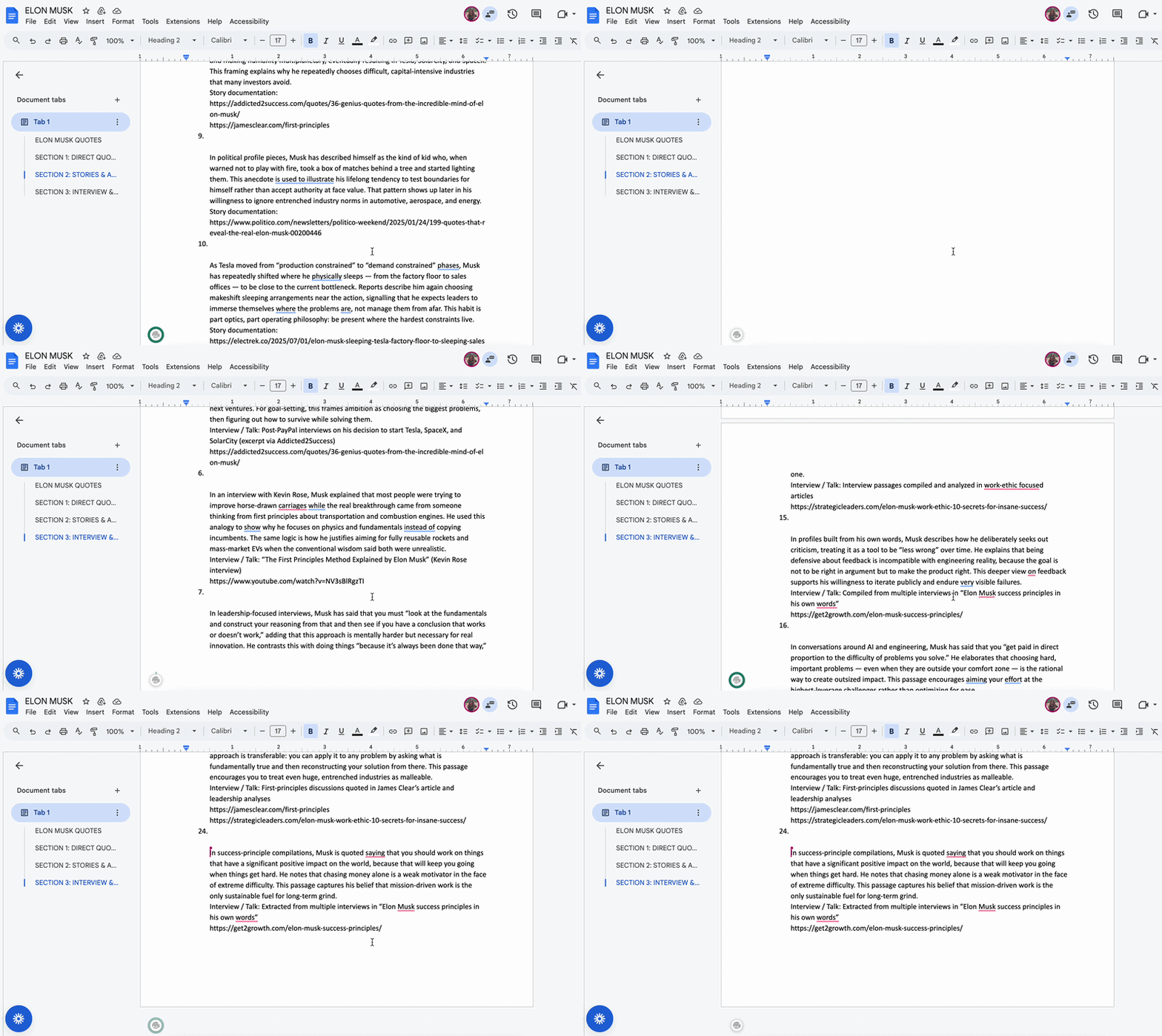
everytime I’m making my goals,I wish there was someone like Elon Musk to tell me I can do better. So I’ve made a doc with all the quotes, stories, talks of Elon Musk to help me be more delusional. Ho…
3.7 posts/week
Posts / Week
2.1 days
Days Between Posts
1
Total Posts Analyzed
HIGH
Posting Frequency
679.1%
Avg Engagement Rate
STABLE
Performance Trend
240
Avg Length (Words)
HIGH
Depth Level
INTERMEDIATE
Expertise Level
0.78/10
Uniqueness Score
NO
Question Usage
0.15%
Response Rate
Writing style breakdown
The author’s voice is that of a 'pragmatic curator'—someone who sits at the intersection of tech-optimism and street-smart business. The tone is professional yet highly conversational, characterized by a 'low-friction' delivery that prioritizes speed of consumption. It is punchy, direct, and persuasive, often using a 'case study' or 'insider secret' framing to build authority.
CORE CHARACTERISTICS: The writing is methodical but disguised as spontaneous thought. It feels like a series of voice notes transcribed into a clean, readable format. It avoids academic jargon in favor of 'internet-native' business speak (e.g., 'headstart', 'unfair advantage', 'ROI', 'distribution infrastructure').
EMOTIONAL TONE: High-energy and fast-paced. The author creates a sense of urgency or 'FOMO' (Fear Of Missing Out) by highlighting massive financial figures ($100k/month, 50 LPA) or 'insane' new technologies. There is an underlying 'hustle' energy that is motivational but grounded in specific examples.
The 'Hook-and-Pivot': Starting with a shocking stat or story, then immediately pivoting to 'how it works'.
Rhetorical Questions: Used to mirror the reader's internal skepticism (e.g., 'did i work hard? yes.').
Direct Audience Engagement: Frequent use of 'comment [WORD] to get it' to drive algorithmic reach.
The 'Let me explain' bridge: A signature phrase used to transition from a bold claim to the supporting logic.
ADDRESSING THE READER: Primarily second-person ('you') to create a coaching relationship. The author uses first-person ('I', 'we') to establish credibility through personal anecdotes or business success. Suggestions are rarely soft; they are framed as 'one advice' or 'the only way to win'.
Sign in to unlock the full writing analysis
Free tools to help you write, score, and benchmark in the same style.
Other creators worth studying alongside Vedika Bhaia.

David Green 🇺🇦
Co-Author of Excellence in People Analytics | People Analytics leader | Director, Insight222 & myHRfuture.com | Conference speaker | Host, Digital HR Leaders Podcast
9 Viral Score

Brent Dykes
Author of Effective Data Storytelling | Founder + Chief Data Storyteller at AnalyticsHero, LLC | Forbes Contributor
40 Viral Score

Michael Saifoudine
Founder @ KLIMB (hiring!) — Branding & Digital Studio | Podcast Host (Notion, Revolut, Lovable, Netflix, Zapier, Qonto, Typeform…)
171 Viral Score

Emily D.
Business Partner & Personal Brand Strategist | Scaled brands to $45M+ | Authority is an energy. I help you own it - and monetise it.
226 Viral Score

Laura Kremer
e-commerce & community building | leading Europe’s largest eCommerce community @eCom Unity
149 Viral Score

Christ Coolen
↳ Specialist Marketing(Psychologie) | Marketeer, Spreker & Trainer
53 Viral Score
ViralBrain plans, writes, and schedules your LinkedIn content, using official LinkedIn APIs so your account stays safe.
Write like Vedika Bhaia.