Very glad to see Humans + AI thinking is now mainstream. McKinsey's latest report "Agents, robots, and us: Skill partnerships in the age of AI" provides excellent analysis in a human-centered frame on…


LinkedIn Content Strategy & Writing Style
Futurist | Board advisor | Global keynote speaker | Humans + AI Leader | Bestselling author | Podcaster | LinkedIn Top Voice | Founder: AHT Group - Informivity - Bondi Innovation
2 people tracking this creator on Viral Brain
Ross Dawson positions himself as a sophisticated architect of the human-AI transition, moving far beyond simple automation to champion a philosophy of "collaborative intelligence." His content strategy centers on synthesizing high-level academic research and economic benchmarks into actionable frameworks for leadership, specifically focusing on how Theory of Mind and cognitive scaffolding enhance human-machine synergy. He is notable for his refusal to view work through a reductionist lens; instead of merely mapping tasks to tools, he explores the frontiers of neurotechnology and "agentic ecosystems" to redefine professional identity. This unique intersection of futurist foresight and organizational strategy allows him to bridge the gap between technical AI evaluations and the messy, emergent reality of real-world economic impact.
34.0K
14.5K
53
—
6.2
19
1
Very glad to see Humans + AI thinking is now mainstream. McKinsey's latest report "Agents, robots, and us: Skill partnerships in the age of AI" provides excellent analysis in a human-centered frame on…

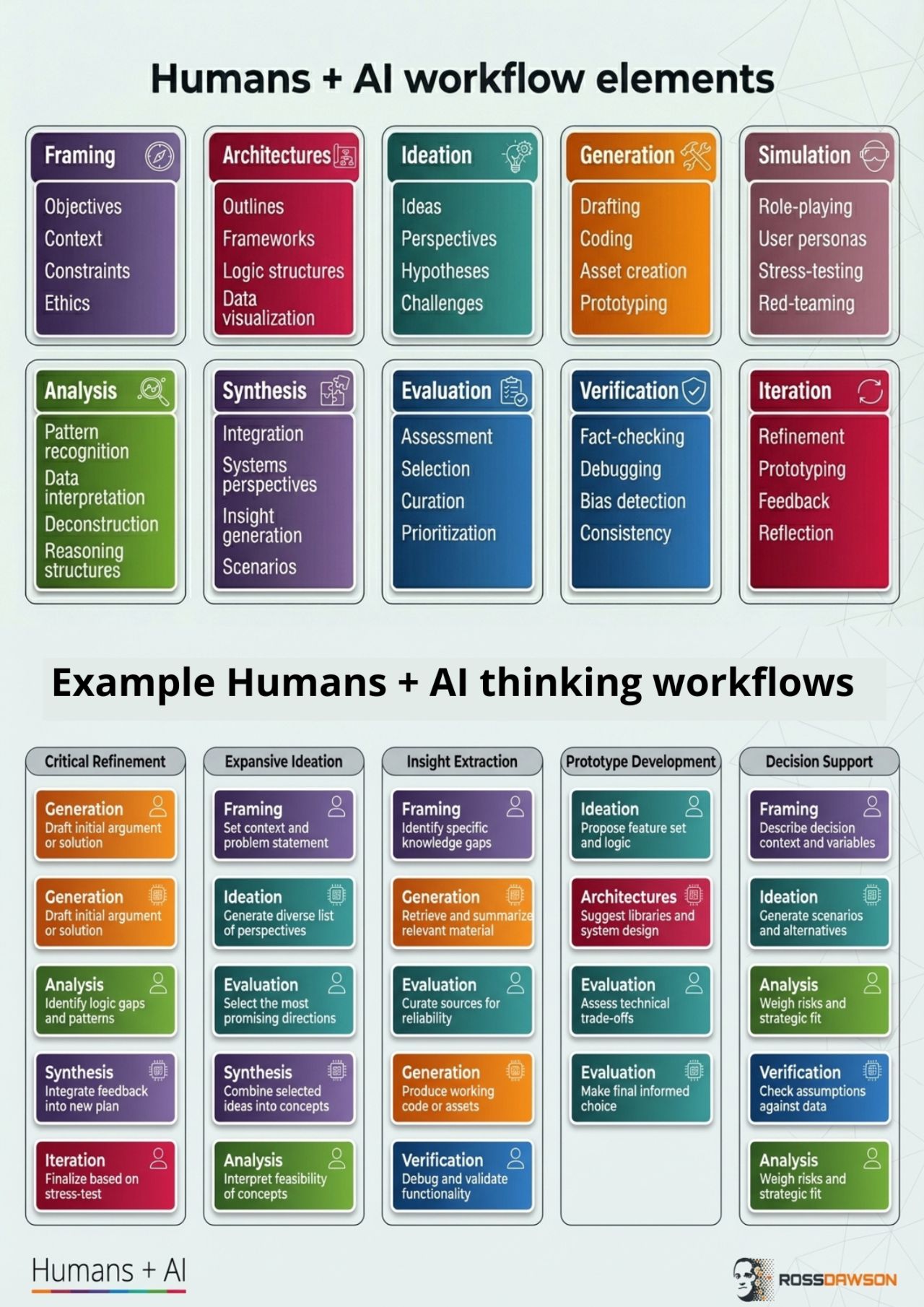
In designing useful, high-performing Humans + AI workflows we need clarity on the respective roles and structure of how humans and AI are integrated. This slight iteration on a previous framework I s…

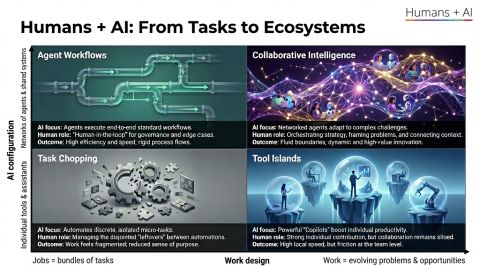
So much of the discussion about AI in the future of work is deeply reductionist. It's about breaking jobs into tasks and allocating them to AI and people (if you have to), or apply specific AI tools t…

This gap is the big story: “They are doing so well on evals, but the economic impact seems to be dramatically behind.” - OpenAI co-founder Ilya Sustekever. There was plenty more really interesting in…

Advances in neurotechnology, including Brain-Computer Interfaces (BCI), will transform what it is to be human. Australia is a world leader in the space, so Neurotechnology Summit 2025, held on Sydney…
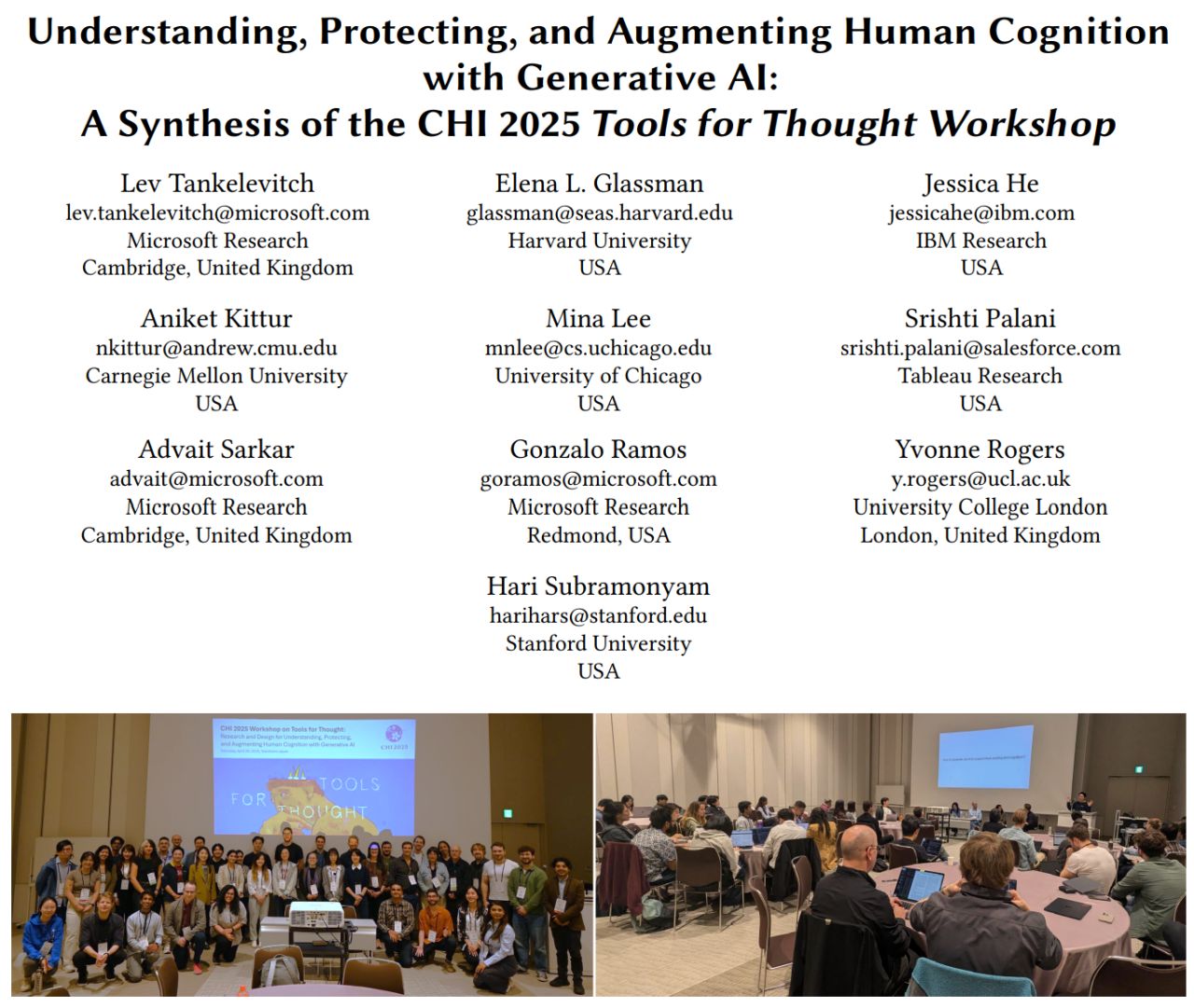
The CHI Tools for Thought Workshop brought together the world's top researchers on computer-human interaction. These are some of their extremely useful findings on the perils and potential of GenAI.…

6.2 posts/week
Posts / Week
1.3 days
Days Between Posts
1
Total Posts Analyzed
HIGH
Posting Frequency
53.3%
Avg Engagement Rate
STABLE
Performance Trend
200
Avg Length (Words)
HIGH
Depth Level
ADVANCED
Expertise Level
0.85/10
Uniqueness Score
YES
Question Usage
0.5%
Response Rate
Writing style breakdown
Overall the style is professional, analytical, and informative with a conversational and human-centered overlay.
Tone is grounded in evidence: studies, reports, conferences, and benchmarks are central. Most posts start from a concrete external source (paper, benchmark, event, report, podcast) and then extract insights.
The author has a clear “expert curator” voice: they synthesize, summarize, and frame others’ work rather than rant or speculate loosely.
The voice is confident but not bombastic; persuasive but via facts and framing rather than hype.
Language is accessible business/academic hybrid: precise terminology (theory of mind, human-in-the-loop, skill adjacencies, agentic workflows) but explained in plain English.
Formality: upper-middle. Not stiffly academic, but clearly professional. Occasional colloquial touches (“a VERY long time ago”, “squarely in a Humans + AI work world”) lighten the tone.
Emotional tone: measured and thoughtful overall, with occasional spikes of enthusiasm around events, people, and opportunities (“fabulous place”, “all-star panel”, “It’s next Tuesday, hope to see you there!!”).
Content-focused posts (papers, McKinsey, Upbench, CHI Workshop) are medium-energy and calm, focusing on clarity and insight.
Event/promo posts are higher energy, more exclamation marks, and more emotional language.
The default mood is constructive and forward-looking, with a strong emphasis on “what this means for Humans + AI work” and long-term implications.
Framing statements: “In short,” “In fact,” “In designing…”, “In other words” (implicit).
Contrastive structure: “Not as a ‘box’… Not as a set of tasks…” leading to a reframe.
Capitalized conceptual phrases: “Humans + AI”, “Simulation and Verification”, “Tools for Thought Workshop”.
Synthesis of complex material into bullet-pointed insights.
Human–AI collaboration as the central lens (“Humans + AI work world”, “Humans + AI workflows”, “collaborative intelligence”).
Distinctions between regimes, zones, or frameworks (three regimes for AI vs human work, low/mid/high-value zones, solo vs collaboration skills).
Often used as section-enders or engagement triggers: “What are the humans + AI workflows where you see the most short-term and long-term potential?”
Also used to open a conceptual issue: “When should we trust human intuition relative to AI outputs?”
Primarily third-person when discussing research (“The study showed…”, “Upwork has created…”, “McKinsey’s latest report…”).
First-person singular appears for context, experience, and opinion (“I have been thinking and writing about BCIs…”, “I, as many, am boggled every day by AI capabilities.”).
Second-person used sparingly but purposefully in CTAs or reflective prompts (“If you want to enhance… join…”, “Where you see the most potential?”).
Mix of direct commands and gentle suggestions.
Directive, especially in bulleted imperatives to leaders: “Reimagine your business…”, “Lead AI as a core business transformation…”.
Softer, reflective invites: “What are the humans + AI workflows…?”, “If you want to enhance… join…”.
There is no aggressive or pushy sales language; CTAs are framed as opportunities for alignment with shared interests.
Write as a knowledgeable, calm expert curating and interpreting high-quality external sources.
Default to precise, neutral, evidence-based language, and then layer in occasional human warmth and enthusiasm.
Use first-person “I” for lived experience or commentary, third-person for descriptions of research, and second-person mainly for calls-to-action or reflective questions.
Sign in to unlock the full writing analysis
Nail your LinkedIn strategy with ViralBrain.
Analyze and write in Ross Dawson's style. Grow your LinkedIn to the next level.