
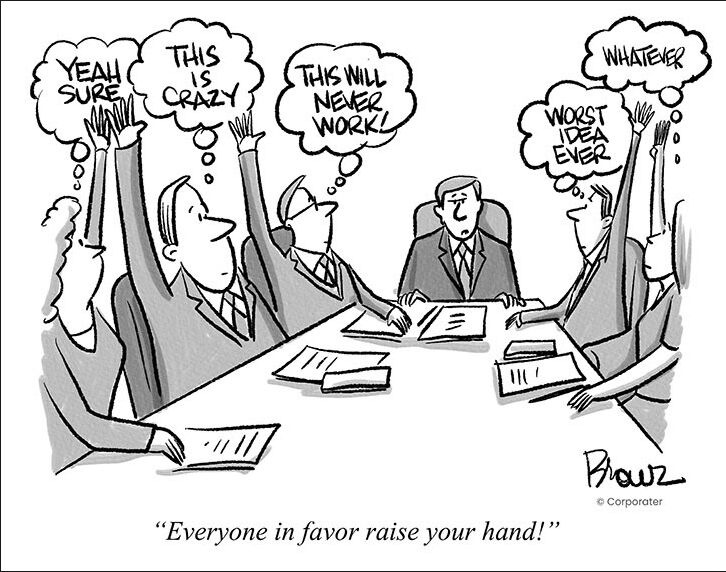
Group discussions often make decisions worse, not better. Leaders have the power and responsibility to avoid groupthink and empower smarter decisions. Here’s how: Before you go into a group meeting…
210152033 viral
Leadership11 months ago

LinkedIn Content Strategy & Writing Style
Author, Professional Speaker & Decision Strategist
1 person tracking this creator on ViralBrain
Annie Duke positions herself as a premier decision strategist who bridges the gap between high-stakes professional poker and cognitive psychology. Her content strategy centers on deconstructing the "paradox of experience," using vivid metaphors like the "Cognitive Chain Saw" and "Monkeys on Pedestals" to help leaders separate process quality from outcome luck. She is notable for her rigorous, academic approach to probabilistic thinking, moving beyond generic productivity advice to offer a sophisticated framework for "quarantining" outcomes to avoid hindsight bias. Her work represents a powerful intersection of behavioral science and educational advocacy, where she leverages her platform to drive systemic change through the Alliance for Decision Education while simultaneously converting her insights into actionable, cohort-based learning.
13.2K
2.1K
97
2.0
75
2
Group discussions often make decisions worse, not better. Leaders have the power and responsibility to avoid groupthink and empower smarter decisions. Here’s how: Before you go into a group meeting…
Outcome vs. Process Poker champions don’t just play the hand they’re dealt—they master the system that decides the game. Leadership is no different. Here’s the playbook I use to separate the two: 1…
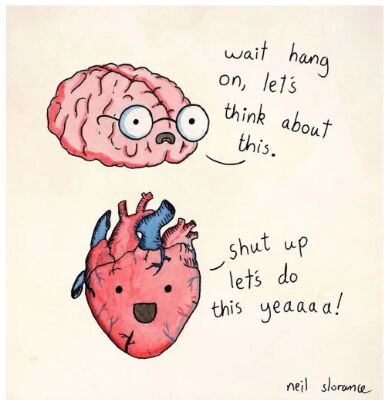
Noise is the silent killer of good decisions. We all know bias can make or break an outcome. But there’s another culprit we often overlook: noise. Noise is the unwanted variability in how different…
On my latest Substack, I sit down with Emily Falk and we talk about her new book: What We Value: The Neuroscience of Choice and Change I learned so much from this conversation about how to think what…

A new report released by The Burning Glass Institute, in collaboration with the Alliance for Decision Education, shows that 💥decision-making💥 is one of the most sought-after and economically valuabl…
I had a fantastic conversation with Paraag Marathe, Chairman of Leeds United Football Club and President of 49ers Enterprises & Executive Vice President of Football Operations for the San Francisco 49…
2.0 posts/week
Posts / Week
4 days
Days Between Posts
2
Total Posts Analyzed
MEDIUM
Posting Frequency
5%
Avg Engagement Rate
STABLE
Performance Trend
300
Avg Length (Words)
HIGH
Depth Level
ADVANCED
Expertise Level
9/10
Uniqueness Score
YES
Question Usage
0.5%
Response Rate
Writing style breakdown
Professional, polished, and educational with a clear expert authority.
Conversational rather than academic, but never sloppy or slangy (with the exception of an occasional emoji in celebratory posts).
Strongly informative and explanatory, with a subtle but consistent persuasive undercurrent leading toward calls-to-action (course, podcast, report).
Tone is direct, clear, and logical; not poetic or flowery.
Emphasis on clarity and cognitive precision (terms like “noise,” “bias,” “probabilistic thinking,” “process vs. outcome”).
Vocabulary is accessible and jargon is either familiar to a business/decision-making audience or briefly explained.
Grammar is clean and standard; intentional rule-breaking (fragments, sentence-initial “And”/“But”) is used as a stylistic device, not from sloppiness.
No slang like “gonna/wanna”; contractions are used (don’t, can’t, you’d) to keep the voice human and approachable.
Moderate energy: calm, confident, not hyped-up.
Posts focused on concepts (noise, process vs outcome) are reflective, analytic, and steady.
Promotional or celebratory posts (Black Friday, new report, podcast episodes) have slightly higher energy, sometimes boosted with exclamation marks and emojis, but still measured.
Emotional palette is primarily: curiosity, seriousness about quality decisions, optimism about learning.
Noise is the silent killer of good decisions.
Group discussions often make decisions worse, not better.
Outcome vs. Process
Rhetorical contrast (process vs outcome, intuition vs analysis, speed vs slowness).
Concept → example → takeaway pattern.
Occasional rhetorical questions to pivot into explanation or CTA.
Metaphors/analogies related to hiring, poker, leadership, or teams.
decision hygiene
Treat options like candidates.
Think in Bets
resulting
kill criteria
You’d want someone with longevity…
You wouldn’t make that choice based on a single shiny trait.
Your team will make better decisions as a result.
Sharing own experiences or interviews (“I loved talking to…”, “I sit down with Emily Falk…”).
Introducing the course: “I run a live, online course…”
We all know bias can make or break an outcome.
We have a responsibility to ensure…
Treat options like candidates.
Don’t let confidence and volume drive your team’s choices.
Judge the strength of your decisions by process, not outcomes.
Want to know what else is preventing you from making better decisions?
Curious to fix how your team makes decisions?
Give it a listen!” / “Listen now!
CTAs are direct but polite, often with verbs like “Join,” “Register,” “Click here,” “Listen now,” “Give it a listen.”
Sign in to unlock the full writing analysis
Free tools to help you write, score, and benchmark in the same style.
Other creators worth studying alongside Annie Duke.

Talia Wolf
CEO, Getuplift | Conversion Optimization Expert. Helping brands generate more leads, sales, and revenue through customer-first CRO, A/B testing, and emotional targeting. Keynote speaker & best selling author.
33 Viral Score

Neil Patel
Co-Founder at Neil Patel Digital
4 Viral Score

Theo Browne
YouTuber & CEO @ T3 Chat (YC W22)
206 Viral Score

Philip Joubert
Building Magic Safari ✨

Ben Desjardins
Fractional CMO | I make Marketing work so you don’t have to | Founder, Sure Shot Systems | Marketing Brains + Ad Muscle | Grill Cheese Virtuoso 🥪 | Collecting passport stamps 🌍
23 Viral Score

Marta Basso
Entrepreneur | Founder @ Brandplane | Lilli Gruber Wannabe, basically a TV | Likely on a train while you’re reading this | 30k limit reached - send a note or use the follow button
5 Viral Score
ViralBrain plans, writes, and schedules your LinkedIn content, using official LinkedIn APIs so your account stays safe.
Write like Annie Duke.