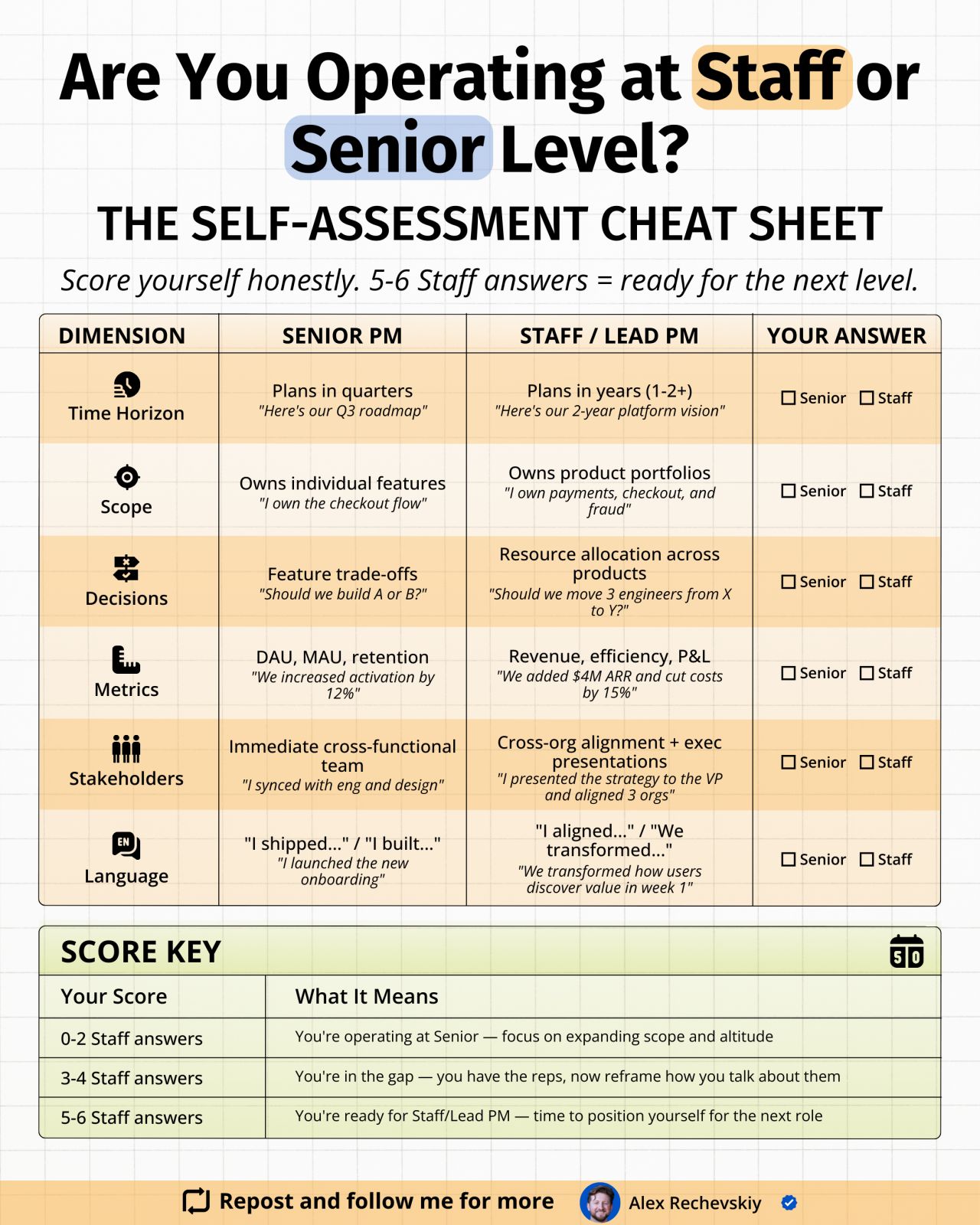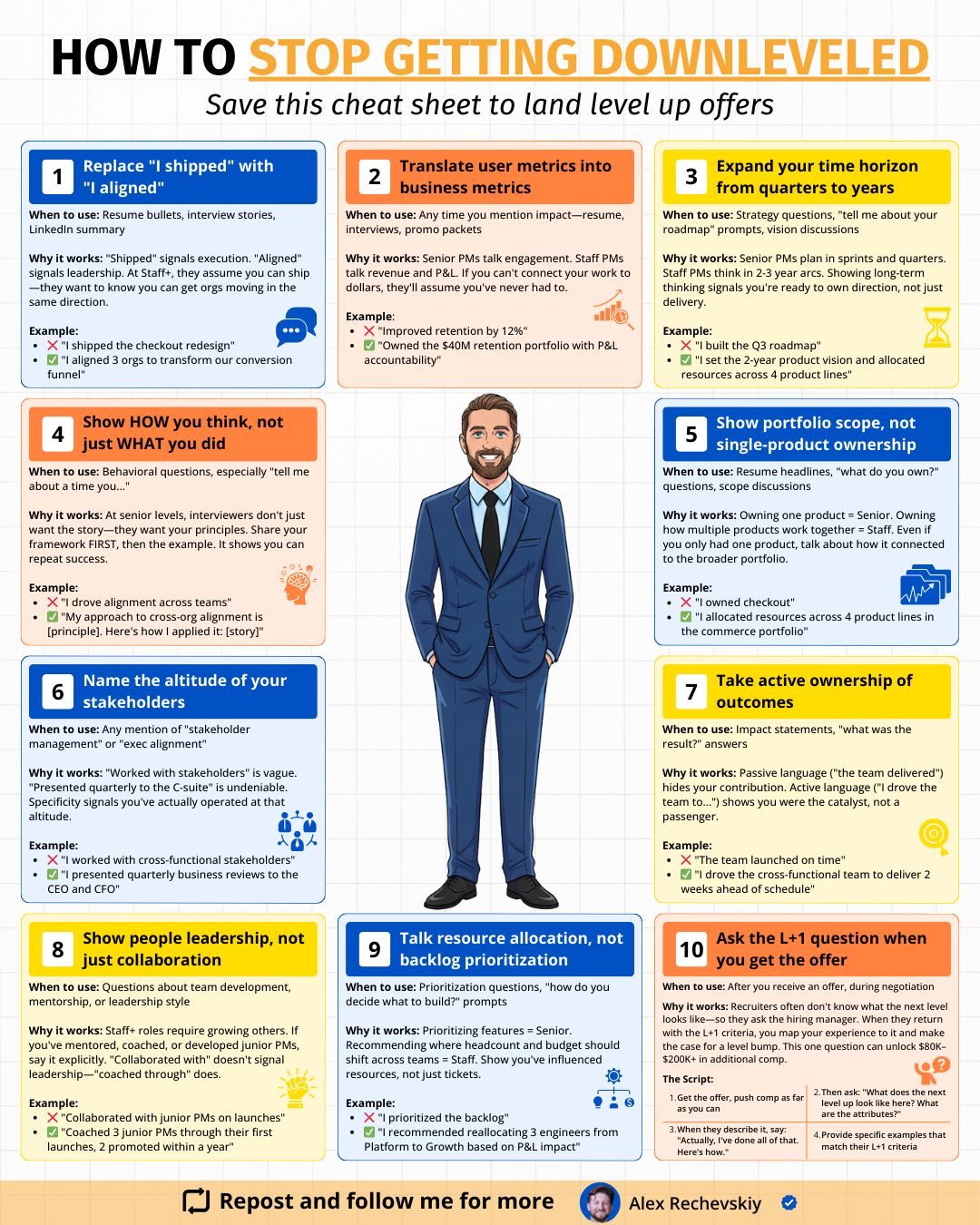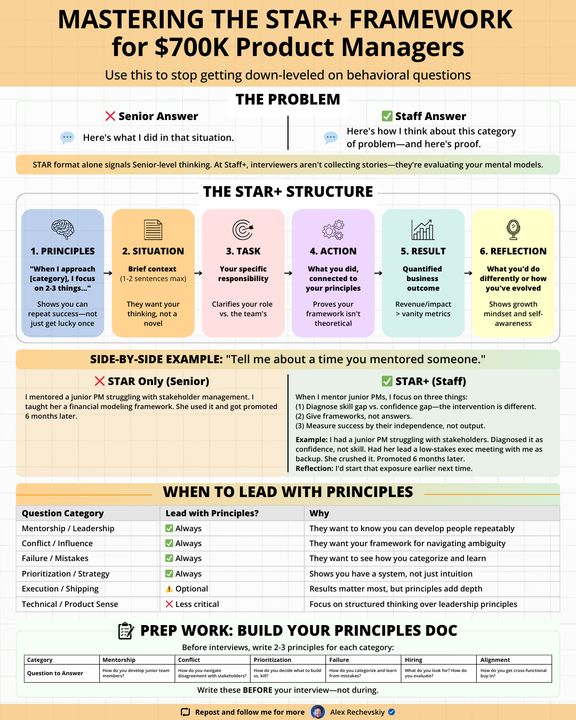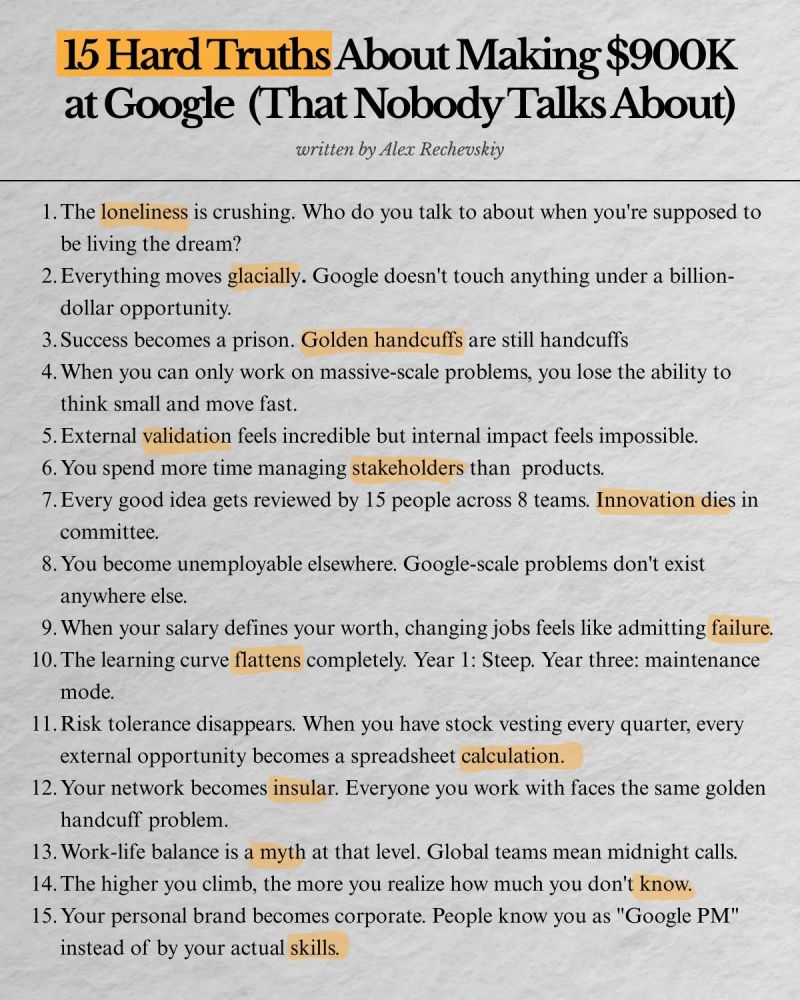
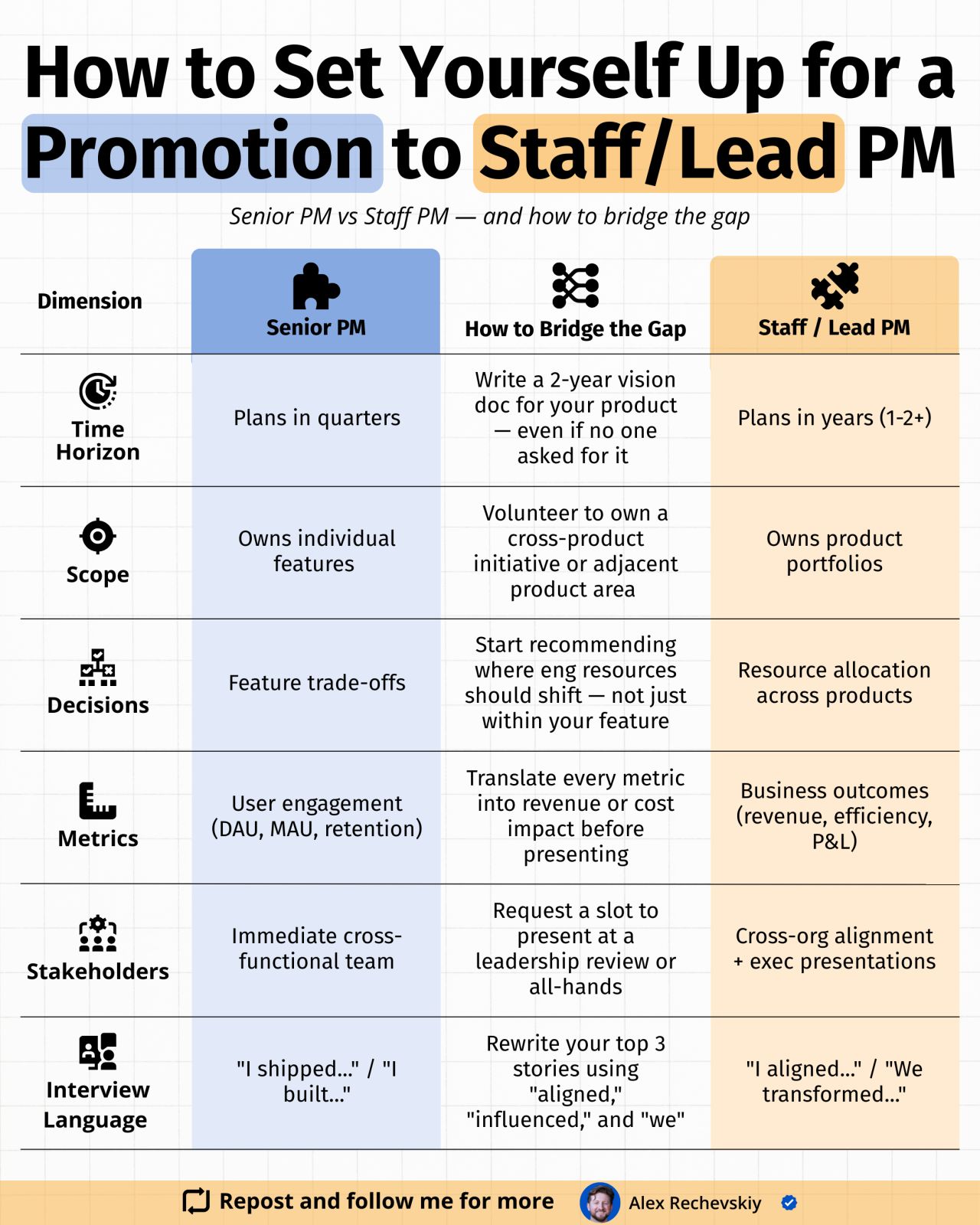
L5 vs L6: The complete breakdown. (Save this. You'll need it for your next promo cycle or interview.) After coaching hundreds of PMs through this transition, I've mapped exactly what separates these…

LinkedIn Content Strategy & Writing Style
I help PMs land $700K+ product roles 🚀 Follow for daily posts on growing your product skills & career 🛎️ Join our exclusive group coaching program for ambitious PMs 👇
1 person tracking this creator on Viral Brain
Alex Rechevskiy positions himself as the high-stakes career architect for elite Product Managers, leveraging his background as a former Google Group PM to demystify the path to $700K+ roles. His content strategy centers on the "language of leadership," moving beyond basic execution to teach PMs how to signal executive-level thinking through mental models and strategic framing. He is notable for his brutal transparency regarding "golden handcuffs" and the psychological isolation of high-comp roles, shifting the value proposition from mere job-seeking to long-term career intentionality. By blending tactical interview psychology with organizational navigation, Alex helps candidates transform from "likable" applicants into undeniable business leaders who command authority in the hiring committee room.
78.7K
5.7K
64
—
7.8
10
1
L5 vs L6: The complete breakdown. (Save this. You'll need it for your next promo cycle or interview.) After coaching hundreds of PMs through this transition, I've mapped exactly what separates these…

Are you actually operating at Staff level? Or just Senior with more years? Most Senior PMs think they're ready for the next level. But when I ask them these 6 questions, they realize they've been op…

"I'm starting to think I peaked at Senior." A PM told me this after rejection 5... 8 years of experience. Products used by millions. And a growing fear that maybe this was his ceiling. He wasn't un…

A PM was devastated. She nailed every answer but still lost the job to someone less qualified… 😬 So this PM came to me after losing a Group PM role she was perfect for. 10 years of experience. L…

I spent 4 years as a Group PM at Google. (Here's what they don't tell you about reaching the top): Four years as a Group PM at Google, making $900k. Stock options hitting all-time highs. Equity…

The L6→L7 jump isn't about doing more L6 work. (It's a fundamentally different job.) After 4 years as a Group PM at Google, I can tell you: most L6 PMs prepare for L7 interviews by showcasing better…
7.8 posts/week
Posts / Week
1 days
Days Between Posts
1
Total Posts Analyzed
HIGH
Posting Frequency
63.6%
Avg Engagement Rate
STABLE
Performance Trend
360
Avg Length (Words)
HIGH
Depth Level
ADVANCED
Expertise Level
0.78/10
Uniqueness Score
YES
Question Usage
0%
Response Rate
Writing style breakdown
<start of post>
You don’t fail interviews because you lack frameworks.
You fail because your thinking is invisible.
(A Staff PM learned this the hard way.)
A Staff PM came to me embarrassed.
He’d made it to final round twice in a row.
Great stories.
Great metrics.
Great delivery.
still got rejected.
Strong execution. Not enough senior judgment.
He told me, “I’m literally using STAR. What else do they want?”
They want to see how you make decisions.
Not just what you did.
Because at Staff+, your stories are table stakes.
Your judgment is the product.
They answer the question.
But they don’t reveal the model behind the answer.
→ “Good example”
→ “Clear communicator”
→ “Seems solid”
At Google, “leaning hire” is a polite no.
Strong hire. This person has exceptional judgment.
That only happens when you make your thinking quote-able.
1️⃣ Lead with your principle
↳ the rule you use when the situation is messy
2️⃣ Show the trade-off
↳ what you optimized for, and what you sacrificed
3️⃣ Prove it with a story (STAR)
↳ one example, tight timeline, clear result
4️⃣ End with evolution
↳ what you’d do differently now, and why
Notice what’s missing?
No extra storytelling.
No rambling context.
Just decision-quality.
Here’s how his answer changed.
I had a stakeholder conflict. I aligned everyone. We shipped.
When stakeholders disagree, I default to one principle: make the trade-off explicit in writing, then force a decision on what we’re willing to lose. I optimized for speed over consensus, because delay was the real risk. Here’s the situation…
See the difference?
One is a story.
The other is a decision engine with a story attached.
Why are you leaving?
Stop making it about your growth.
Make it about THEIR problem.
They’re listening for whether you can solve THEIR problem without needing perfect conditions.
He paused…
So I’m not failing the interview. I’m failing the notes.
Exactly.
Your interviewer is writing your future in bullet points.
Give them bullets they can defend.
He used the structure in his next loop.
Offer.
Staff. $520K.
Same experience.
Different structure.
P.S. Want the exact scripts for every ‘why are you leaving’ variation, plus the Staff-level behavioral frameworks?
👉 https://example.com/pm-blueprint
♻️ Repost to help a PM who keeps getting “not senior enough”
➕ Follow Alex Rechevskiy for more
<end of post>
Sign in to unlock the full writing analysis
Nail your LinkedIn strategy with ViralBrain.
Analyze and write in Alex Rechevskiy's style. Grow your LinkedIn to the next level.