
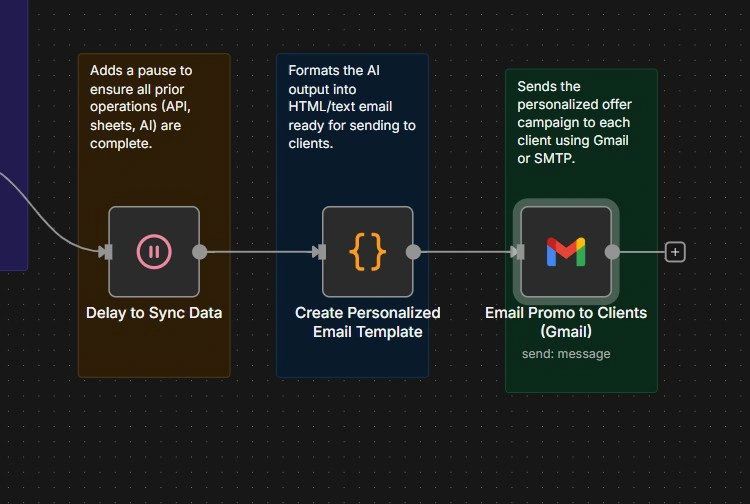
Most people think “automation” means complex AI, multi-agent systems, or futuristic workflows. But the biggest wins usually come from the tiny, ignored tasks. Yesterday I was reminded of that again.…
6048151 viral
Automation10 months ago

LinkedIn Content Strategy & Writing Style
I Build AI Agents That Work While You Sleep 😉
1 person tracking this creator on ViralBrain
Vishnu Gupta positions himself as a pragmatic architect of automation, moving the conversation away from AI hype toward functional, production-grade systems. His content strategy centers on the transition from "fragile experiments" to operational intelligence, frequently using n8n workflows and multi-agent orchestration to solve "boring" repetitive tasks. He is notable for his "system-first" philosophy, arguing that a model is only as good as the guardrails and failure handling designed around it. By intersecting technical system design with founder-level productivity, Vishnu transforms complex AI concepts into high-ROI business assets that work autonomously.
5.1K
2.3K
93
1.9
308
2
Most people think “automation” means complex AI, multi-agent systems, or futuristic workflows. But the biggest wins usually come from the tiny, ignored tasks. Yesterday I was reminded of that again.…
Most people are scared of falling. They think a stumble means they messed up. Wrong choice Wrong move Wrong timing But the more I build, the more I realise something simple: Every fall I’ve had pus…
The #1 Reason Your AI Agents Keep Failing to Scale It’s not the model. It’s the workflow. If your agents: – Break under load – Drift out of context – Or become unreliable in production... You’re no…
AI Voice isn’t “emerging” in 2026. It’s already the baseline. And most companies still haven’t caught up. Not because the technology is unclear… but because they still treat AI voice like a fun feat…
🚨 Most companies think they’ve “adopted AI.” But almost none have operationalized it. Everyone is rushing to plug models into their workflow… but if we’re being honest? Most AI projects never move…
🚨 The future isn’t “AI helping you code.” It’s AI coding the world in front of you. A leaked demo of what looks like Gemini 3.0 just dropped and it’s the clearest sign yet that we’re entering the po…
1.9 posts/week
Posts / Week
4 days
Days Between Posts
2
Total Posts Analyzed
MEDIUM
Posting Frequency
92.8%
Avg Engagement Rate
STABLE
Performance Trend
300
Avg Length (Words)
HIGH
Depth Level
ADVANCED
Expertise Level
8.5/10
Uniqueness Score
YES
Question Usage
0.9%
Response Rate
Writing style breakdown
Professional, conversational, and highly structured.
Tone is direct, clear, and confident, with a strong analytical and explanatory bent.
Persuasive and didactic: the writer is almost always teaching or reframing something.
Lightly motivational and reflective in some posts (especially on growth/falling), but grounded in practical, concrete examples.
Occasional dry humor and subtle sarcasm, but never over-the-top or goofy.
Professional in content (AI, automation, workflows, multi-agent systems, markets).
Casual in delivery (short sentences, rhetorical questions, conversational phrases, occasional slang like 'bro', emojis, and fragments).
Grammar is mostly correct but intentionally broken at times for rhythm, emphasis, and voice.
Highly structured and methodical at the macro level: clear hooks, clear transitions, clear lists, and clear conclusions.
Within that structure, micro-level phrasing feels conversational and spontaneous.
The style gives the impression of thinking out loud, but with deliberate control over pacing and emphasis.
Moderate to high energy.
Sentences are short and punchy, creating a fast-paced, scrolling-friendly rhythm.
Contrasts ('Most people think… They’re wrong.' / 'Not because X… but because Y.')
Repetition and parallelism.
Escalation toward a conclusion or CTA.
Posts about failure/growth are more reflective, but still concise and forward-driving.
Frequent rhetorical questions aimed directly at the reader.
'Most people think X. They’re wrong.'
'Not because X… but because Y.'
'They still fail. They still refuse. They still behave weirdly at the edges.'
'Progress isn’t clean. It’s messy. It’s awkward.'
'Less typing. More directing. Less boilerplate. More vision.'
Use of metaphors that are concrete and workmanlike (e.g., 'sharp junior', 'magic employee', 'fall forward', 'momentum in disguise'), not flowery or poetic.
'And here’s the truth most builders won’t tell you:'
'This is why…'
'That’s the fragile AI trap.'
'Hard'
'Fall forward'
'That’s it.'
'No fancy bullshit.'
'This isn’t theory it’s architecture.'
Heavy use of second-person 'you' and 'your' to involve the reader.
Mixed with first-person singular 'I' (sharing rules they live by or personal experiences) and first-person plural 'we' to signal a shared journey or industry-wide shift.
'Stop asking… Start asking…'
'Tell me one boring thing you do every week'
'Save this post for later'
'If you’re serious about… start fixing…'
'If you like honest, builder-style posts… follow me.'
Inclusive tone: the reader is treated as a builder, operator, or decision-maker, not a passive consumer.
Sign in to unlock the full writing analysis
Free tools to help you write, score, and benchmark in the same style.
Other creators worth studying alongside Vishnu Gupta.

Greg McKeown
2X NYTs Bestselling Author
2 Viral Score

Nozomi Michiki Morgan
Strategic Partner to Global Executives: Accelerating Innovation & Intercultural Agility for Future-Ready Leadership | CEO, Speaker, Organizational Transformation Expert
5 Viral Score

Dave Ulrich
Speaker, Author, Professor, Thought Partner on Human Capability (talent, leadership, organization, HR)
24 Viral Score

Nico Orie
VP People & Culture
31 Viral Score

Brunno Batista
Worldwide Brand Ambassador- Roofing Consultant, Roofer & Social Media Influencer in the Roofing Industry.
8 Viral Score

Alex Komoroske
CEO and Co-founder at Common Tools
65 Viral Score
ViralBrain plans, writes, and schedules your LinkedIn content, using official LinkedIn APIs so your account stays safe.
Write like Vishnu Gupta.