
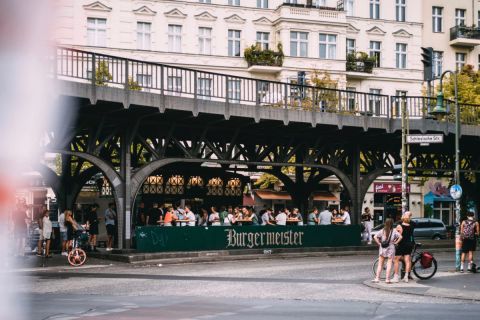
The most successful hospitality brands win by mastering the mundane. Berlin’s Burgermeister is one of the clearest examples. Zurich has been going through a burger wave. New brands appear every few m…

LinkedIn Content Strategy & Writing Style
Co-Founder of Mimo Hospitality I Building enduring hospitality concepts & brands with ambitious clients I Hotellerie Suisse trusted Consultant.
1 person tracking this creator on Viral Brain
Simon Bernhard positions himself as a strategic architect of the modern hospitality landscape, bridging the gap between operational discipline and urban placemaking. His content strategy centers on the "economy of hospitality," moving beyond aesthetic trends to dissect the structural viability of food halls, hybrid canteens, and delivery-first brands. He is notable for his ability to translate complex industry data into actionable insights, often using a "mundane as a moat" philosophy to champion systems over hype. By intersecting consulting transparency with urban development, Bernhard provides a sophisticated lens on how culinary concepts act as cultural anchors while remaining ruthlessly focused on the fiscal resilience required to survive in a shifting Swiss market.
2.4K
2.4K
35
—
1.0
182
1
The most successful hospitality brands win by mastering the mundane. Berlin’s Burgermeister is one of the clearest examples. Zurich has been going through a burger wave. New brands appear every few m…

It’s a cold Sunday in Zurich. The streets are quiet, the shops have been closed since Saturday evening, and most households are simply looking for dinner without heading back outside. This is one of t…

Mimo Hospitality ist ab sofort offizieller Unternehmenspartner von Placemaking Switzerland. In der Gastronomie wird noch immer erstaunlich häufig linear geplant: Eine Vision wird definiert, Architekt…
Food Halls haben in den letzten Jahren stark an Bedeutung gewonnen. Sie passen zu einer Zeit, in der Menschen Orte suchen, die unkompliziert funktionieren, Vielfalt bieten und gleichzeitig Atmosphäre…
Letzte Woche war ich beim Stammtisch von Placemaking Switzerland. Am Tisch sassen Architektinnen, Bauplaner, Quartiersentwickler und Vertreter von Wincasa. Eine Frage hat die Runde an meinem Tisch bes…
1.0 posts/week
Posts / Week
7.8 days
Days Between Posts
1
Total Posts Analyzed
LOW
Posting Frequency
34.5%
Avg Engagement Rate
STABLE
Performance Trend
300
Avg Length (Words)
HIGH
Depth Level
ADVANCED
Expertise Level
0.85/10
Uniqueness Score
YES
Question Usage
0.5%
Response Rate
Writing style breakdown
Predominantly professional, analytical and reflective.
Calm, confident, low-drama tone; neither hyped nor dry.
Clear focus on context, systems and structures (economics, urbanism, operations) rather than on personal feelings.
Stylistically polished; close to editorial/essay style rather than typical social media chatter.
Mix of German and English posts; both are high-level, with similar voice.
Overall formal–neutral, but not stiff.
In German: uses standard written registers with plenty of nominalisations (Tragfähigkeit, Nutzungsmuster, Rahmenbedingungen, Frequenz, Betriebsmodell).
In English: similarly mature, essay-like style; no slang, limited idioms, but conversational enough to feel human.
Very few colloquialisms. When present, they’re restrained (e.g. ‘cool position. cool team.’).
Medium energy, steady pace. Not breathless, not slow.
Emotion is mostly channelled into clarity and precision, not drama.
Moments of emphasis come through short, punchy lines rather than exclamation marks or emotional language.
Understatement is preferred to exaggeration. Example: ‘Cool position. Cool team.’ as a minimalistic endorsement.
Contrast (Effizienz vs. Erlebnis; Nähe vs. Effizienz; Erlebnis vs. Tragfähigkeit).
Framing sentences that summarise an observation into one clear line (‘The restaurants make the food, but the platform frames the decision.’).
Aphoristic closing sequences (‘The mundane is not the enemy. The mundane is the moat.’).
Introduce a phenomenon, then zoom into a specific example, then zoom out to a systemic takeaway.
Use of statistics or clear numbers to underline fragility or scale.
Quietly critical analysis (e.g. of buzzwords, platforms, superficial branding) without polemics or ranting.
‘Was tun mit Kantinen, die durch hybride Arbeitsmodelle kaum noch genutzt werden?’
Metaphors are sparse but carefully chosen (e.g. ‘The mundane is the moat.’ ‘kleine urbane Markenwelten.’).
Direct audience engagement is limited and subtle. The tone is more ‘let me lay this out’ than ‘let me talk to you personally.’
Dominant person: third person and first person singular/plural.
Third person for describing sectors and systems: ‘Die Gastronomie steht unter Druck.’
First person singular for personal observations: ‘Für mich wurde das erstmals in Berlin greifbar.’
First person plural ‘wir’ when speaking for the company or a team: ‘Letzte Woche haben wir bei MIMO unsere neue Serie … gestartet.’
Second person ‘du/Sie/you’ is rare. The writer almost never lectures the reader directly.
‘Mehr dazu: [Link]’
‘Im Slider zeigen wir fünf Beispiele…’
‘Untenstehend unser Einführungsartikel…’
‘Mehr denn je gilt es, das richtige Betriebsmodell zu finden…’ rather than ‘Du musst das richtige Modell finden…’
Sign in to unlock the full writing analysis
Nail your LinkedIn strategy with ViralBrain.
Analyze and write in Simon Bernhard's style. Grow your LinkedIn to the next level.