
The wealthy don't buy life insurance for protection. They buy it for leverage. Borrow at 5–7%. Target 10–13%. Keep the spread. Most people see life insurance as protection. Sophisticated invest…

612337 viral
Investing10 months ago
LinkedIn Content Strategy & Writing Style
Founder @ Fully Funded | Vetted Alternative Investments for RIAs, Family Offices, Fund Managers & HNWI | $250k–$100M+ Allocations
2 people tracking this creator on ViralBrain
Sam Silverman positions himself as a high-level capital strategist and private markets architect who bridges the gap between sophisticated operators and institutional-grade investors. His content strategy centers on the "Mechanics of Money," where he deconstructs complex fund structures, tax-efficient leverage, and the brutal reality of cash flow over vanity metrics like AUM. He is notable for his radical transparency, frequently "roasting" his own debt-heavy portfolio and exposing the misaligned incentives of fee-driven fund managers to educate his audience on asymmetric upside. By blending high-finance consulting with a philosophy of lifestyle preservation, Silverman creates a unique intersection where technical fund structuring meets the human element of building businesses with people you actually trust.
24.5K
20.6K
50
7.8
29
1
The wealthy don't buy life insurance for protection. They buy it for leverage. Borrow at 5–7%. Target 10–13%. Keep the spread. Most people see life insurance as protection. Sophisticated invest…
The 21-year-old broke kid has something the $50k/month doctor doesn't: Options. Here's the math nobody talks about. That young person just out of college? Their monthly burn is maybe $2-3k. They ca…
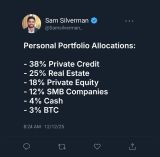
Here's my personal portfolio breakdown. Roast it. Every dollar should have a job - cash flow, tax efficiency, growth, stability, or asymmetric upside. Here's how I think about mine today: - 38% Pri…
One of the hardest conversations in business: "You're capable of both roles... just not at the same time." There's a fork every strong salesperson eventually hits: → Head of Sales - you build the t…
Kudo Income Fund update Another month. Another full distribution. Up to 16% annually, paid like clockwork. - 14 states - Dozens of fundings - 100+ positions by end of Q1 No single deal concentrat…

Every operator needs a share class for larger checks. If you don't have one, you are leaving money on the table. Here's why: If you don’t build an economic class of shares for $500K–$2M+ checks, yo…
7.8 posts/week
Posts / Week
1 days
Days Between Posts
1
Total Posts Analyzed
HIGH
Posting Frequency
50%
Avg Engagement Rate
STABLE
Performance Trend
250
Avg Length (Words)
HIGH
Depth Level
ADVANCED
Expertise Level
8/10
Uniqueness Score
YES
Question Usage
0.6%
Response Rate
Writing style breakdown
Professional, highly informative, and pragmatic.
Conversational but not casual-sloppy. It feels like a sharp operator talking to peers, not a guru talking down.
Direct, grounded, and very clear. Almost no fluff or poetic language.
Persuasive through clarity and structure, not hype. He sells by explaining mechanics, not by exaggerating.
Tone is confident and calm; it signals "I know how this works" without bragging.
Medium-to-high energy, but controlled. Posts are fast to read, with punchy lines and quick idea shifts.
Not hyperactive. The pacing feels measured, like a well-structured talk rather than a rant.
Emotionally, the voice is steady and rational even when the content challenges common beliefs.
Frequent use of contrast and inversion: "Most people think X. The best ones do Y." / "Some people want excitement... I want my excitement somewhere else."
Regular use of "here's" framings: "Here's how I think about mine today:", "Here's the basic idea:", "Here's why:", "Here's the point:".
No public equities.
AUM doesn't pay your bills
Cash flow does
Business is hard enough. Why spend it with people who drain you?
What would you change?
Direct audience engagement with light commands: "Share this with someone who needs to read this.", "Drop your best sales story in the comments below."
First-person used to share personal portfolio, observations, or credibility: "Here's how I think about mine today:", "A friend of mine went the enterprise route..."
Second-person used to guide and challenge the reader: "If you want the option to build something of your own someday, guard that gap...", "Every operator needs a share class for larger checks."
Third-person is used primarily in anecdotes about "a friend", "a close friend", "another friend", "the doctor", "the 21-year-old broke kid".
Commands are generally firm but not aggressive: "Know which one you want. Then make sure your company knows too." / "Optimize for the dollars that actually hit your account...".
Suggestions are framed as guidance, not pleas; there is almost no hedging language ("maybe", "sort of", "kind of").
Sign in to unlock the full writing analysis
Free tools to help you write, score, and benchmark in the same style.
Other creators worth studying alongside Sam Silverman.

Bjion Henry
I help agencies/consultancies grow without extra hires • AI Expert for Inbound/Outbound Sales • Ex-Google
64 Viral Score
Dan Hockenmaier
CSO at Faire; danhock.com
82 Viral Score

Lenny Rachitsky
Deeply researched product, growth, and career advice
22 Viral Score

Tim Yakubson 🚀
I teach & implement Clay, Claude Code & n8n ✨ | Clay Expert (London-based) | Founder @ B2B Boosted
44 Viral Score

Paolo Trivellato
Agencies & SaaS: Add $15,000-$50,000 MRR in 90 days with a LinkedIn Inbound Funnel
85 Viral Score

Matt Gray
Founder & CEO, Founder OS | Proven systems to grow a profitable audience with organic content.
20 Viral Score
ViralBrain plans, writes, and schedules your LinkedIn content, using official LinkedIn APIs so your account stays safe.
Write like Sam Silverman.