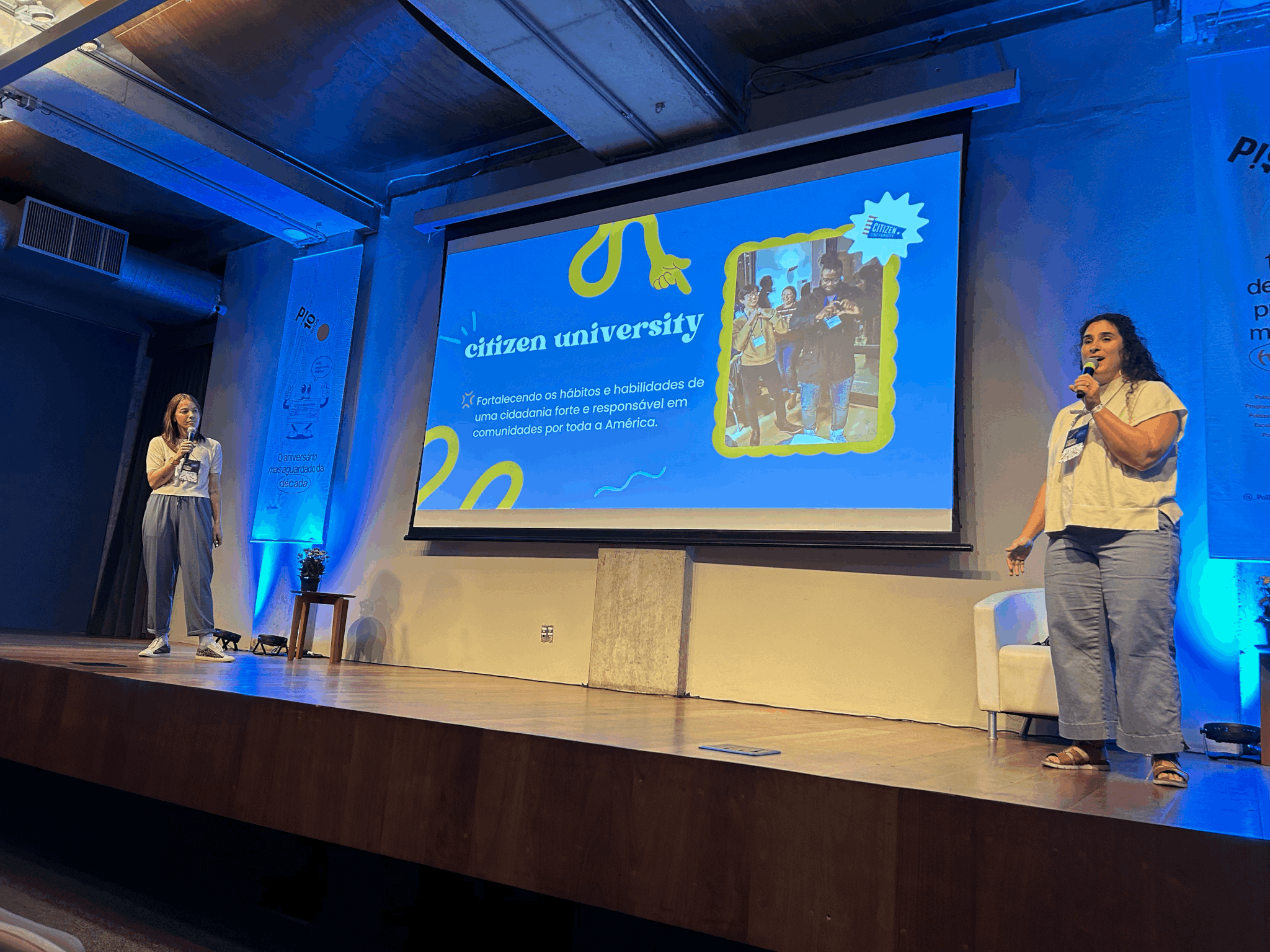
Throughout the last few years I’ve emphasized to my teammates at Citizen University that we must not let everything in civic life get nationalized — that we must help our network of CU catalysts pract…
LinkedIn Content Strategy & Writing Style
CEO & Co-founder at Citizen University
1 person tracking this creator on Viral Brain
Eric Liu positions himself as a civic architect and cultural diplomat, moving beyond traditional political commentary to focus on the underlying "habits of heart and mind" required for a functioning democracy. His content strategy centers on a global-to-local narrative of civic renewal through ritual, where he uses high-level platforms like TED and the American Academy of Arts and Sciences to amplify grassroots stories from places like Flint, Michigan, and São Paulo, Brazil. What makes Liu notable is his refusal to nationalize or partisanize the civic crisis; instead, he offers a value proposition rooted in "civic joy" and the practical application of power. By blending institutional leadership with emotional transparency, he frames democratic participation not as a chore of governance, but as a creative, relational practice that sustains human hope in turbulent times.
2.8K
1.7K
115
—
0.8
421
1
Throughout the last few years I’ve emphasized to my teammates at Citizen University that we must not let everything in civic life get nationalized — that we must help our network of CU catalysts pract…
We are hiring for a Communications Director at Citizen University to succeed Natalie Valentine, who raised our game substantially over the last many years and is now off on new adventures. Looking for…
My late wife Jená Cane, the co-founder of Citizen University, was the epitome of the citizen artist. She brought deep civic intention to her work as a theater artist. And she brought a deep attunement…
I’m sometimes asked how I maintain hope during these challenging times. Let me describe my last two weeks to give you a sense of my answer. In Seattle, my Citizen University teammates and I welcomed…

Last week my Citizen University teammates Zoey Cane Belyea and Talya Gillman and I traveled to São Paolo, Brazil for the second of four global learning exchanges CU is doing this year and next. We wer…

0.8 posts/week
Posts / Week
10.3 days
Days Between Posts
1
Total Posts Analyzed
LOW
Posting Frequency
0%
Avg Engagement Rate
STABLE
Performance Trend
230
Avg Length (Words)
HIGH
Depth Level
ADVANCED
Expertise Level
9/10
Uniqueness Score
YES
Question Usage
0.5%
Response Rate
Writing style breakdown
The style is warm, thoughtful, and civically-minded: a blend of professional, reflective, and conversational.
It is highly informative and observational, with a consistent normative layer (what we should do, what matters, why this is important).
It feels methodical and structured rather than free-associative, even when describing travel or multiple events.
The voice is earnest and sincere, not ironic or sarcastic. There is essentially no snark.
It is quietly persuasive rather than salesy: the writer nudges the reader toward certain values (democracy, civic culture, empathy, perseverance) more than toward transactions.
Emotional tone: calm, serious, hopeful, often tender.
Energy: medium. The posts are not high-octane or breathless; they move at a steady, measured pace.
There is a strong undercurrent of moral seriousness, but it is tempered by gratitude, admiration for others, and practical hope.
Pain, conflict, and polarization are acknowledged directly, but the emotional landing is usually on recommitment and possibility rather than despair.
Enumerations of places, people, and events to show breadth of engagement.
Conceptual reframing (e.g., turning specific visits or events into general lessons about civic culture, democracy, or human behavior).
Pairs of opposites: build/destroy, heal/scorn, progress/backlash, presence/absence, live/die.
Named individuals and organizations, with brief contextual descriptions of who they are and why they matter.
Rhetorical questions are rare but used for setup (e.g., “I’m sometimes asked how I maintain hope…”).
Metaphors are minimal and modest when present (e.g., “bottle their can-do civic spirit”), favoring clear, literal description.
Storytelling is used mostly as anchored vignettes: where he went, who he met, what they did, and what it means.
Repetition is used for emphasis and rhythm, especially with sentence openings (“A kind of pain…”, “There are ways…”, “We can and must…”).
First person singular “I” is common for describing experience and reflection.
Organizational: “we at Citizen University”.
Civic/moral community: “we must…” (citizens in general).
Second person “you” appears mainly near the end of posts to draw the reader in (“You don’t have to travel like I do… I think you are one of them.”).
Commands are mostly invitational (“Go see it, go experience it”, “Join me”, “Apply here”).
Prescriptive statements for values are more declarative than imperative (“We must fortify those habits everywhere we can.”).
Soft suggestions appear as reflections the reader is meant to share, not instructions (“You don’t have to travel like I do to find such people.”).
Sound like a civic educator and community builder who is widely traveled, deeply relational, and morally grounded.
Be earnest, respectful, and humble but confident in your convictions.
Use “we” and “our” to invite the reader into a shared civic project, not as a marketing “we”.
Avoid sarcasm, edginess, or flippant humor; levity appears mainly through light asides and appreciation, not jokes.
Sign in to unlock the full writing analysis
Nail your LinkedIn strategy with ViralBrain.
Analyze and write in Eric Liu's style. Grow your LinkedIn to the next level.