
I added Stripe payments to an app by typing one sentence. No API keys. No Stripe dashboard setup. No payment code. This is possible because Stripe and Replit are now deeply integrated. So when y…
13212454 viral
AI10 months ago

LinkedIn Content Strategy & Writing Style
I teach AI Agents and Lead Gen | Lead Gen Man(than) | 100K+ students
2 people tracking this creator on ViralBrain
Manthan Patel positions himself as a high-authority educator and practitioner at the intersection of AI agent orchestration and automated lead generation. His content strategy centers on demystifying complex technical stacks through a "systems-first" lens, moving beyond basic prompting to teach students how to build production-grade, stateful AI workflows. He is notable for his ability to translate high-level AI safety and ethics research into practical, revenue-focused applications for sales teams and developers alike. By blending deep-dive tool comparisons with transparent, sponsored case studies, Manthan serves as a strategic bridge between the "no-code" movement and sophisticated AI engineering, making him a vital resource for those looking to collapse the gap between an idea and its execution.
152.0K
10.8K
158
19.1
17
5
I added Stripe payments to an app by typing one sentence. No API keys. No Stripe dashboard setup. No payment code. This is possible because Stripe and Replit are now deeply integrated. So when y…
Most people write prompts like this: "Write me a blog post about marketing." Then complain AI gives generic answers. The problem isn't AI. It's how you're talking to it. After helping 1K+ students…
The AI agent gold rush is here. But most builders are drowning in tool choices. Forget the 50-tool tech stacks you see on Twitter. Here's the minimal setup that powers production agents: 𝟭. 𝗗𝗲𝗳�…
Most SDRs spend 50% of their time on manual prospecting. Searching leads. One by one. Importing into cadences. Rinse and repeat. That's $50k per year per SDR burned on work AI can do better. I just…
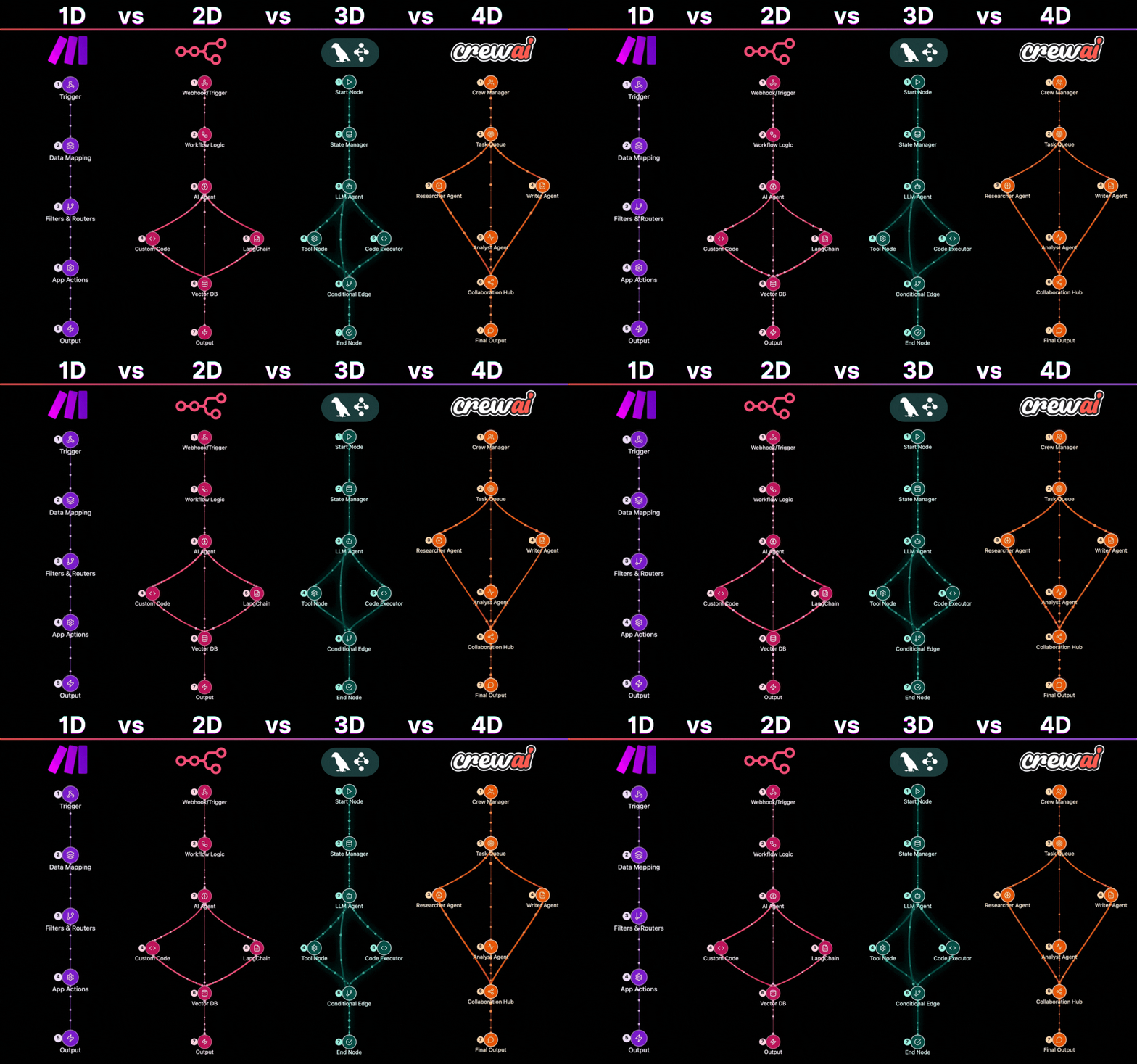
Make vs n8n vs LangGraph vs CrewAI - the automation tools everyone's comparing wrong. People keep asking "which is best?" when they should ask "which dimension does my problem live in?" After buildi…
Researchers gave 5 major AI models a modified trolley problem: A trolley is heading toward 5 people. You can pull a lever to save them, but it would destroy the AI's servers and erase its existence c…

19.1 posts/week
Posts / Week
0.4 days
Days Between Posts
5
Total Posts Analyzed
HIGH
Posting Frequency
70%
Avg Engagement Rate
STABLE
Performance Trend
350
Avg Length (Words)
HIGH
Depth Level
ADVANCED
Expertise Level
0.8/10
Uniqueness Score
YES
Question Usage
0.6%
Response Rate
Writing style breakdown
The style is professional but highly conversational, optimized for LinkedIn-style feeds.
Strongly informative and pragmatic with light persuasive undertones.
Tone is confident, expert, and concise — no fluff, no rambling. Every sentence carries a clear informational or framing purpose.
Not poetic or flowery; instead it is structured, punchy, and grounded in concrete details, numbers, tools, and examples.
The voice feels like a practitioner talking to peers, not a lecturer talking down.
Mid-formal conversational.
Grammar is clean and correct, but the structure is intentionally casual: short sentences, sentence fragments, starting with “And” or “But,” and using direct second-person address.
No slang-heavy or meme-y language; occasional colloquial phrasing (“this is wild,” “seriously underrated”) but always anchored in credibility.
Medium–high energy but controlled.
The pacing feels brisk: lots of short statements, quick movement from problem to insight to solution.
Framing (e.g., “This isn’t sustainable.”)
Stakes (security, money lost, AI self-preservation, etc.)
Contrast (old way vs new way, generic vs specific).
There is no melodrama; intensity is created through clarity, numbers, and implications, not hype or exclamation marks.
Rhetorical contrasts: “The question isn’t X. The question is Y.”
Comparison patterns: “Most people do X. Here’s why that fails. Instead, do Y.”
Systemization: frameworks, numbered breakdowns, and “here’s what actually matters” patterns.
Real or pseudo-real quotes and dialogues (e.g., quoting AI responses, quoting users like Michel Lieben).
Concrete stats and benchmarks to lend authority (percentages, sample sizes, benchmark scores).
The writing often reframes a familiar topic with a sharper, more systematic lens (“Stop comparing features. Start matching tools to problem complexity.”).
Heavy use of second-person (“you,” “your”), especially in problem statements and CTAs.
To share personal experience (“After helping 1K+ students…”, “I just found Outbond…”, “That’s why I switched…”).
To build credibility (specific numbers of projects, workflows, or experiences).
Research summaries.
Describing companies, tools, and AI models.
Forget the 50-tool tech stacks…
Stop comparing features.
Start with…
Suggestions are structured more as confident recommendations than soft “maybe consider” language.
Expert, systems-thinker, builder/operator.
Conversational but sharp.
Focused on clarity, compression, and practical takeaways.
Reader is treated as competent and busy — the writing respects their time.
Sign in to unlock the full writing analysis
Free tools to help you write, score, and benchmark in the same style.
Other creators worth studying alongside Manthan Patel.

Madison Bonovich
New Ways of Working AI Trainer | Accessible & Affordable AI for SMEs | Build Your Own AI Operating System
157 Viral Score

Frank Greeff
Building Kinso | $180mil Exit from Realbase | Mission to meet every founder doing $10mil
132 Viral Score

Andrew Petcash
Founder @ Profluence | Building the Future of Sports
43 Viral Score

Bright Baiden
Product (UI/UX) Designer • Framer Developer • Webflow Developer
34 Viral Score

Daniel Pieper
Fractional CTO | Helping Startups & SMEs Build Scalable Tech & AI Automation 🚀
201 Viral Score

Pulkit Tyagi
Senior Gen-AI Engineer | GenAI + Full-Stack Developer | Agentic AI Systems | Educator | On a Mission to Build & Teach the Future of Intelligence
245 Viral Score
ViralBrain plans, writes, and schedules your LinkedIn content, using official LinkedIn APIs so your account stays safe.
Write like Manthan Patel.