

LinkedIn Personal Brand vs Company Page: Which Wins in 2026?
LinkedIn personal brand vs company page in 2026: personal wins 3.85% vs 2.10% engagement. See the full head-to-head, scorecard, and hybrid playbook.
If you only have time to feed one LinkedIn account in 2026, feed the personal profile. Across the public data we have and the 30,360 posts in our own dataset, personal profiles out-engage company pages by roughly 1.8x and pull a level of trust no logo can replicate. Company pages still earn their keep for multi-author scale, paid amplification, and brand continuity, but as the front door for reach and pipeline, they are a distant second.
The linkedin personal brand vs company page question is not abstract. It is a weekly decision for founders, marketing leads, and B2B execs choosing where the next post goes. Picking wrong is expensive: the same 800-word piece can pull 80,000 impressions from a personal profile and 4,000 from a company page running the same audience.
This article gives you the head-to-head data, the underrated tradeoffs (founder departure risk, voice authenticity, scalability), and a hybrid playbook that uses both surfaces without doubling your workload.
Automate your LinkedIn for 30 days
Quick verdict
Personal profiles win on engagement, algorithmic reach, trust, and lead-gen depth. Company pages win on multi-author scalability, brand continuity if the founder leaves, and paid-ad infrastructure. For most founders and operators in 2026, the right answer is 80% personal-led, 20% company-page amplification, not a binary choice.
If you are an early-stage founder or solo operator, the math is unambiguous. Build the personal brand first, attach the company page as a secondary surface, and only invest in dedicated company-page content once you have multiple employees willing to post.
At-a-glance comparison
The scorecard below summarizes the head-to-head across the eight dimensions that actually drive ROI on LinkedIn time. Numbers are sourced where available, qualitative where the signal is harder to quantify.
| Dimension | Personal profile | Company page | Winner |
|---|---|---|---|
| Avg engagement rate (2026) | 3.85% | 2.10% | Personal |
| Algorithmic reach | Favored by 2026 interest graph | Down-weighted in feed ranking | Personal |
| Trust signal | High (face + voice + history) | Medium (institutional, less human) | Personal |
| Lead-gen depth | DMs work, conversational, fast | DM access blocked, slow | Personal |
| Scalability across team | Single voice, owner-bound | Multi-author, employee advocacy | Company |
| Founder-departure risk | Brand leaves with the person | Brand stays with the company | Company |
| Content velocity | Capped by one human | Multiple authors, agency posting | Company |
| Analytics depth (native) | Limited (impressions, basic eng) | Richer page analytics, demographics | Company |
Personal wins 4 of 8. Company wins 4 of 8. The asymmetry is in which four: personal owns every dimension that touches reach, trust, and conversion. Company owns every dimension that touches operations and continuity. That split is the entire strategic story.
The engagement gap (the headline number)
The cleanest data point in this debate: Socialinsider's 2026 benchmark study put personal-profile average engagement at 3.85% and company-page average engagement at 2.10%. Personal profiles see roughly 1.83x more engagement per post on average, and the gap has widened every year since 2023.
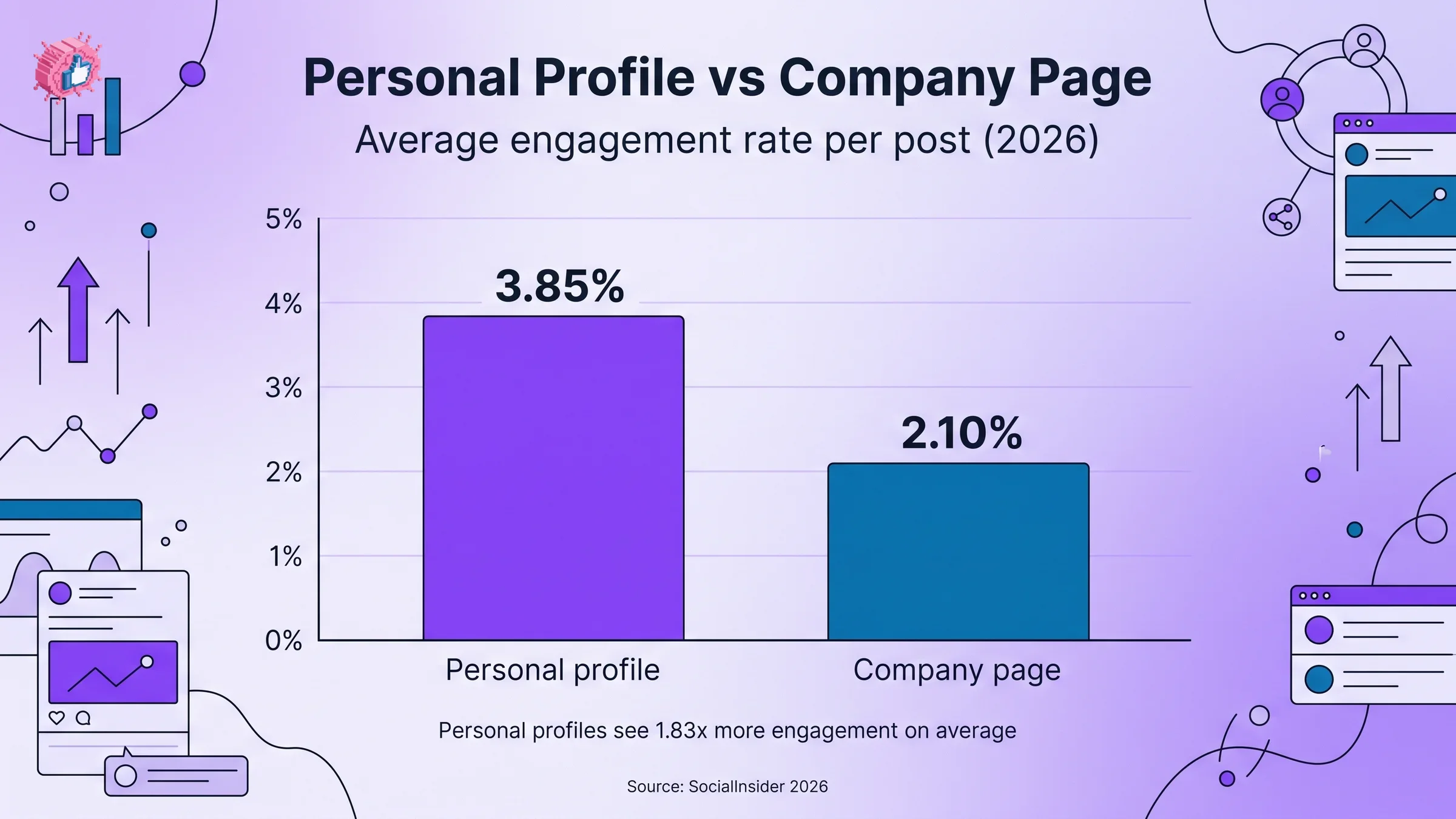
A few things to understand about that gap before you act on it.
The 3.85% figure is the median, not the ceiling. In our analytics dataset of 30,360 LinkedIn posts across 968 active hero creators, the top tier (HIGH and EXCEPTIONAL combined) hits 12.5% of all personal-profile posts and routinely lands above 6% engagement. The 3.85% line is the average creator. The top creators run 2 to 7 times higher. See the full tier breakdown in our LinkedIn engagement benchmarks guide.
Company-page engagement is structurally capped. Even an extremely well-run company page rarely clears 4% engagement consistently, because the algorithm itself caps how much reach a company-page post gets before it has to "earn" more through comment velocity. Personal posts get a generous first-3-hour reach push. Company-page posts do not.
The gap is widening, not closing. Socialinsider tracked roughly 1.4x gap in 2024 and 1.83x in 2026. The trend is on personal-brand's side, and there is no signal from LinkedIn that this is about to reverse.
Why the gap exists
Three structural reasons drive the engagement asymmetry.
- Algorithm preference. LinkedIn's 2026 ranking model shifted from a social-graph to an interest-graph approach. Personal profiles map cleanly to interest graphs (one human, consistent topics, identifiable voice). Company pages broadcast across many interests, which the algorithm reads as low-relevance.
- Trust gradient. A face on a post outperforms a logo on a post. Users reflexively trust other humans more than institutional voices. Comments on a personal post feel like dialogue; comments on a brand page feel like marketing.
- Conversational reciprocity. Personal-profile authors reply to comments and the algorithm rewards the resulting back-and-forth with more reach. Company pages rarely reply with the same speed or warmth, so the comment thread dies faster.
If you want a deeper read on how the 2026 ranking model treats each surface, our LinkedIn algorithm 2026 deep-dive breaks down dwell time, the 3-hour momentum window, and the comment-velocity weights.
Algorithm treatment: what LinkedIn actually does to each surface
The 2026 LinkedIn algorithm treats personal profiles and company pages as fundamentally different content sources. Understanding the difference is the foundation of every other decision in this article.
Personal-profile posts get a momentum window. When you publish from a personal profile, LinkedIn distributes the post to a sample of your followers and second-degree connections in the first 60 to 90 minutes. If the post hits a threshold of qualified engagement (comments outweigh likes, dwell time is high), the algorithm extends reach to a wider audience in the 3 to 8 hour window after posting. This is where viral posts actually take off. See our full breakdown of the LinkedIn algorithm 2026 for the signal weights.
Company-page posts get a capped initial push. LinkedIn explicitly limits how much organic reach a company-page post gets out of the gate. The momentum-window mechanic still exists, but the ceiling is lower, the algorithm is more reluctant to push the post to non-followers, and a company-page post almost never goes viral organically without paid amplification.
Comment-velocity weights are the same, but the denominator is not. Both surfaces benefit from comments, but personal posts start with more first-hour reach to convert into comments. Company pages start from a smaller pool, so the absolute number of comments needed to trigger broader distribution is harder to reach.
Hashtags work on both, but neither is decisive. This is a common myth. Hashtags barely move reach on either surface in 2026 (the algorithm leans on topic detection from the post body itself). Use 2 to 3 if they feel natural. Skip them if they do not.
For the full how-to on writing posts that survive the momentum window, see our guide on how to write a LinkedIn post that gets noticed.
Lead-gen and conversion depth (the underrated personal advantage)
If your reason for being on LinkedIn is pipeline, this section is the one that matters most. Personal profiles unlock one specific feature that company pages structurally cannot: direct messages.
Here is the asymmetry.
- A prospect who engages with a personal-profile post can DM the author within one click. The reply lands in a real human's inbox. Response times average minutes to hours, not days.
- A prospect who engages with a company-page post cannot DM the page. Company pages do not have inboxes in the same way. The conversion path is forced through a website form, a "contact us" link, or LinkedIn's clunky page-message feature that most prospects never find.
For B2B sales cycles, this is decisive. Roughly 70% of LinkedIn-sourced pipeline (in the founder-led-sales motion that defines most of 2026 B2B) starts with a comment thread or DM exchange on a personal profile, not a click-through from a company page. The personal profile is not just a content surface, it is a two-way sales channel. The company page is a one-way broadcaster.
Three downstream effects of this asymmetry:
- Sales velocity is faster from personal profiles. Conversations start in DMs the same day a post lands, not after a form-fill nurture sequence.
- Inbound demos compound. A founder who posts consistently for 12 months and replies in DMs typically books 3 to 5 inbound demos per week from LinkedIn alone.
- Comment threads do double duty. A great comment thread on a personal post is both social proof for the next reader and an open door for the prospect commenting. Company-page threads rarely create either.
For founders ready to systematize this, our viral post generator is trained on the personal-profile patterns that consistently land in the top engagement tiers, and our viral score checker predicts whether a draft will hit the momentum-window threshold before you publish.
Automate your LinkedIn for 30 days
The case FOR a company page (let's be honest)
The contrarian case for the company page is real and worth taking seriously, even though the engagement math points the other way. Three scenarios where the company page is genuinely the right surface.
Multi-author scalability. If you have a team of 5+ employees willing to publish on behalf of the brand, the company page becomes the natural hub. Coordinating five personal profiles around a shared content calendar is operationally painful. A company page lets multiple authors push to a single surface without requiring each person to maintain a personal-brand discipline.
Brand continuity if the founder leaves. Personal brands walk out the door with the person. If your founder builds a 100,000-follower personal brand and then leaves (sells the company, joins a board, retires), the brand audience leaves with them. A company page protects the brand-equity investment across founder transitions, acquisitions, and leadership churn. For mature companies, this is non-trivial.
Employee-advocacy and amplification infrastructure. Company pages plug into LinkedIn's employee-notification system. When you publish from the page, employees get a one-click "share to your network" prompt. Done well, this turns 50 employees into a 50-amplifier network on every post. Done poorly, it produces robotic copy-paste shares that nobody reads.
Paid-ad infrastructure. LinkedIn Ads requires a company page. If paid amplification is part of your distribution strategy (Sponsored Content, Message Ads, Conversation Ads), you need a page regardless of organic engagement rates. Many B2B teams use the page as the paid surface and personal profiles as the organic surface, which is a defensible split.
Richer native analytics. Page analytics expose visitor demographics, follower demographics, and competitor benchmarks that personal-profile analytics do not. If you are reporting LinkedIn performance to a board or a CEO, page-level data is easier to package.
The honest read: a company page is worth maintaining for continuity, scale, and paid infrastructure, not for organic reach. Treat it as a complement to personal-led content, never as the primary engine.
The tradeoff matrix (where each surface wins)
Below is the head-to-head broken down by what actually drives the decision. Use this as the scorecard when you are deciding where to invest the next hour of content time.
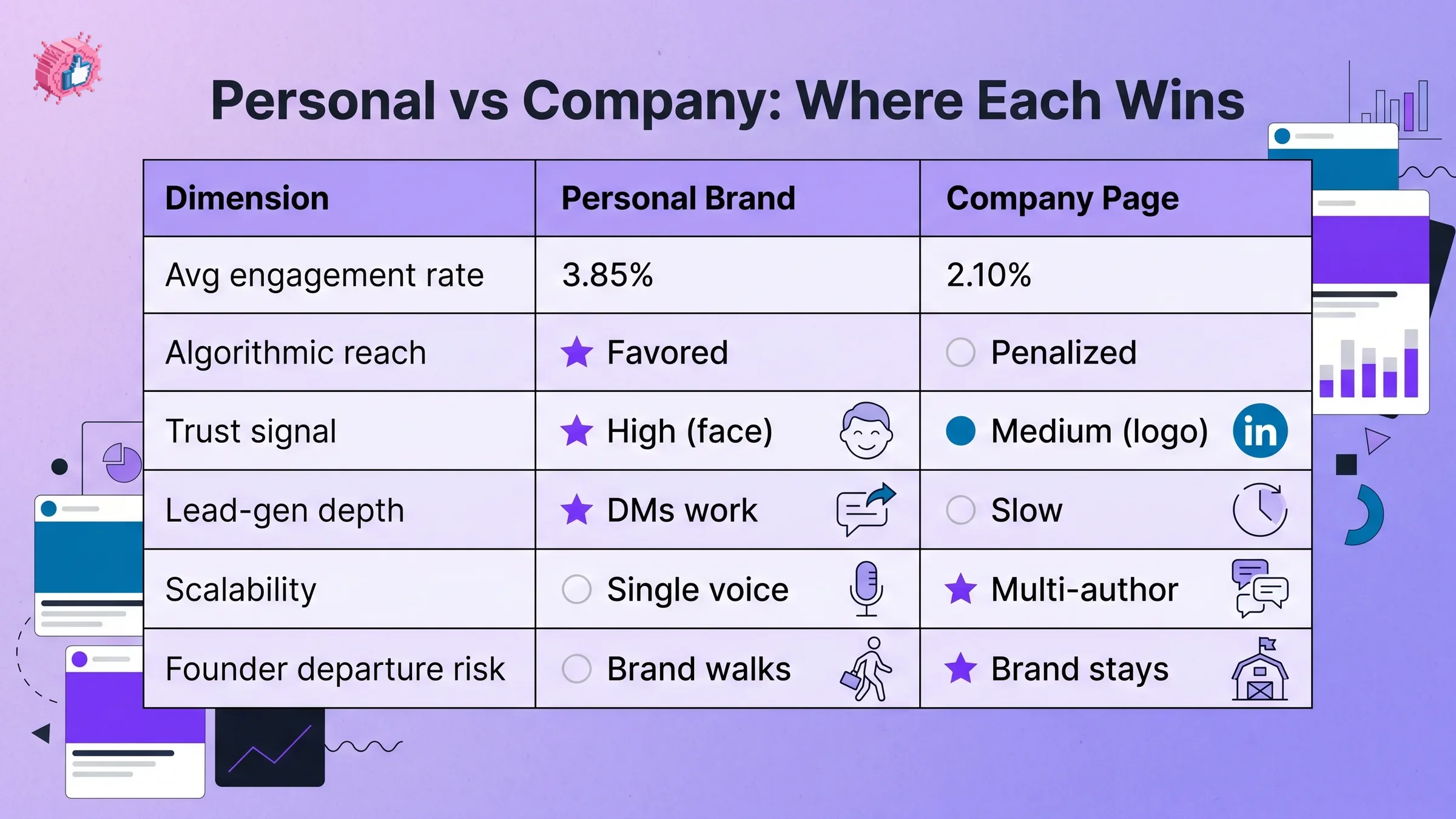
| Dimension | Personal brand | Company page |
|---|---|---|
| Avg engagement rate | 3.85% | 2.10% |
| Algorithmic reach | Favored | Penalized |
| Trust signal | High (face) | Medium (logo) |
| Lead-gen depth | DMs work | DM access blocked |
| Scalability | Single voice | Multi-author |
| Founder-departure risk | Brand walks | Brand stays |
| Content velocity | Capped by 1 human | Multiple authors |
| Native analytics depth | Limited | Rich (demographics) |
| Paid-amp infrastructure | None | Required for ads |
| Authenticity ceiling | Very high | Medium |
The pattern is clear: anything that touches reach, trust, or conversion goes to personal. Anything that touches operations, continuity, or paid goes to the page. This is the strategic split underneath the headline engagement gap.
The hybrid playbook (80/20)
For 90% of B2B companies in 2026, the right structure is not "pick one." It is a hybrid where the personal profile drives reach and conversion, and the company page provides amplification, brand continuity, and paid infrastructure. Here is the cadence we recommend after watching how the top founder-led brands actually run it.
Personal profile cadence (4 to 5 posts per week)
- 3 posts per week from the founder or top exec on substantive topics (product POV, customer stories, industry analysis, learnings)
- 1 post per week of personal narrative or behind-the-scenes (humanizes the brand, drives trust)
- 1 carousel or document post per week (highest-engagement format, see our LinkedIn engagement benchmarks)
- Reply to every comment in the first 3 hours (this is non-negotiable for the momentum window)
Company page cadence (2 to 3 posts per week)
- 1 post per week amplifying the founder's best personal post from the prior week (with a brand-voice rewrite, not a copy-paste)
- 1 post per week of company news, customer stories, or product updates
- 1 post per week tagged for employee-advocacy share
- Use the page for all paid amplification (boost the highest-performing personal posts via the page's ad infrastructure)
The 80/20 split in practice. 80% of your distribution wattage goes into the personal profile (volume, velocity, replies). 20% goes into the company page (scale, continuity, paid amp). The personal profile is the foundry. The company page is the press release wire and the paid distribution surface.
For the writing side of the cadence, our LinkedIn post generator handles the personal-profile drafts using patterns from the top creators in our 968-hero dataset, and the LinkedIn post preview lets you proof both surfaces before publishing.
Decision framework (4 questions)
If you are still stuck between the two, walk this 4-question checklist. Each question shifts the answer by one weighted point. Tally and decide.
1. What is your stage?
- Pre-seed to Series A → Personal profile (+2 points personal)
- Series B to growth → Hybrid (+1 personal, +1 company)
- Public or enterprise → Company page as primary, personal as exec amplifier (+1 company)
2. Is the founder willing to post personally 4 to 5 times per week?
- Yes → Personal profile (+2 personal)
- No, but a marketing lead can ghostwrite → Personal profile with ghostwriting (+1 personal)
- No, nobody will commit to personal posting → Company page is your only option (+2 company)
3. Do you have multiple employees willing to publish?
- Yes, 5+ employees → Company page makes sense as a hub (+1 company)
- No, founder is the only voice → Personal profile (+1 personal)
4. Is your motion B2B founder-led-sales or DTC/brand-led?
- Founder-led B2B → Personal profile (+2 personal)
- Brand-led DTC or e-commerce → Company page (+1 company)
- Hybrid (B2B with brand investment) → Both, with 80/20 split (+0)
Tallying the answer. Sum the points. If personal scores +3 or higher, go personal-first. If company scores +3 or higher, go company-first. If the gap is +1 or less, run the hybrid 80/20 playbook above. Most B2B founders in 2026 will land in the personal-first bucket, and that recommendation is consistent with what works for the top creators in our dataset.
What this means for you
- Default to personal-first if you are a founder. The engagement gap (3.85% vs 2.10%) is real, widening, and structurally tied to how the 2026 LinkedIn algorithm ranks content. Pour 80% of your LinkedIn time into the personal profile.
- Use the company page for amplification, not as the primary engine. Keep it active for brand continuity, employee advocacy, and as the surface for paid ads. Do not expect it to carry organic reach on its own.
- DMs are the underrated personal-profile feature. If pipeline is your goal, the personal profile is a two-way sales channel that the company page structurally cannot match.
- Run the 80/20 hybrid playbook. Personal profile for volume and conversion (4 to 5 posts per week). Company page for amplification and paid (2 to 3 posts per week). Reply in DMs in hours, not days.
- Test a draft before you ship it. Run hooks through the hook generator and check predicted engagement with the viral score checker. The cost of a flat post is the next 48 hours of momentum-window decay. Worth catching before you publish.
- For the full content-strategy build, see our LinkedIn content strategy guide. It maps the personal-vs-company split into a 90-day publishing cadence.
Personal brand is not just bigger numbers, it is a different category of distribution and trust. Build it deliberately, support it with the company page, and the two together compound. See ViralBrain pricing for the full content-generation stack, or start the free trial to see your first post-momentum score in minutes.
Sources: Socialinsider 2026 LinkedIn Benchmarks, LinkedIn Marketing Solutions, ViralBrain proprietary analysis of 30,360 posts across 968 active hero creators (snapshot May 2026), LinkedIn 2026 algorithm research.
FAQ
Can I run both a personal profile and a company page at the same time?
Yes, and most B2B founders should. The right structure is an 80/20 split where the personal profile carries reach and conversion (4 to 5 posts per week) and the company page handles amplification, brand continuity, and paid ads (2 to 3 posts per week). Avoid copy-pasting the same content to both surfaces, the algorithm penalizes duplicate posts and the company-page version will under-perform regardless.
Which has higher engagement, a LinkedIn personal profile or a company page?
Personal profiles. Socialinsider's 2026 data put personal-profile average engagement at 3.85% and company-page average engagement at 2.10%, meaning personal profiles see roughly 1.83x more engagement per post. The gap has widened every year since 2023 and is structural to how LinkedIn's 2026 interest-graph algorithm distributes content. See our engagement benchmarks tool for live tier comparisons.
Is a LinkedIn company page worth it in 2026?
Yes, but not as your primary content surface. Keep a company page for three specific reasons: brand continuity if the founder leaves, multi-author scalability for teams with 5+ employees who post regularly, and as the required infrastructure for LinkedIn Ads. Treat it as a complement to personal-led content, never as the lead engine for organic reach.
Do hashtags work on LinkedIn company pages?
Hashtags work roughly the same on both surfaces in 2026, which is to say they barely move the needle. The 2026 algorithm leans on topic detection from the post body itself, not hashtags. Use 2 to 3 if they feel natural to the post. Skipping them entirely has no measurable downside.
Should I post from a company page or personal profile for B2B sales?
Personal profile, almost always. The decisive factor is direct messages: a prospect who engages with a personal-profile post can DM the author in one click, while company-page prospects have no equivalent path. Roughly 70% of LinkedIn-sourced B2B pipeline in 2026 starts in a personal-profile DM exchange, not a company-page click-through.
What happens to my company page if the founder leaves?
This is the strongest argument for maintaining a company page alongside a personal brand. The page persists across founder transitions, acquisitions, and leadership churn, while a personal brand walks out the door with the person. For mature companies, the founder-departure risk is a real reason to invest in page-side brand equity, even if engagement rates are lower.
How much does it cost to run a company page vs a personal profile?
Both are free to create and maintain on LinkedIn. The hidden cost is content production time, which is roughly the same on either surface. The cost asymmetry comes from paid amplification: LinkedIn Ads requires a company page, so any paid distribution strategy adds budget on the company-page side. Personal profiles cannot run ads. See ViralBrain pricing for the content-generation stack that powers both surfaces.
What is the LinkedIn personal profile engagement rate in 2026?
3.85% on average, per Socialinsider's 2026 benchmark study, up roughly 44% year over year from the 2024 baseline. The top tier of creators in our 30,360-post dataset runs significantly higher (6% to 12%+ on consistent posts), and the median is the floor, not the ceiling. See our LinkedIn engagement benchmarks for the full tier breakdown.
Can I get verified or get a "Top Voice" badge on a company page?
No, the "LinkedIn Top Voice" badge and most credibility signals (verified identity, contribution to collaborative articles, course completion badges) are tied to personal profiles only. This is another structural advantage of personal brand: the trust signals LinkedIn surfaces in the feed live on the person, not the page.
Should I delete my company page if I'm going personal-first?
No, keep it. The downside of maintaining a company page is minimal (a few posts per week, light moderation) and the upside is real: brand continuity, paid-ad infrastructure, and employee-advocacy capability. The mistake is investing equal effort into both surfaces. The right move is asymmetric: 80% personal, 20% company, and let the company page do the operational work the personal profile cannot.
Automate your LinkedIn for 30 days
ViralBrain plans, writes, and schedules your LinkedIn content, using official LinkedIn APIs so your account stays safe.
- Official LinkedIn APIs, no risk of ban
- You approve every post before it goes live
- Cancel anytime
Keep reading
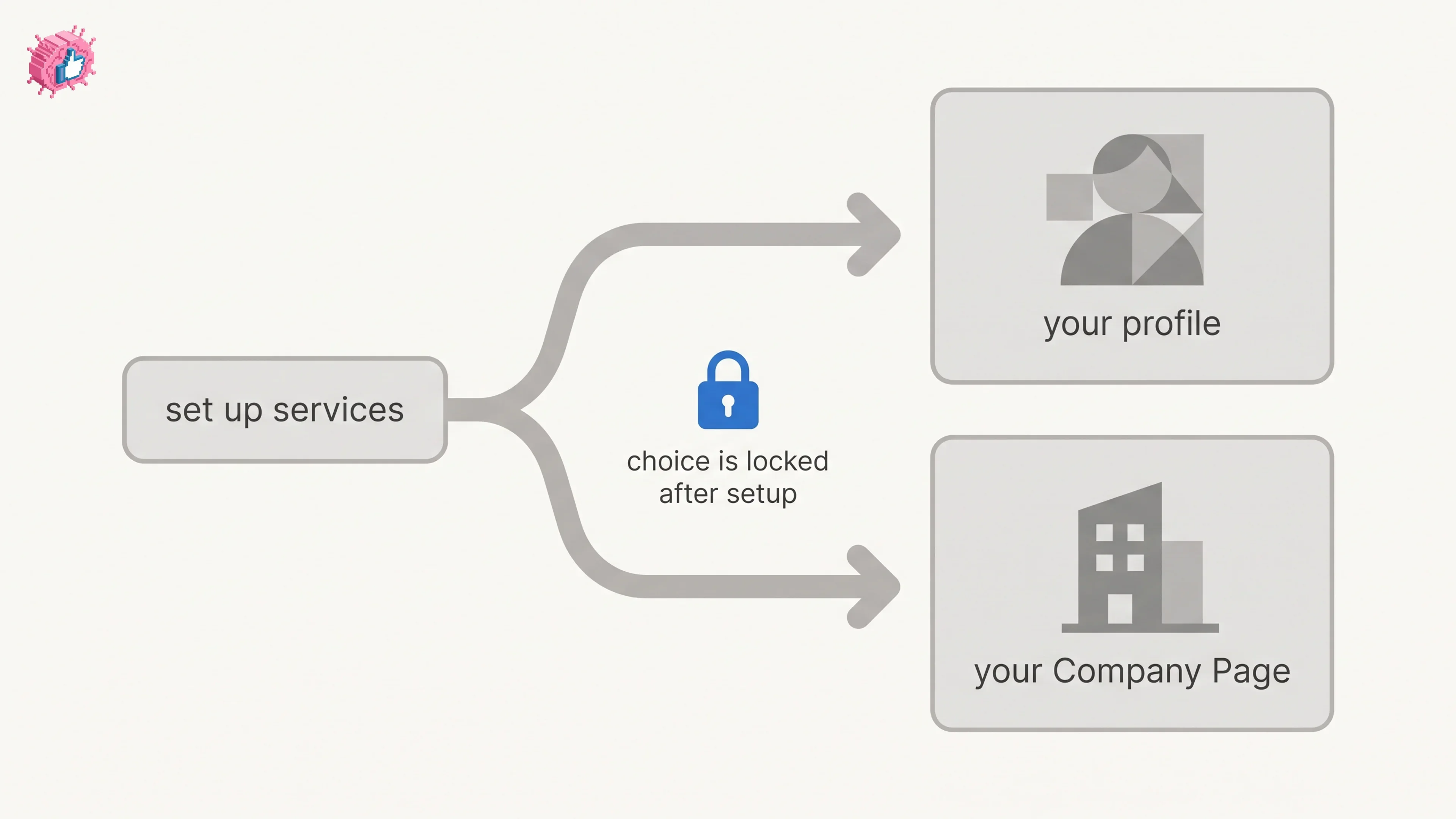
LinkedIn Service Page: setup, pricing, and the one-way choice
LinkedIn Service Pages are free for freelancers and consultants, but choosing profile or Company Page is locked once set. Setup steps and Premium limits.
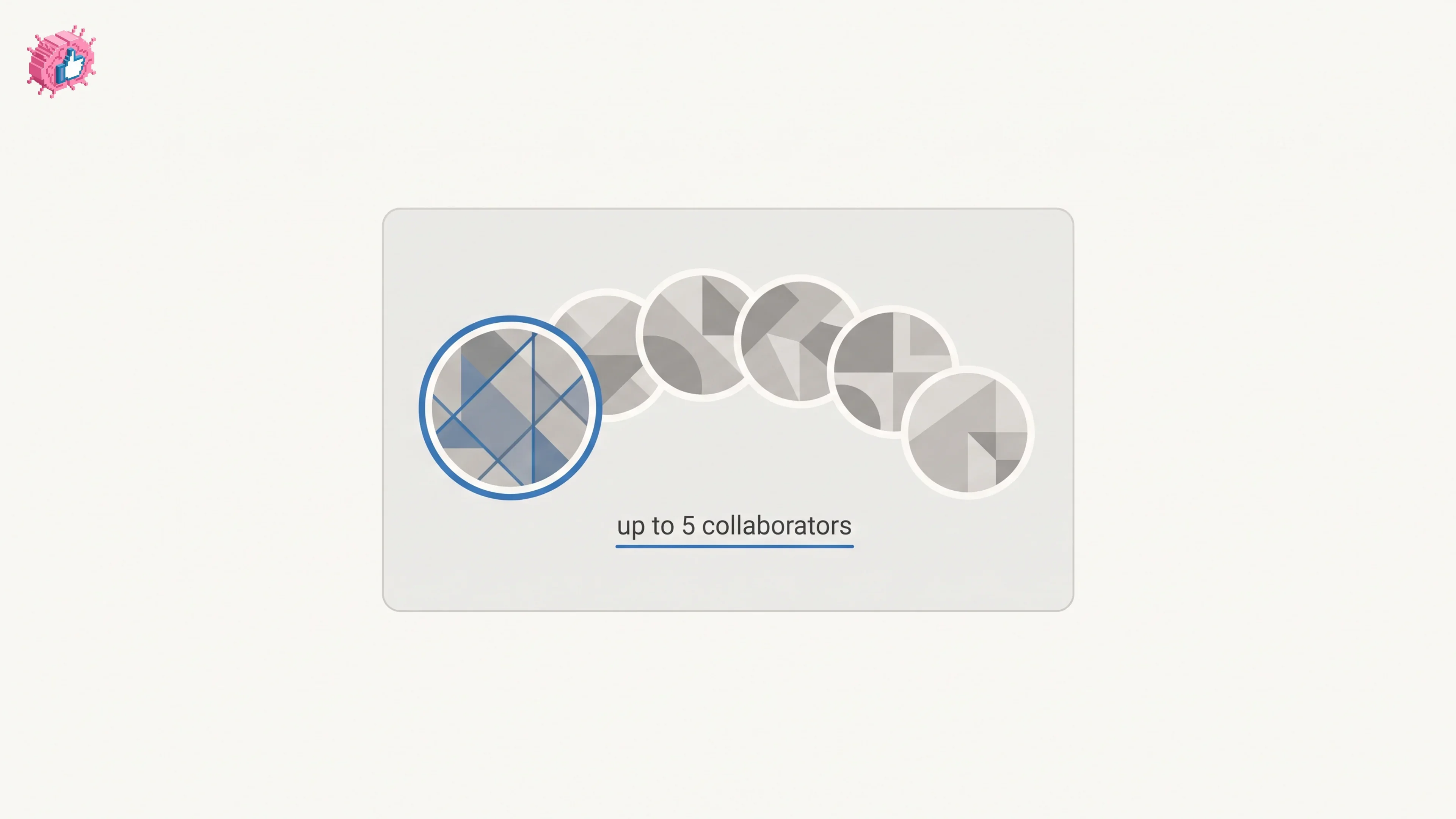
LinkedIn collaborative posts: how they work and who can use them
LinkedIn announced collaborative posts globally in July 2026, but help still limits creation to early access. How to add collaborators, and the limits.
How to become a LinkedIn Top Voice: what LinkedIn actually says
LinkedIn Top Voice is invite-only and the gold Community badge was retired in October 2024. The five selection factors, and the nomination form.