

LinkedIn ghostwriting pricing: what agencies publish
Most LinkedIn ghostwriting agencies do not publish rates. Here is what one does, checked 2 September 2026, plus how to read a quote you have been given.
This guide is for someone deciding whether to hire a LinkedIn ghostwriter, and how to judge a number they have been quoted. If you are a writer trying to work out what to charge, that is a different question with different answers, and this page does not try to serve both.
Here is the honest headline before anything else: most LinkedIn ghostwriting agencies do not publish their rates. We checked the providers named in our own LinkedIn ghostwriting services roundup on 2 September 2026, and exactly one of them shows prices on its site. Everything below is either a figure quoted from a provider's own public page with the date we checked it, or it is labelled as something we could not verify.
Automate your LinkedIn for 30 days
What one agency publishes, in full
storyarb publishes a rate card at storyarb.com/pricing. These figures were read off that page on 2 September 2026.
| Plan | Published price | Posts included | Minimum term |
|---|---|---|---|
| Executive | $4,999/mo | 15 posts/mo | 6-month minimum |
| Essentials | $9,999/mo | 10 posts/mo | 6-month minimum |
| Scale | $13,999/mo | 15 posts/mo | 12-month minimum |
| Premium | $Custom | Custom | 12-month minimum |
Two details from that same page matter more than the headline numbers.
The entry tier carries a qualifying condition. Its footnote reads: "Executive tier is designed for B2B founders and executives who want to build a strong LinkedIn presence without the full content engine. Requires a specific POC and 2-exec minimum to qualify." So the $4,999 figure is not a single-person price.
And every tier commits you for months, not weeks. Six months on the two lower plans, twelve on the two higher ones. That changes what you are actually agreeing to: six times the published $4,999 is $29,994, which is our arithmetic on their figure rather than a number they advertise, and it is the sum the entry tier really commits you to.
The most useful thing on that rate card is not a price
Look at the posts column again. The $4,999 plan includes fifteen posts a month. The $9,999 plan includes ten.
Paying twice as much buys you fewer posts, because the higher tier is not selling volume. Per storyarb's own descriptions, Executive is for "Executives building a stronger POV through social thought leadership" while Essentials is for "Teams that need a consistent newsletter nurture engine". The second one adds a newsletter and a different scope of work.
That is the single most transferable lesson for a buyer. Price in this market tracks scope, not output. If you compare two quotes on post count alone you will reliably pick the wrong one, and you will think the cheaper one is a bargain when it is simply doing less.
What we could not verify, and what those sites actually show
This is the part most pricing articles skip. Of the providers our roundup names, here is what each one's site showed when we looked on 2 September 2026.
- Cleverly. No published pricing.
cleverly.co/pricingreturns a 404, and the homepage offers a "Free Consultation" button with no figures anywhere. - NUOPTIMA. Quote-only. Its LinkedIn ghostwriting page directs prospects to book a strategy call rather than showing rates.
- Column. Its pricing page loads a "Coming Soon" message with no plans on it.
- YellowInk. We could not reach an official site to check. Figures for it circulate online, but they trace back to secondary write-ups rather than the company's own page, and they do not even agree on the currency. We are not repeating them.
- Reachly and Stop The Scroll. No reachable public pricing page.
So a fair summary of this market is: one public rate card, several deliberate quote-only models, and a lot of numbers in circulation that nobody can point to a source for.
If you have seen a confident "$X to $Y per month" range for LinkedIn ghostwriting, ask yourself who was surveyed and whether the answer is anywhere on the page. Usually it is not.
The four pricing models you will actually be quoted
Rates vary, but the shapes do not. Almost every quote you receive will be one of these, and knowing which one you are looking at is most of the work.
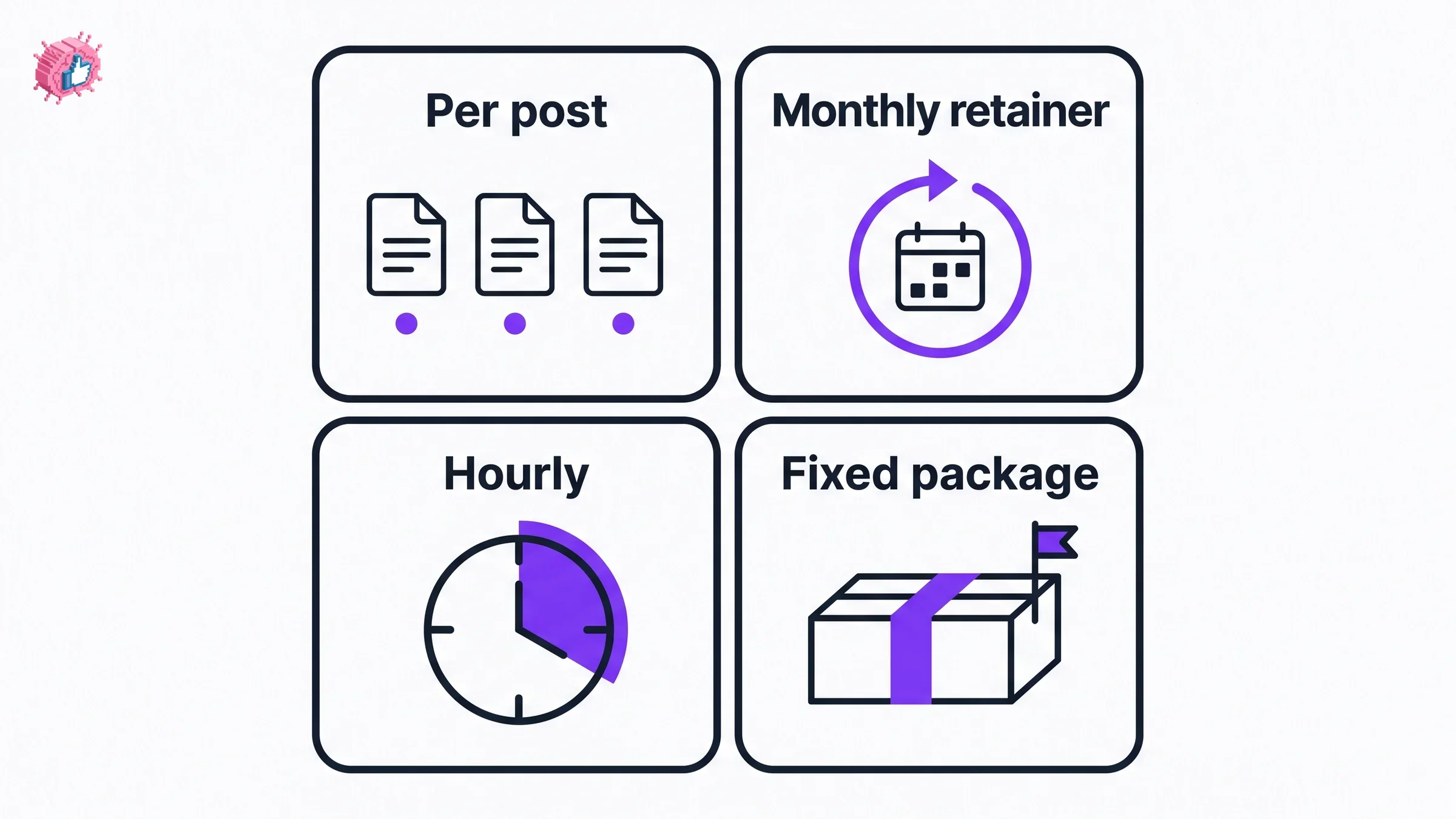
Per post. You pay for each piece. Easy to compare on paper and easy to get wrong, because a post written from a thirty-minute interview with you is a different product from a post written from your old blog archive.
Monthly retainer. The dominant model for agencies, and the one storyarb uses. You buy an ongoing capacity rather than a fixed list of deliverables. Watch for the minimum term.
Hourly. More common with individual freelancers than agencies. It prices the writer's time honestly, and it makes your total cost depend on how much revising you do.
Fixed package. A defined block of work, often a launch or a profile overhaul, with an end date. Useful when you want a specific outcome rather than a standing arrangement.
Automate your LinkedIn for 30 days
What actually moves the number
When two quotes differ by a factor of three, it is usually one of these, not the writer's skill.
- Whether strategy is included, or only execution. Someone deciding what you should say costs more than someone writing what you tell them to say. This is the biggest single driver and it is often invisible in the quote.
- How the raw material gets collected. Recorded interviews with you are expensive and produce the best work. Working from documents you send is cheaper. Working from your existing posts is cheapest and sounds the most recycled.
- Volume and cadence. Related to price, but as the table above shows, not proportional to it.
- Whether profile and positioning work is in scope. A profile rewrite is a distinct project that often gets bundled invisibly into month one.
- Revisions. Unlimited revisions and two rounds are very different products at the same headline price.
- Contract minimum. This is not a rate at all. It determines the size of what you are actually committing to.
- Exclusivity and category conflicts. Some writers will not take a competitor of yours. That constraint costs money.
How to read a quote you have been given
You do not need a market average to tell whether a quote is fair. You need to make it comparable. Ask for these in writing before you compare anything.
- What is the minimum term, and what is the total across it? Convert every monthly figure into that number before comparing.
- How many posts, and who decides the topics?
- How does my input get captured, and how much of my time does that take each month?
- How many revision rounds are included, and what happens after them?
- Is profile or positioning work included, or billed separately?
- Who actually writes it, and will that person change?
- What happens to the content and the account if we stop?
A provider who answers all seven plainly is easier to trust than one with a lower number and vague scope. If a quote cannot survive those questions, the price was never the problem.
The comparison worth doing before you hire anyone
Ghostwriting is one way to solve this. The other is writing the posts yourself with something that handles the blank page, for a great deal less money.
For context on the gap: our own product, ViralBrain, is €39 per month on Pro, checked 2 September 2026, with €1 for a seven-day trial. That is our tool and we are obviously not neutral about it, so treat that as a data point about the DIY end of the market rather than a recommendation.
The honest version of the trade-off is time. A ghostwriter removes the work and the deadline pressure, and a good one brings an outside view of what is worth saying. Software removes the blank page but not the thinking. If your bottleneck is that you do not know what to write about, neither a tool nor a cheap writer fixes that, and the expensive strategy-inclusive engagements exist precisely because that is the hard part.
If you have decided you want a person rather than a tool, our roundup of the best LinkedIn ghostwriting services covers who the providers are and how they work. This page is about what it costs; that one is about who to call.
A note on the other question
Search results for LinkedIn ghostwriting prices mix two audiences. Alongside buyers asking what it costs to hire, there are writers asking what to charge, plus queries about ghostwriting jobs, salaries and courses.
Those need genuinely different answers, and the rate a writer can command is not the same figure as the price a buyer pays an agency, because the agency price includes strategy, editing, account management and margin. This page is written for the buyer, and we have not tried to answer the earning side inside it.
FAQ
How much does a LinkedIn ghostwriter cost?
There is no verifiable market rate, because most providers do not publish one. The one public rate card we found among the agencies we track is storyarb's, which lists $4,999, $9,999 and $13,999 per month, checked 2 September 2026, with six or twelve month minimum terms. Treat any confident range you see elsewhere as unsourced unless the article names whose page it came from.
Why do so few LinkedIn ghostwriting agencies publish pricing?
Because most of them scope each engagement individually and price it after a call. Of the providers we checked on 2 September 2026, several route to a consultation instead of a rate card, one had a pricing page marked "Coming Soon", and one returned a 404 on its pricing URL. Quote-only is a deliberate model in this market, not an oversight.
Is a monthly retainer or per-post pricing better?
Per-post is easier to compare and better for a defined, short piece of work. A monthly retainer is better when you want consistent output and a writer who learns your voice over time, which is most people's situation. The important question with a retainer is the minimum term, since a six-month commitment turns a monthly price into a much larger decision.
What should be included in a LinkedIn ghostwriting quote?
At minimum: the number of posts, who chooses the topics, how your input is captured, how many revision rounds you get, whether profile work is included, who the writer is, and the minimum term. Two quotes are only comparable once you have all seven, and the biggest hidden difference is usually whether strategy is included or only execution.
Does paying more get you more posts?
Not reliably. On the one public rate card we could verify, the $4,999 plan includes fifteen posts a month and the $9,999 plan includes ten, because the more expensive tier adds a newsletter and a wider scope rather than more volume. Price in this market tracks scope rather than output, which is why post count is a poor way to compare quotes.
Is LinkedIn ghostwriting worth it compared to doing it yourself?
It depends on whether your bottleneck is time or direction. A ghostwriter removes the writing work and the deadline, and the strategy-inclusive engagements also decide what is worth saying, which is the genuinely hard part. Tools cost far less, and for reference our own is €39 per month on Pro as of 2 September 2026, but they remove the blank page rather than the thinking.
Automate your LinkedIn for 30 days
ViralBrain plans, writes, and schedules your LinkedIn content, using official LinkedIn APIs so your account stays safe.
- Official LinkedIn APIs, no risk of ban
- You approve every post before it goes live
- Cancel anytime
Keep reading
How to Change Your Profile Picture on LinkedIn
How to add, change and remove your LinkedIn profile photo on desktop, in the app and in a mobile browser, plus who can see it and the file specs.
How to Hide Active Status on LinkedIn
How to hide your LinkedIn active status: the Manage active status setting, its three documented options on desktop and in the app, and what you give up.
How to Log Out of LinkedIn on Desktop and in the App
How to log out of LinkedIn on desktop, on iOS and on Android, how to sign out of other sessions or all devices, and what Keep me logged in changes.