
Pew found half of Americans feel more concerned than excited about AI, and only about one in ten feel more excited than concerned. That same caution shows up inside organizations. You can push back b…
18011 viral
AI9 months ago

LinkedIn Content Strategy & Writing Style
Called the “Office Whisperer” by The New York Times, I help tech-forward leaders stop overpaying for AI while boosting adoption and decreasing resistance
1 person tracking this creator on ViralBrain
Dr. Gleb Tsipursky positions himself as a pragmatic bridge between executive ambition and organizational reality, earning his reputation as the "Office Whisperer" by navigating the friction of the post-pandemic workplace. His strategy centers on de-risking the transition to hybrid work and generative AI through a value proposition of behavioral science and operational efficiency, moving beyond tech hype to focus on human adoption. He is notable for his data-driven advocacy for middle managers and his sharp warnings regarding the "gendered return to the office," which distinguishes him from typical tech evangelists. By intersecting high-level management consulting with grassroots pilot programs, he demonstrates that sustainable digital transformation requires bottom-up trust and project-based learning rather than top-down mandates.
34.0K
27.3K
8
23.0
2
1
Pew found half of Americans feel more concerned than excited about AI, and only about one in ten feel more excited than concerned. That same caution shows up inside organizations. You can push back b…
Hybrid work safeguards mental health by providing flexibility.

Gen AI can save your association months of effort, or waste them fast, depending on who you bring into the room. The fastest path to real value runs through pilot programs with staff and volunteers s…
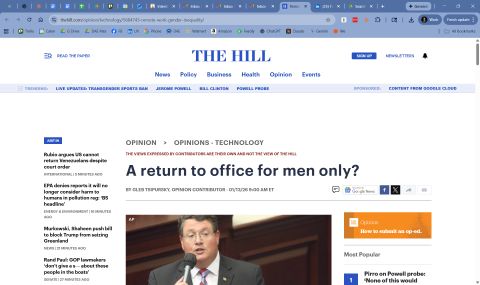
Securing the future of your leadership team requires immediate attention to a silent gender divide emerging in corporate offices. New data from the Bureau of Labor Statistics confirms a striking tren…
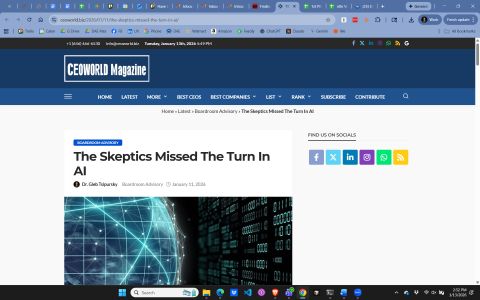
You can spend millions on Gen AI software, but you cannot buy the trust required to make your team actually use it. Real adoption happens when skepticism is dismantled by a peer, not a directive from…

Securing a dominant market position requires acknowledging the massive transition occurring in enterprise AI right now. The latest data from Wharton and GBK Collective reveals that Gen AI serves as a…
23.0 posts/week
Posts / Week
0.3 days
Days Between Posts
1
Total Posts Analyzed
HIGH
Posting Frequency
7.6%
Avg Engagement Rate
STABLE
Performance Trend
180
Avg Length (Words)
HIGH
Depth Level
ADVANCED
Expertise Level
0.8/10
Uniqueness Score
NO
Question Usage
0%
Response Rate
Writing style breakdown
The style is professional, authoritative, and data-informed, but accessible.
It is clearly business-oriented, with a consulting / thought-leadership tone.
The voice is direct and confident, not chatty, humorous, or poetic.
It is persuasive through logic and evidence rather than emotion, jokes, or dramatic flair.
The language is plain, precise, and jargon-light, but it does use standard business and AI vocabulary (e.g., Gen AI, workflows, adoption, operating leverage).
Overall formal to semi-formal.
No slang.
No contractions (always 'do not', 'cannot', 'it is', 'that is', 'you are', etc.).
Grammar is standard and correct; sentences follow conventional syntax.
Calm, steady, and measured.
The energy comes from clarity and momentum of ideas, not from exclamation marks or emotional language.
Emotion is understated; words like 'critical', 'massive', 'undeniable', 'striking' are used sparingly as amplifiers.
The tone is serious, reflective, and focused on implications and action.
Frequent use of evidence or references: data, studies, named organizations, and specific engagements.
Abstract concepts anchored with concrete examples (e.g., ASNT event, retail consulting engagement).
Cause-and-effect framing: 'This situation threatens...', 'That shared feedback loop creates...', 'Real adoption happens when...'.
Clear problem → implication → solution pattern.
Short, punchy summary or thesis statements, often as standalone paragraphs.
No rhetorical questions in the sampled texts; the style prefers declarative statements over question-based hooks.
Repetition for emphasis is light but present in structural ways (e.g., a sequence of parallel sentences beginning with 'This' or 'That').
Uses second person 'you' and 'your' when giving advice or prescriptions, especially toward the end of posts.
Third person is used to describe situations, organizations, and leaders ('Organizations must...', 'Leaders who want...', 'We are witnessing...').
First person 'I' is rare and limited to meta-references to the author’s content ('Read more in my article...').
'Invite a mix of early adopters and everyday users.'
'Recognize participants as co-creators.'
'Stop trying to force compliance from the top and start fueling the momentum...'
Commands are framed as guidance from an expert, not as casual imperatives or hype.
Sign in to unlock the full writing analysis
Free tools to help you write, score, and benchmark in the same style.
Other creators worth studying alongside Dr. Gleb Tsipursky.

Daniel Grieder
CEO, HUGO BOSS AG
147 Viral Score

Jodie Cook
Make the AI version of YOU | Founder, Coachvox | Forbes senior contributor | Forbes 30 under 30 | GB powerlifter | digital nomad
35 Viral Score

Dr. Mohammed Al Amin
Cybersecurity Leader | Founder @ Arabc0n | Ex-Ministry of Interior | Trusted by Gov & Telecom | Information Security Expert | Parrot Ambassador | Red Team | CEH | CISO | Operation Manager | Logistics Expert
61 Viral Score

Kevin Thomas
Ex AI & Product @ Amazon, IBM & Salesforce
75 Viral Score

Dr. Efi Pylarinou
Top Global Fintech & Tech Influencer • Trusted by Finserv & Tech Global • Content & Influencer Services • Advisory for Digital Transformation • Speaking • connect@efipylarinou.com
6 Viral Score

Szymon Negacz
Wise Business Growth 🔵 Strategy, Sales, Marketing, HR, Technology 🔵 WiseGroup.pl Founder 🔵 Investor 🔵 I love to create! More: szymon.eu
36 Viral Score
ViralBrain plans, writes, and schedules your LinkedIn content, using official LinkedIn APIs so your account stays safe.
Write like Dr. Gleb Tsipursky.