

LinkedIn engagement pods: what LinkedIn's own rules say
LinkedIn's policy names pre-arranged engagement directly. Here is what it says, what it does not say about reach, and how to judge the risk of joining a pod.
If you are weighing up whether to join a LinkedIn engagement pod, the question worth answering first is not whether pods work. It is what LinkedIn's own rules actually say, because on this particular topic they say something unusually specific.
A disclosure before anything else, since it should shape how you read this. We sell a LinkedIn content tool. A page concluding that pods are worthless would flatter our product, so treat any conclusion here that happens to suit us with the scepticism it deserves. Where the honest answer is inconvenient for us, this page says it anyway, and there is a section near the end that spells out exactly where our interest and your interest diverge.
Everything about LinkedIn's position below is quoted from LinkedIn's own policy pages with the date we checked them. Where LinkedIn says nothing, this page says that instead of filling the silence.
Automate your LinkedIn for 30 days
What an engagement pod actually is
A pod is a group of people who agree in advance to engage with each other's posts. The reciprocity is the point: you comment on mine, I comment on yours, and the early activity is meant to signal to LinkedIn that the post is worth showing to more people.
They come in three practical shapes, and the differences matter more than the label they share.
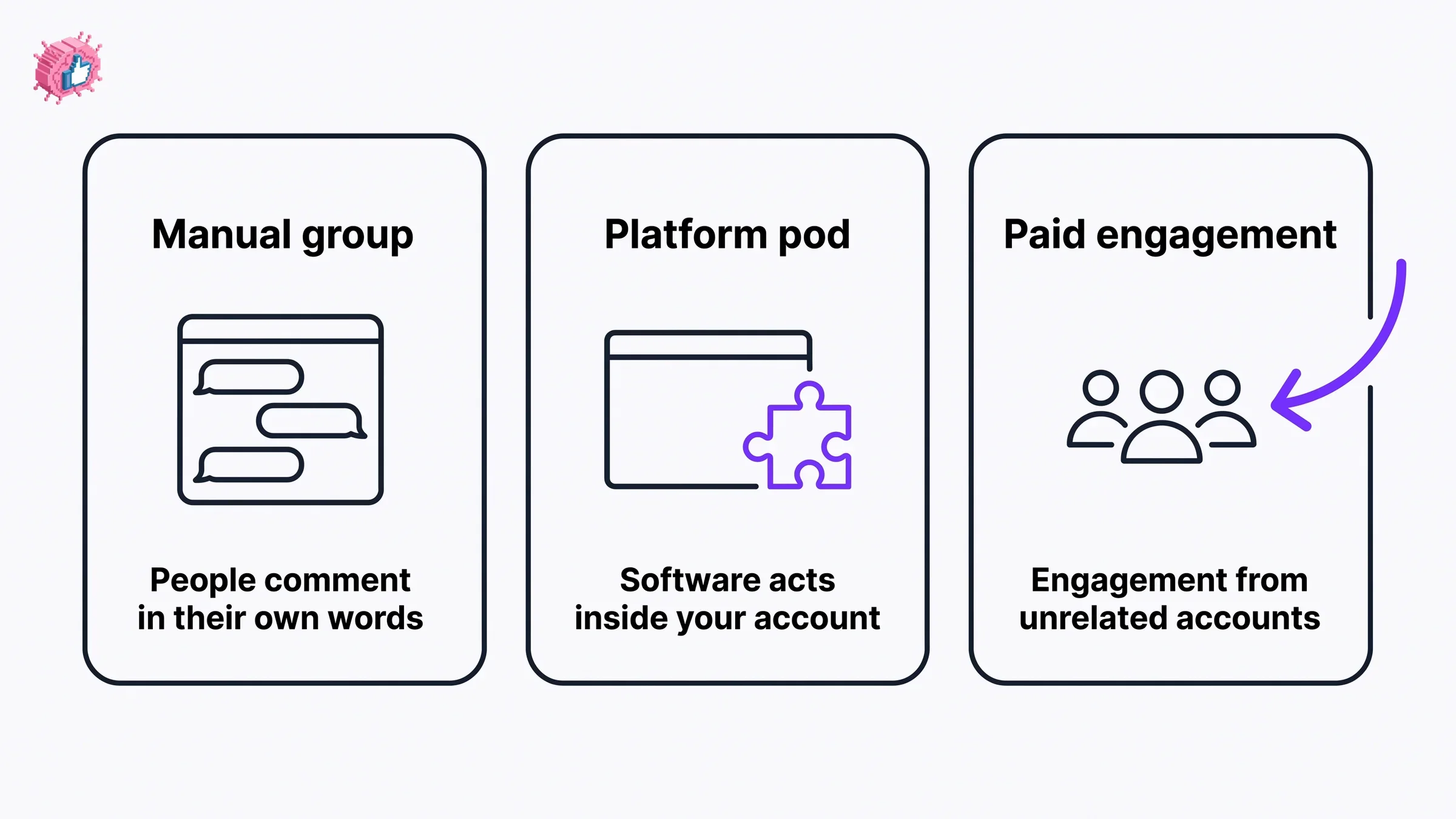
Manual groups. A WhatsApp, Telegram, Slack or Discord group where someone drops a link and members go and comment in their own words. No software, no access to your account.
Platform pods. A product that coordinates the group, usually through a browser extension that acts inside LinkedIn on your behalf. It may queue comments, place them automatically, or handle the reciprocity bookkeeping for you.
Paid engagement. A service where engagement arrives from people who have no relationship to you or your work, bought as a volume.
Those three carry genuinely different risks. Lumping them together is why most writing on this topic is unhelpful.
What LinkedIn's policy says, in its own words
This is the part that is usually asserted rather than sourced. LinkedIn's Professional Community Policies, checked 3 September 2026, address it directly under the "Be professional" heading in the subsection on spam:
"Please make the effort to create original, professional, relevant, and interesting content in order to gain engagement. Don't do things to artificially increase engagement with your content. Respond authentically to others' content and don't agree with others ahead of time to like or re-share each other's content."
Read that last clause again. "Don't agree with others ahead of time to like or re-share each other's content" is a description of a pod. Not an interpretation of one, not an inference from a broader principle about authenticity. The defining mechanic of a pod, named in the policy.
So the question "are engagement pods against LinkedIn's rules" has a clear answer, and it is yes. That is unusual for this kind of topic and it is worth being precise about, because almost everything else you will read about pods is not sourced this way.
LinkedIn's account restrictions page, checked the same day, connects policy to consequence: "Access to your account may be restricted if you violate our Professional Community Policies."
What LinkedIn does not say, which matters just as much
LinkedIn publishes no mechanism by which pods reduce reach, no pod-specific penalty and no detection method. That silence is where most advice on this topic goes beyond its evidence.
LinkedIn does not publish any mechanism by which pods reduce your reach. The claim that pods "kill your reach", or that the algorithm detects and suppresses pod engagement, appears nowhere in LinkedIn's documentation. LinkedIn does not publish how its content ranking works at all, which is the same point our LinkedIn SEO guide makes about profile search: LinkedIn describes its relevance systems as proprietary. Anyone giving you a confident mechanism for how pod engagement is detected and penalised is describing something no public source supports.
LinkedIn does not publish a pod-specific penalty. The restriction language quoted above is about policy violations generally. There is no published schedule of consequences for this specific behaviour, no stated threshold, and no stated detection method.
Nobody outside LinkedIn knows how well any of this is enforced. That sentence is the honest centre of this topic. You can source the rule. You cannot source the enforcement rate, and neither can anyone telling you it is nothing to worry about or that it will end your account.
What that leaves you with is a rule you can read and a risk you cannot size. That is genuinely uncomfortable, and pretending otherwise in either direction would be the dishonest move.
The software risk is separate, and it is the concrete one
If you take one practical thing from this page, take this. The pre-arranged engagement question is a policy question with unknown enforcement. The browser extension question is a different question with a much clearer answer, and it applies to platform pods rather than manual ones.
LinkedIn's prohibited software and extensions page, checked 3 September 2026, prohibits "any third party software, including 'crawlers', bots, browser plug-ins, or browser extensions that scrape, modify the appearance of, or automate activity on LinkedIn's website."
The same page separately prohibits "Fake accounts or fake engagement on LinkedIn's website, including any tools or services that try to manipulate LinkedIn's content algorithms", and states that people using such tools "risk having their accounts restricted or shut down". It also notes a second-order problem worth weighing: "prohibited tools they're using may become non-operational without notice."
LinkedIn's automated activity page adds that "Automated inauthentic activity violates the LinkedIn User Agreement and can result in temporary or permanent restriction of your account", and describes the remedy if it happens: "review and disable the software or extension that automates activities. Your account will then automatically be re-enabled at the time specified on the suspension notification."
So a platform pod that works through an extension sits inside two separate prohibitions rather than one, with a stated consequence and a stated recovery path. A manual group chat where you read the post and write your own comment sits inside one of them. That distinction is real and almost nobody makes it.
Automate your LinkedIn for 30 days
What pods can move, and what they cannot
This is where the honest answer is more useful than either sales pitch.
Pods can move engagement counts and early activity. That is what they are built to do and there is no reason to pretend they fail at it. A post with early comments looks different from a post with none, both to a human scrolling past and, most people assume, to the distribution system.
Pods cannot make that audience your buyers. The people commenting are in the pod because they are in the pod. If your goal is inbound from a specific kind of buyer, engagement from a reciprocal group does not produce it, and a high comment count from the wrong people can read as noise to the right ones.
Pod comments are visible, and often visibly generic. Anyone who lands on your post can read them. A row of "Great post!" under a piece you wanted a prospect to take seriously does measurable damage to exactly the impression you were building.
That is the trade worth thinking about, and it has nothing to do with the algorithm. It is about who sees what, and what it tells them about you.
How to tell a lower-risk arrangement from a higher-risk one
If you are going to evaluate a pod rather than dismiss the category, these are the questions that actually separate them.
- Does it require a browser extension or ask for your LinkedIn login? If yes, you are inside the prohibited-software language quoted above, not just the pre-arranged-engagement one. This is the single biggest discriminator.
- Does anything get posted without you writing it? Automated commenting is a different act from being reminded to go and comment.
- Are the members people whose work you would engage with anyway? A group of genuine peers in your field is a different proposition from a volume arrangement, both in risk and in whether the engagement is worth having.
- Is engagement bought? Paid engagement from unrelated accounts is the closest thing here to the "fake engagement" language in LinkedIn's own policy.
- Would you be comfortable if a prospect read the comment thread? A practical test that costs nothing and answers a lot.
None of that makes a pod compliant with the sentence quoted earlier. It does separate an arrangement that risks your account from one that mostly risks how your posts read.
Where our interest and yours diverge
We sell a tool that helps people write LinkedIn posts, so we benefit if you conclude that the way to get engagement is better content rather than a pod. You should discount our verdict accordingly.
So here is the version that does not flatter us. A small manual pod of genuine peers, no extension, everyone writing their own comments about work they actually read, is a much lower-risk activity than this category's reputation suggests, and the "pods destroy your reach" warnings you will read are not supported by anything LinkedIn publishes. If that is what you are considering, the honest risk is reputational rather than algorithmic, and it is yours to weigh.
What we would say regardless of what we sold: the sentence in LinkedIn's policy is not ambiguous, the extension prohibition is the part that carries a stated consequence, and no source outside LinkedIn can tell you the enforcement odds. Decide with that, not with a mechanism someone invented.
FAQ
Are LinkedIn engagement pods against the rules?
Yes. LinkedIn's Professional Community Policies, checked 3 September 2026, state: "Respond authentically to others' content and don't agree with others ahead of time to like or re-share each other's content." Pre-arranged reciprocal engagement is the defining mechanic of a pod, so the policy names the behaviour directly rather than leaving it to inference.
Will an engagement pod get my LinkedIn account banned?
Nobody outside LinkedIn can tell you the odds, and anyone who states them is guessing. What is documented is that LinkedIn says account access "may be restricted if you violate our Professional Community Policies", and that for automated activity specifically it "can result in temporary or permanent restriction of your account". No pod-specific penalty, threshold or detection method is published.
Do engagement pods hurt your reach?
No LinkedIn documentation says so, and LinkedIn does not publish how its content ranking works. The widely repeated claim that pods trigger algorithmic suppression is unsourced. The observable downside is different and does not need an algorithm to explain it: pod comments are public, often generic, and read as such to anyone you were trying to impress.
Do LinkedIn engagement pods actually work?
They move what they are designed to move, which is engagement counts and early activity on a post. What they do not do is make the engaging audience into your buyers, because those people are participating out of reciprocity rather than interest. So a pod can raise a number while doing nothing for the outcome the number was supposed to represent.
Is a manual WhatsApp or Telegram pod safer than a pod app?
They carry different risk. A manual group where you write your own comments falls under the pre-arranged-engagement wording in the policy. A platform that works through a browser extension falls under that wording plus LinkedIn's separate prohibition on "browser plug-ins, or browser extensions that scrape, modify the appearance of, or automate activity on LinkedIn's website", which carries a stated risk of accounts being "restricted or shut down". Neither is compliant; only one involves software acting on your account.
What does LinkedIn say about buying engagement?
Its prohibited software page, checked 3 September 2026, prohibits "Fake accounts or fake engagement on LinkedIn's website, including any tools or services that try to manipulate LinkedIn's content algorithms". Paid engagement from accounts with no relationship to your work is the clearest fit for that wording of anything discussed here.
If my account gets restricted for automated activity, what happens?
LinkedIn's automated activity page describes the path: "review and disable the software or extension that automates activities. Your account will then automatically be re-enabled at the time specified on the suspension notification." That is the documented remedy for the automation case specifically, and it is worth knowing that it is not necessarily permanent.
What should I do instead of joining a pod?
That depends on what the pod was going to solve. If it was distribution, the honest answer is that consistency and a specific point of view do more over a quarter than early comments do on any single post. If it was the blank page, that is a writing problem with tools that address it. We sell one, so weigh that, and the LinkedIn SEO guide covers the findability side without any product in it.
Automate your LinkedIn for 30 days
ViralBrain plans, writes, and schedules your LinkedIn content, using official LinkedIn APIs so your account stays safe.
- Official LinkedIn APIs, no risk of ban
- You approve every post before it goes live
- Cancel anytime
Keep reading
4 real LinkedIn carousel examples to study in 2026
4 real, linked LinkedIn carousel examples, including a ViralBrain cofounder's own post, broken down slide by slide, plus the pattern that makes them work.

Do LinkedIn Hashtags Still Work in 2026? What the Data Says
Do LinkedIn hashtags still work in 2026? Data shows a 12.6% engagement lift but only 9% reach gain. Here is how many to use and what beats hashtags.

How to Measure Content Performance Honestly
Learn how to measure content performance with a no-nonsense framework. Ditch vanity metrics and track what actually drives business growth. For marketers.