

What Is LinkedIn 360Brew? How the AI Algorithm Ranks Posts
LinkedIn 360Brew is the 150B-parameter AI model now ranking your feed. Here is what it is, how it ranks posts via the interest graph, and how to win in 2026.
In January 2025, LinkedIn's research team published a paper describing a single 150-billion-parameter AI model that could replace thousands of separate recommendation systems at once. That model is LinkedIn 360Brew, and by 2026 it is the engine deciding who sees your posts, your jobs, your connection suggestions, and your ads.
If you have read that "the LinkedIn algorithm changed" but never got a straight answer on what changed under the hood, this is it. 360Brew is not a tweak to the old ranking rules. It is a different kind of system entirely: a decoder-only foundation model, closer in design to ChatGPT than to the feature-engineered ranking stack LinkedIn ran for the previous decade.
This article explains what 360Brew is, how it actually ranks your posts, why it shifted LinkedIn from a social graph to an interest graph, and the specific moves that work now. For the broader list of signal changes (comment weighting, dwell time, format performance), see our companion piece on what changed in the LinkedIn algorithm in 2026. This post is about the model itself.
Automate your LinkedIn for 30 days
What is LinkedIn 360Brew?
360Brew is LinkedIn's unified, decoder-only foundation model for personalized ranking and recommendation. It was detailed in a research paper, "360Brew: A Decoder-only Foundation Model for Personalized Ranking and Recommendation," submitted to arXiv on January 27, 2025 by Hamed Firooz and the LinkedIn Foundation AI Technologies (FAIT) team.
The headline specs from that paper:
- ~150 billion parameters in the V1.0 model
- Decoder-only transformer architecture, the same family as modern large language models
- Trained and fine-tuned primarily on LinkedIn's first-party data
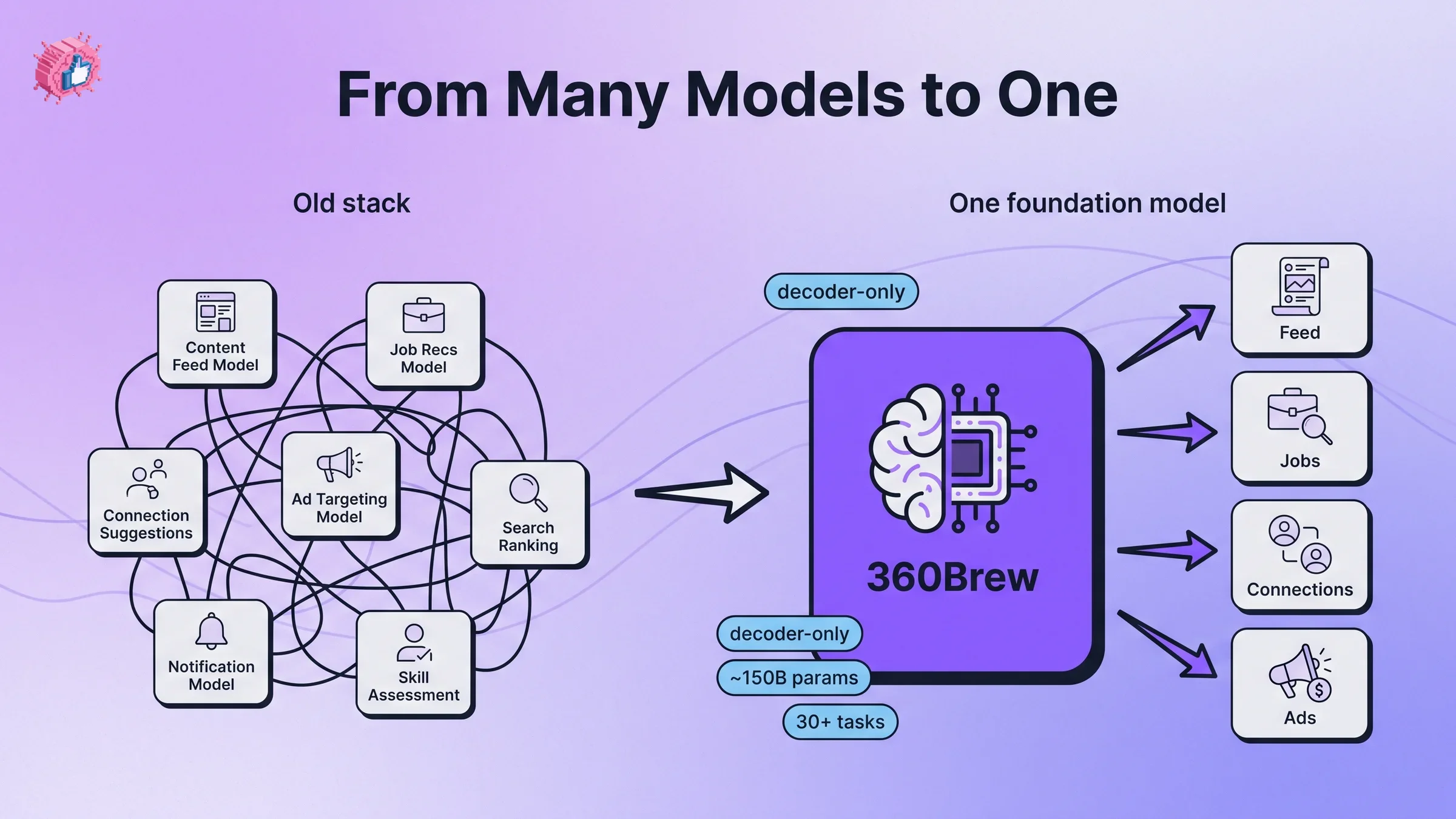
- Solves over 30 predictive tasks across the platform with a single model
- Matches or beats LinkedIn's previous task-specific production systems on offline metrics, without task-specific fine-tuning
In plain terms: instead of running a different specialized model for feed ranking, a different one for "People You May Know," another for job matches, and another for ads, LinkedIn now runs one large model that understands all of these as variations of the same question. That question is roughly: given everything we know about this member, how relevant is this piece of content to them right now?
One honest caveat for accuracy. The original arXiv paper was later withdrawn by the authors over a submission licensing issue, so the public technical record is thinner than it was at launch. The core architecture and approach, though, have been widely reported and are consistent across LinkedIn's own engineering communications.
Why a "foundation model" changes everything
The old LinkedIn ranking stack was built on feature engineering. Engineers hand-designed hundreds of input signals (your connection degree to the author, how many likes a post had, your past clicks) and fed them into specialized models. Adding a new signal meant building and maintaining a fragile chain of model dependencies.
360Brew throws that approach out. Because it is a language model, it reads member behavior and content as natural-language text rather than pre-engineered numeric features. The paper's authors describe this as eliminating the need for feature engineering and the maintenance of complex model-dependency graphs.
The practical consequence for you: the model now comprehends what your post is about, semantically, the way an LLM understands a paragraph. It is not just counting likes. It is reading the substance.
Social graph vs interest graph: the core shift
For most of its history, LinkedIn ran on a social graph. The feed asked one main question: who are you connected to? If you followed someone, their posts fanned out to you. Reach was a function of network size.
360Brew completes LinkedIn's move to an interest graph. The feed now asks: what topics does this member actually engage with, and who demonstrates genuine expertise in them? Connection is still a signal, but it is no longer the primary one. A post from a stranger who is a recognized voice on your topic can now outrank a post from a direct connection who is off-topic.
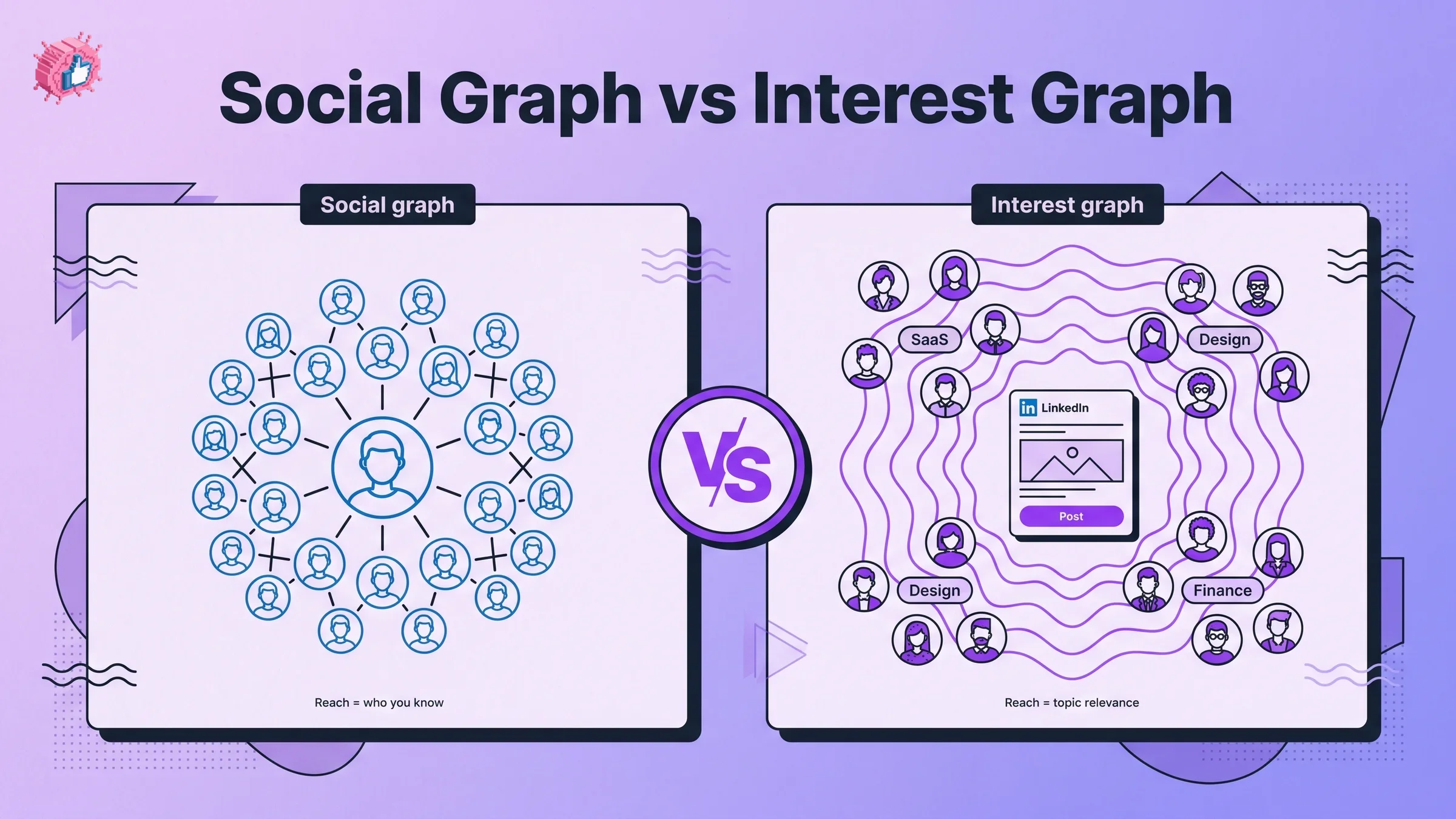
| Dimension | Social graph (pre-360Brew) | Interest graph (360Brew, 2026) |
|---|---|---|
| Primary ranking question | Who are you connected to? | What topics are you interested in? |
| What drives reach | Network size and connection degree | Topic relevance and demonstrated expertise |
| Who sees your post | Mostly your 1st-degree network | Anyone the model judges interested, connected or not |
| Best content strategy | Grow followers, post broadly | Go deep in a narrow domain |
| Generic broad content | Worked (wide fan-out) | Underperforms (no clear topic signal) |
| Niche expert content | Capped by follower count | Rewarded and pushed beyond your network |
This is why so many creators saw impressions fall while engagement rate held or climbed. The model stopped spraying your posts across your whole network and started routing them to people who actually care about the topic. Smaller audience, higher intent.
If your numbers dropped, the fix is rarely "post more." It is "post more specifically." Broad, generalist content gives 360Brew no clear topic to match you against. To see which tier your engagement now sits in, compare your posts against LinkedIn engagement benchmarks.
How 360Brew ranks your posts
Because 360Brew reads content semantically, ranking is now driven by signals of genuine professional value rather than surface-level engagement counts. Strip away the marketing language and four things decide how far your post travels.
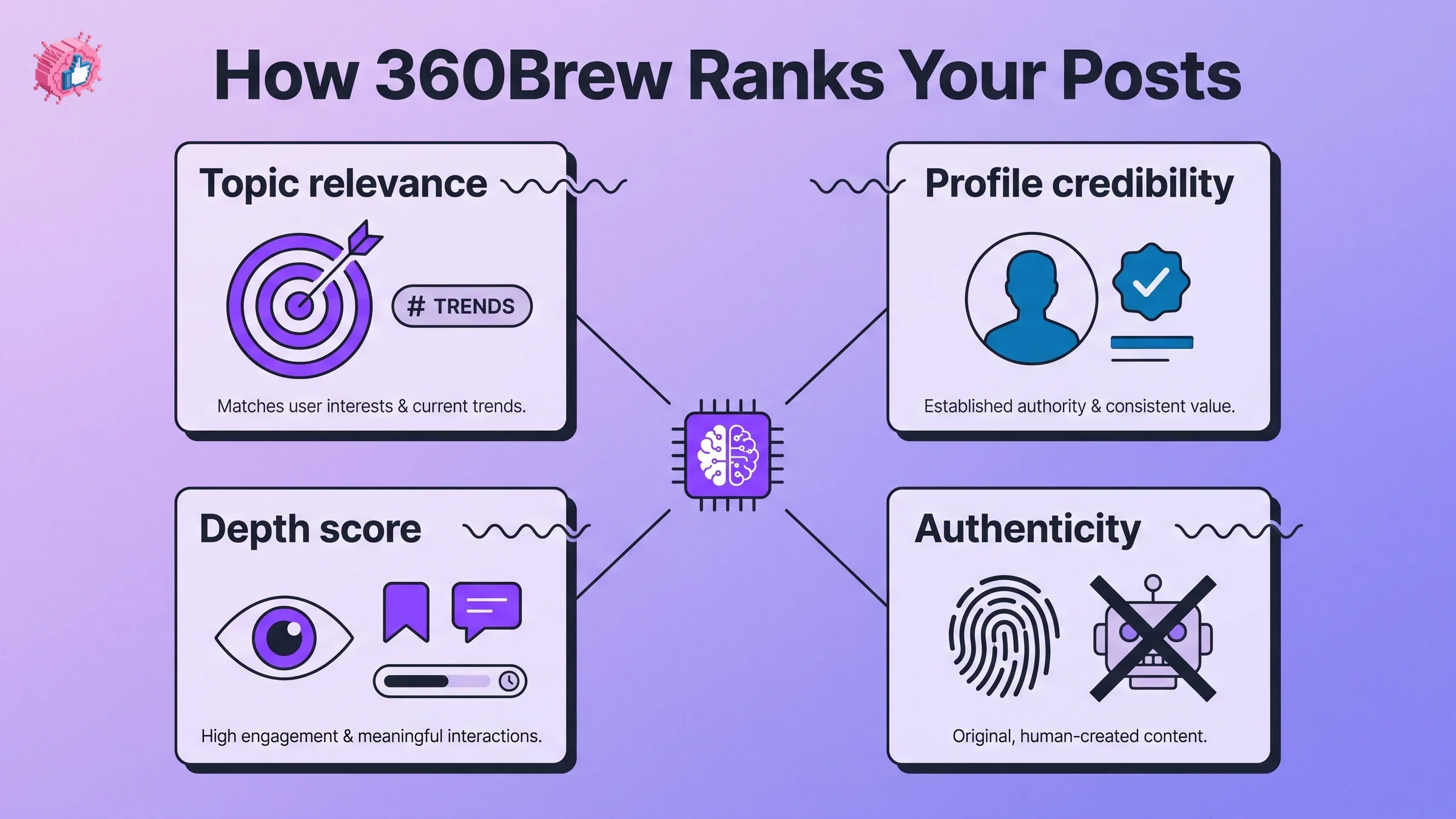
1. Topic relevance and expertise match
360Brew classifies your post's topic from the text itself, then matches it to members who engage with that topic. The tighter and more consistent your subject matter, the stronger your topic signal. Creators who jump between unrelated subjects confuse the model and dilute their reach.
2. Your profile as a credibility signal
This is the part most creators miss. Because 360Brew verbalizes member context as text, your profile now functions as a credibility input to ranking, not just a page people visit. Your headline, your "About" section, your role, and your post history tell the model whether you are a plausible authority on the topic you just posted about.
A finance post from someone whose profile screams finance expertise gets a relevance boost a generic profile does not. Tighten your LinkedIn headline and your LinkedIn summary so they reinforce the exact topic you want to be known for.
3. Depth: dwell time, saves, and meaningful comments
The model rewards sustained attention over passive reactions. Long dwell time (people actually reading), saves, shares to DMs, and multi-sentence comments all signal that a post delivered real value. A quick like is nearly worthless by comparison. This cluster of attention signals is what third-party analysts call the "depth score."
4. Authenticity over engagement bait
360Brew, paired with LinkedIn's classifiers, is far better at spotting manufactured engagement. Explicit asks ("comment YES for the template," "hit like if you agree") and templated, voice-less AI output get demoted. The model is trained to recognize patterns of real human expertise versus filler.
| Signal | What 360Brew measures | How to optimize |
|---|---|---|
| Topic relevance | Semantic subject of the post vs member interests | Stay in one lane, post consistently on your niche |
| Profile credibility | Whether your profile supports the topic | Align headline, About, and role to your topic |
| Depth score | Dwell time, saves, sends, comment quality | Write substantive posts that earn a finish |
| Authenticity | Human expertise vs templated AI or bait | Add first-person specifics, drop explicit asks |
To predict how a draft will land on these signals before you publish, run it through the viral score checker.
Automate your LinkedIn for 30 days
Old ranking stack vs 360Brew
If you optimized for LinkedIn in 2022, your mental model is now wrong in specific ways. Here is the before-and-after.
| Factor | Old ranking stack | 360Brew (2026) |
|---|---|---|
| Architecture | Many specialized, feature-engineered models | One ~150B-parameter decoder-only foundation model |
| Inputs | Hand-engineered numeric features | Natural-language text (posts, behavior, profile) |
| Content understanding | Surface signals (likes, clicks, keywords) | Semantic comprehension of meaning |
| Reach driver | Network size and connection degree | Topic relevance and demonstrated expertise |
| Follower count | Strong reach multiplier | Weaker; relevance can override it |
| Engagement bait | Often worked | Detected and demoted |
| Profile | A page people visited | An active credibility signal in ranking |
| Winning play | Broad reach, viral hooks | Narrow expertise, depth, consistency |
The strategic takeaway: 360Brew rewards thought leadership in the literal sense. Depth in a defined domain beats breadth across many. A post that teaches a memorable framework or mental model tends to earn saves and sends, which the model reads as long-term relevance. For the full playbook on building topic authority, see the LinkedIn personal branding guide.
The "Post prompts" feature and the March 2026 Authenticity Update
Two changes turned 360Brew from a back-end research project into something every creator feels.
Post prompts. LinkedIn rolled out a "Post prompts" feature that nudges creators to share structured, topic-aligned insights. The reason is mechanical: structured, clearly-topic'd posts are easier for 360Brew to classify and route to the right interest cluster. Prompts are a soft way of helping the model understand what you are an authority on.
The March 2026 Authenticity Update. This update operationalized 360Brew's preferences at the policy level. Reported effects include:
- Engagement bait ("comment YES," "agree?") demoted or flagged
- Legacy automation and engagement pods penalized for unnatural patterns
- External link spam suppressed
- NLP classifiers flagging generic, unedited AI output (boilerplate openers, bullet-heavy posts with no personal voice, templated frameworks repeated across accounts)
- A longer, more forgiving 3 to 8 hour evaluation window before wide distribution
The nuance worth repeating: the algorithm is not reliably detecting "AI-written" text and banning it. What it detects is whether anyone cared enough to read, save, and discuss. Generic AI content fails because it produces near-zero dwell time and no real conversation, not because a robot-detector caught it. You can use AI to draft; you cannot ship unedited filler. A tool like the LinkedIn post generator helps because it is built to match your voice and earn depth, not to mass-produce boilerplate.
What this means for you
The model changed, but the response is simpler than the 2022 playbook, not harder.
- Pick one lane and stay in it. 360Brew rewards topic consistency. Three to five recurring themes beat posting about everything. This is how you build the interest-graph signal.
- Make your profile match your topic. Your headline and About section are now ranking inputs. Align them to the exact expertise you want reach for.
- Write for depth, not the like button. Aim for posts people finish, save, and send. Frameworks and specific, first-person insight beat hot takes with no substance.
- Drop the explicit asks. "Comment YES" is a demotion risk. Write something genuinely worth replying to instead. Our LinkedIn hook generator leans on openers that provoke real responses, not manufactured ones.
- Use AI to draft, never to autopilot. Edit for your voice and a concrete insight. Check drafts against the viral score checker before posting.
The interest-graph era is harder for low-effort broadcasting and much easier for anyone with real expertise willing to go deep. For the systems layer behind this, the LinkedIn content strategy guide and the LinkedIn algorithm guide cover cadence, pillars, and distribution.
Sources: 360Brew: A Decoder-only Foundation Model for Personalized Ranking and Recommendation (arXiv 2501.16450), Falia: 360Brew, LinkedIn's New Algorithm Explained (2026), TheLinkedBlog: 360Brew and the LinkedIn Algorithm, What We Know, upGrowth: Optimize LinkedIn 2026 Algorithm (360Brew), LinkBoost: LinkedIn Algorithm Changes 2026, Beat the Depth Score, ZoomSphere: LinkedIn Algorithm 2026, Why Generic AI Content Kills Reach. Paper authors: Hamed Firooz and the LinkedIn FAIT team, January 2025 (paper later withdrawn from arXiv over a licensing issue).
FAQ
What is 360Brew?
360Brew is LinkedIn's unified, decoder-only foundation model for personalized ranking and recommendation. It is a roughly 150-billion-parameter AI model, detailed in a January 2025 arXiv paper by LinkedIn's FAIT team, that replaced thousands of separate recommendation systems. By 2026 it ranks your feed, job recommendations, connection suggestions, and ads from a single model.
How does 360Brew work?
360Brew works like a large language model. Instead of using hand-engineered numeric features, it reads member behavior, post content, and profiles as natural-language text and comprehends what each post is semantically about. It then matches content to members based on topic relevance and demonstrated expertise rather than just connection degree or like counts, solving over 30 predictive tasks with one model.
How is 360Brew different from the old LinkedIn algorithm?
The old algorithm used many specialized, feature-engineered models that counted surface signals like likes and clicks and relied heavily on your network size. 360Brew is a single foundation model that understands content meaning, weighs topic relevance and profile credibility, and rewards depth over passive engagement. It marks the shift from a social graph to an interest graph.
What is the interest graph vs the social graph?
The social graph ranks content by who you are connected to, so reach scales with follower count. The interest graph, which 360Brew powers, ranks content by topic relevance and expertise, so a post can reach interested strangers regardless of connection. Niche, specific content now outperforms broad generalist content.
Does my LinkedIn profile affect how 360Brew ranks my posts?
Yes. Because 360Brew reads your profile as text, your headline, About section, role, and post history act as credibility signals. A post on a topic your profile clearly supports gets a relevance boost a generic or off-topic profile does not. Aligning your profile to one expertise area improves reach.
How do I rank on LinkedIn in 2026?
Pick a narrow topic and post consistently within it, align your profile to that topic, and write substantive posts people finish, save, and send. Drop explicit engagement bait like "comment YES," because 360Brew and LinkedIn's classifiers demote it. Use AI to draft if you want, but always edit for your voice and a concrete insight.
Is the 360Brew paper still available?
The original arXiv paper (2501.16450) was withdrawn by the authors over a submission licensing issue, so the full PDF is no longer hosted there. The abstract, model specifications, and core architecture have been widely reported and remain consistent across LinkedIn's engineering communications and third-party analyses.
Does 360Brew penalize AI-generated content?
Not directly. LinkedIn's systems do not reliably detect AI authorship. What 360Brew measures is whether content earns dwell time, saves, and real discussion. Generic, unedited AI output fails because it generates near-zero depth, while edited AI drafts with genuine insight perform fine. ViralBrain is built to draft in your voice and optimize for depth, and a 7-day trial for €1 is available on the pricing page.
Automate your LinkedIn for 30 days
ViralBrain plans, writes, and schedules your LinkedIn content, using official LinkedIn APIs so your account stays safe.
- Official LinkedIn APIs, no risk of ban
- You approve every post before it goes live
- Cancel anytime
Keep reading
How to Log Out of LinkedIn on Desktop and in the App
How to log out of LinkedIn on desktop, on iOS and on Android, how to sign out of other sessions or all devices, and what Keep me logged in changes.
LinkedIn Two Step Verification: How to Turn It On and Off
LinkedIn documents it as two-factor authentication. How to turn it on and off on desktop and in the app, the two methods, and what to do if locked out.
How to Change Your LinkedIn Password
How to change your LinkedIn password on desktop, iOS, Android and a mobile browser, how to reset a forgotten one, and what the sign out control does.