

LinkedIn Brand Deals in 2026: Inside the New Creator-Brand Marketplace
LinkedIn brand deals changed when Creator Marketplace launched in June 2026. See how the marketplace, rates, and Thought Leader ads work now.
For years, LinkedIn creators landed brand deals the hard way: cold DMs, a media kit cobbled together in Canva, and a lot of waiting. That friction has dropped. LinkedIn launched Creator Marketplace on 10 June 2026, per LinkedIn's announcement, a dealmaking surface that connects creators with brands for sponsored posts. Internal strategy documents viewed by Business Insider (June 2026) had described it as part of a broader creator monetization push for fiscal year 2027 (July 2026 to June 2027); the marketplace arrived ahead of the rest of that list, which remains reported rather than shipped.
This matters because LinkedIn now has roughly 1.3 billion users and a creator-driven feed that looks more like TikTok every quarter. Yet most LinkedIn influencers still close their brand partnerships on Instagram, because that is where the matchmaking infrastructure lives. A native marketplace would change who gets discovered, how deals get priced, and how fast a niche B2B voice can turn an audience into income. If you create content to attract brand deals, or you are a B2B marketer who buys creator partnerships, this is the clearest signal yet of where LinkedIn brand deals are headed. This piece covers what is coming, how sponsored posts and Thought Leader ads work on LinkedIn today, what rates look like, and how the marketplace could reshape pricing and discovery.
Automate your LinkedIn for 30 days
What the leaked marketplace actually is
That marketplace now exists. LinkedIn launched Creator Marketplace on 10 June 2026, per LinkedIn's announcement, which its pressroom dates "Published on Jun 10, 2026". The function is brand matchmaking: a system that connects creators with brands that want to pay for sponsored posts. An earlier version of this page described it as planned for LinkedIn's FY2027 window, based on internal documents reported by Business Insider. That was accurate when written and is out of date now.
Think of it as LinkedIn formalizing a process that already happens informally. Today a SaaS brand that wants a developer-influencer to post about its product has to find that creator manually, negotiate over email, and track deliverables in a spreadsheet. A native marketplace collapses that into a discovery layer, a deal layer, and (likely) a payments layer inside the platform where the audience already lives.
The strategic logic is straightforward. LinkedIn owns the professional graph: job titles, industries, company sizes, seniority. That is exactly the targeting data a B2B brand wants when choosing a creator partner. No other platform can match a brand to a creator whose audience is verifiably full of, say, mid-market CFOs. That data advantage is why a LinkedIn marketplace could become the default for linkedin influencer marketing in the B2B world.
"LinkedIn is investing heavily in creators and creator marketing, and I think it is very early stages," said Gigi Robinson, a creator with around 35,000 followers who is in LinkedIn's partner program and has done paid partnerships with the platform, per Business Insider (June 2026). The "early stages" framing still matters, but for a different reason now. The marketplace has shipped, so the creators who already have distribution and clear positioning are the ones it surfaces first.
This marketplace sits inside a larger plan. For the full picture of paid subscriptions, the creator fund, events, and one-time experiences, read our breakdown of the LinkedIn creator monetization roadmap. Brand deals are only one income stream, so it helps to see where they fit among all the ways to make money on LinkedIn.
How LinkedIn brand deals work today
Before the marketplace exists, it helps to understand the three mechanics already in market. They will not disappear when the marketplace launches. They are the rails it will run on.
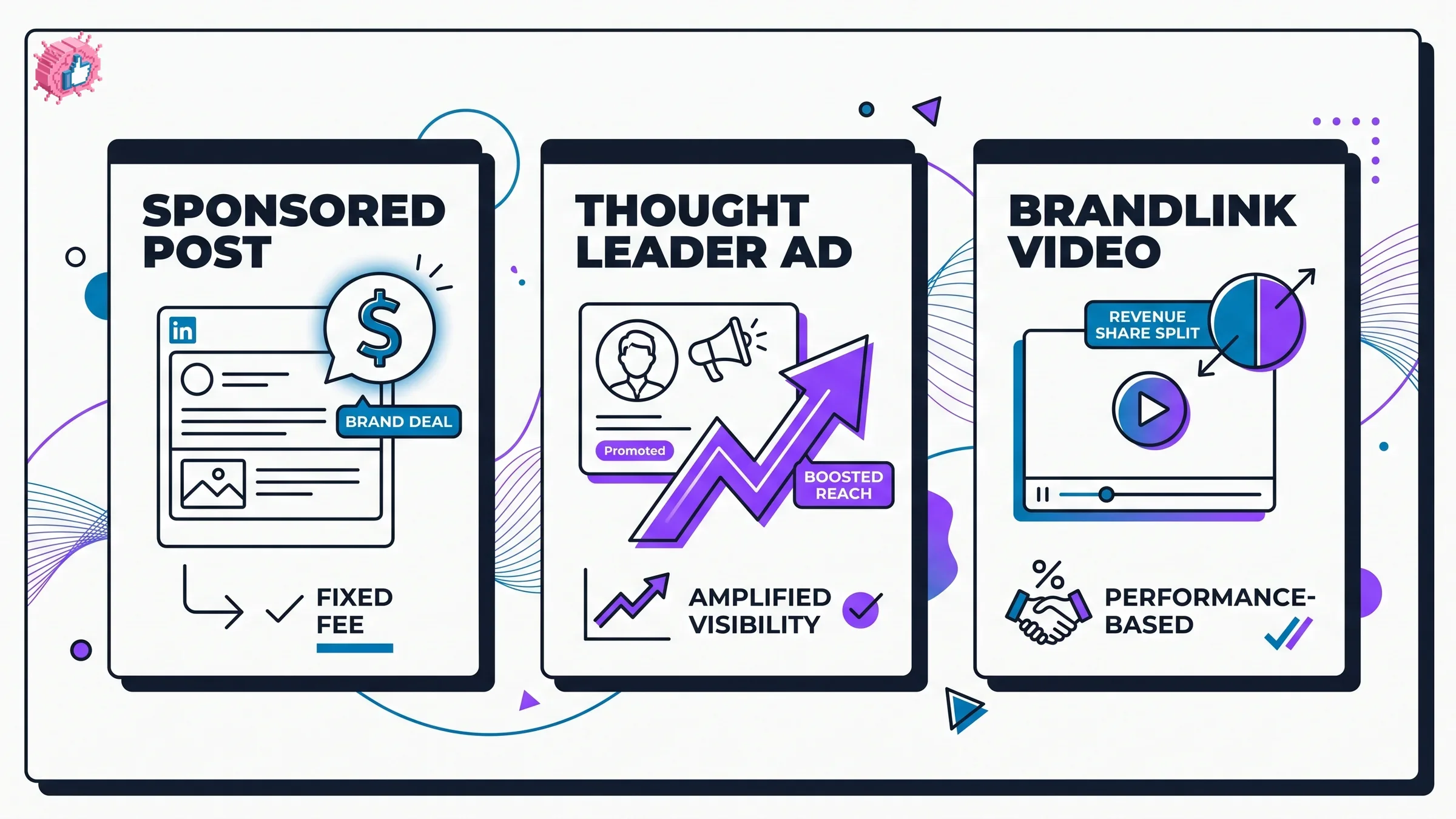
Sponsored posts (direct creator-brand deals)
A sponsored post is the classic arrangement: a brand pays a creator to publish a post about the brand's product, event, or message. On LinkedIn this is usually a text post or document carousel that reads like the creator's normal content but discloses a partnership. These deals are negotiated directly today, off-platform, with no LinkedIn involvement in discovery or payment. The marketplace targets exactly this gap.
Thought Leader ads
Thought Leader ads are a LinkedIn advertising format where a brand pays to amplify a person's post as a sponsored ad. In practice, a brand can boost a post from its own employee or from a creator it partners with, putting paid spend behind authentic, first-person content rather than a polished corporate ad. This is one of LinkedIn's most direct existing links between creators and brand budgets. A creator's post becomes the creative, and the brand pays for the reach.
For B2B marketers, Thought Leader ads already outperform standard company-page ads on trust signals, because audiences engage more with a named human than a logo. Creator Marketplace makes finding the right person to feature considerably easier, since brands can now search opted-in creators by topic and expertise.
BrandLink
BrandLink is LinkedIn's video ad-revenue-share program, running with 100-plus creators and publishers. Brands place ads against premium creator video, and the creator shares in the revenue. It is closer to the YouTube model than the others: the creator does not negotiate a one-off deal, they earn a share of ad spend tied to their video content. BrandLink shows LinkedIn is comfortable cutting creators into ad dollars, which makes the marketplace a natural next step.
Here is how the three formats compare.
| Format | How the creator gets paid | Who initiates | Best for | Discovery today |
|---|---|---|---|---|
| Sponsored posts | Flat fee per post, negotiated directly | Brand or creator outreach | Niche authority creators | Manual, off-platform |
| Thought Leader ads | Brand pays to amplify the creator's post | Brand (with creator permission) | Creators with high-trust content | Brand picks the person |
| BrandLink | Revenue share on video ads | LinkedIn program (invite) | Video creators and publishers | Program selection |
The pattern is clear. Two of three formats currently depend on a brand finding the creator. The marketplace flips that by giving creators a place to be found.
What LinkedIn brand deal rates look like
There is no official LinkedIn rate card, and the platform has not published pricing for sponsored posts. What follows is drawn from how comparable creator markets price deals, so treat these as ranges, not guarantees.
Sponsored-post rates on LinkedIn are driven less by raw follower count and more by audience quality. A creator with 8,000 highly targeted followers (say, procurement leaders) can command more than a creator with 80,000 generalist followers, because the B2B buyer the brand wants is concentrated. This is the opposite of consumer influencer pricing, where reach often dominates.
The rough variables that set a LinkedIn brand-deal rate:
- Audience relevance. How tightly the follower base matches the brand's buyer
- Engagement rate. Comments and saves matter more than likes for B2B intent
- Content format. A document carousel or video typically prices above a plain text post
- Exclusivity and usage. Whether the brand can run the post as a Thought Leader ad adds value
- Deliverable count. A single post versus a multi-post campaign
If you do not know where your engagement sits relative to your niche, check our LinkedIn engagement benchmarks before you quote a brand a number. Underpricing is the most common mistake new creators make, and walking into a negotiation with benchmark data fixes it.
For B2B marketers on the buying side, the calculus is different. You are not buying reach, you are buying borrowed credibility from a voice your buyers already trust. A Thought Leader ad behind a respected operator's post often beats a higher-reach campaign on a generalist account, because relevance converts and vanity reach does not.
How creators land LinkedIn brand deals right now
The marketplace is not live, so the deals available today still go to creators who do the groundwork. The good news is that the work that wins deals now is the same work that will make the marketplace surface you later.
1. Build a clear, single-topic positioning. Brands buy specific audiences, not general popularity. A creator known precisely for "RevOps for Series B startups" is far easier to match to a sponsor than a creator who posts about everything. Tighten your niche before you chase deals. Our LinkedIn personal branding guide walks through how to define and defend a positioning.
2. Make your content consistent and on-message. A brand evaluating you scrolls your recent posts. If half are off-topic, your perceived authority drops. Plan your output so the topics a sponsor cares about appear regularly, which is exactly what a documented LinkedIn content strategy is for.
3. Show engagement, not just followers. Screenshot your comment threads and saves. A brand wants proof your audience acts, and engagement evidence beats a follower count every time.
4. Create a lightweight media kit. One page: who your audience is, your engagement numbers, example posts, and your rates. You do not need design polish, you need clarity.
5. Demonstrate you can make sponsored content perform. The hardest part of a brand deal is making a paid post that still goes far. If you can show a sponsored post that landed well, you become a repeat partner. Drafting a sponsored post that reads natively and still performs is exactly the job the LinkedIn post generator is built for, and you can pressure-test the draft with the viral score checker before it goes live.
Automate your LinkedIn for 30 days
How the marketplace could change pricing and discovery
A native marketplace does not just add convenience. It changes the underlying economics of LinkedIn brand deals in three ways.
Discovery shifts from outreach to search. Today the bottleneck is being found. In a marketplace, brands filter by audience attributes and shortlist creators in minutes. That favors creators with clean positioning and strong proof, and it pulls mid-tier creators (the 5,000 to 50,000 follower range) into deals they would never have been pitched manually.
Pricing gets more transparent, and more competitive. When deals happen in a marketplace, rates become comparable. That transparency helps creators price confidently, but it also introduces competition. Differentiation moves from "do I have a big audience" to "do I have a uniquely relevant one." Niche depth becomes the moat.
LinkedIn's data becomes the matching engine. This is the part no rival can copy. LinkedIn can match a brand to a creator using verified professional data: the seniority, industry, and company size of the creator's actual engaged audience. That makes LinkedIn the most precise venue for B2B linkedin sponsored posts, and it is why the company is building this now rather than ceding the budget to Instagram.
There is a real risk for creators too. A marketplace can commoditize deals, pushing rates down for undifferentiated accounts and concentrating premium budgets on a smaller set of clearly positioned voices. The defense is the same as the offense: own a niche, prove engagement, and build distribution before the system goes live.
LinkedIn versus other platforms for B2B brand deals
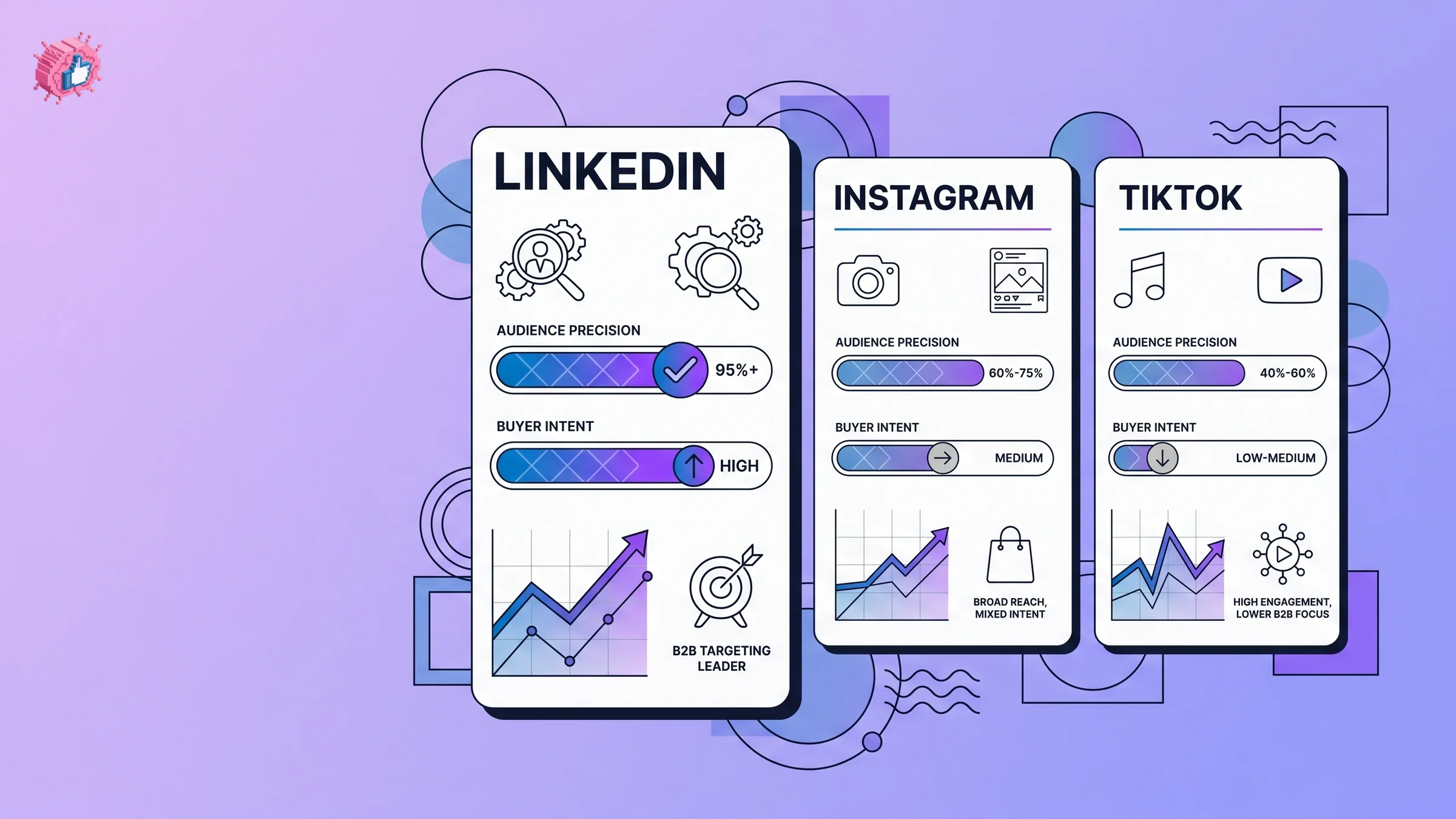
Many influencers still run their brand-deal business on Instagram and TikTok, even when their content is professional. The marketplace is LinkedIn's bid to pull that activity onto its own turf for B2B specifically. Here is how the platforms compare for brand partnerships aimed at business buyers.
| Factor | TikTok | ||
|---|---|---|---|
| B2B audience precision | Highest (verified professional data) | Low to moderate | Low |
| Native deal marketplace | Live since June 2026 (Creator Marketplace) | Mature (Creator Marketplace) | Mature (Creator Marketplace) |
| Best content for deals | Text, carousels, Thought Leader ads | Reels, stories | Short video |
| Buyer intent of audience | High for B2B | Mixed | Low for B2B |
| Rate driver | Audience relevance | Reach and aesthetics | Reach and virality |
| Where deals close today | Off-platform | In-app and off-platform | In-app and off-platform |
The summary: LinkedIn lags on marketplace maturity but leads on the one thing B2B brands actually pay for, which is audience precision. Closing the infrastructure gap is exactly what the dealmaking marketplace does. For context on why the broader feed and reach dynamics favor consistent creators, see how to go viral on LinkedIn, because reach is still the raw material a sponsor is buying.
What this means for you
Whether you create content or buy partnerships, the window before the marketplace launches is the time to position.
- If you are a creator, pick one topic and own it. Marketplace matching rewards precise positioning over broad reach. Decide what brand category you want to attract and make your feed unmistakably about it.
- Build engagement proof now. Save the comment threads and metrics that show your audience acts. Quote rates against LinkedIn engagement benchmarks so you do not underprice.
- Practice sponsored content that performs. Draft and test a branded post with the LinkedIn post generator so you can show a sponsor you make paid content that still travels.
- If you are a marketer, start with Thought Leader ads today. Thought Leader ads work independently of Creator Marketplace, so you can put budget behind a trusted creator post without going through it. Identify the voices your buyers already follow and partner now.
- Treat positioning as the asset. When discovery moves to search, the creators with the clearest, most relevant audiences win the deals. If you want help turning a profile into a discoverable brand, start with ViralBrain and review the plans on the ViralBrain pricing page.
The marketplace is early, as Gigi Robinson said. That is the opportunity. The creators who build a tight niche and provable engagement before it ships will be the ones LinkedIn surfaces first.
Sources: Business Insider, "Internal LinkedIn docs reveal the new features it's cooking up" (June 2026)
FAQ
What are LinkedIn brand deals?
LinkedIn brand deals are paid partnerships where a brand pays a creator to promote its product, event, or message to the creator's audience. Most run as sponsored posts today, negotiated directly between brand and creator. LinkedIn made this matchmaking native to the platform when Creator Marketplace launched in June 2026.
What is the LinkedIn dealmaking marketplace?
It is a live feature, launched on 10 June 2026, that connects creators with brands for sponsored posts. It functions as brand matchmaking inside LinkedIn. Internal documents viewed by Business Insider (June 2026) had placed it in the company's creator monetization plans for fiscal year 2027, before it shipped early.
What are Thought Leader ads on LinkedIn?
Thought Leader ads are a LinkedIn advertising format where a brand pays to amplify a person's post as a sponsored ad. Instead of a corporate ad, the brand boosts authentic first-person content from an employee or partnered creator, which tends to earn more trust and engagement than a standard company-page ad.
How much do LinkedIn sponsored posts pay?
There is no official LinkedIn rate card, and rates vary widely. On LinkedIn, audience relevance and engagement matter more than raw follower count, so a smaller, highly targeted B2B audience can command higher rates than a larger generalist one. Check engagement benchmarks before quoting a brand.
How do I get brand deals on LinkedIn right now?
Define a single, clear niche, post consistently on that topic, and collect engagement proof such as comment threads and saves. Build a one-page media kit with your audience data and rates, then reach out to brands whose buyers match your audience. The same positioning work will help the future marketplace surface you.
Is LinkedIn better than Instagram for B2B brand deals?
For B2B specifically, LinkedIn offers the most precise audience targeting because it has verified professional data like job title, industry, and seniority. Instagram and TikTok have more mature deal marketplaces, but LinkedIn now has one of its own and it keeps the B2B precision advantage.
What is BrandLink on LinkedIn?
BrandLink is LinkedIn's video ad-revenue-share program running with more than 100 creators and publishers. Brands place ads against premium creator video, and creators earn a share of the revenue, similar to the YouTube model rather than a one-off sponsored post.
When will the LinkedIn creator-brand marketplace launch?
It already has. LinkedIn announced Creator Marketplace on 10 June 2026, so this is no longer a question of timing. Creators opt in to be discoverable by brands, and our guide to LinkedIn Creator Marketplace covers what you control once you do.
Automate your LinkedIn for 30 days
ViralBrain plans, writes, and schedules your LinkedIn content, using official LinkedIn APIs so your account stays safe.
- Official LinkedIn APIs, no risk of ban
- You approve every post before it goes live
- Cancel anytime
Keep reading
LinkedIn Creator Marketplace: how creators get found
LinkedIn launched Creator Marketplace on 10 June 2026. What it does for creators, the four controls you get after opting in, and what LinkedIn has not said.
LinkedIn's Creator Monetization Roadmap: What Leaked for 2026
LinkedIn creator monetization: the brand-deal marketplace shipped June 2026, while paid subscriptions, a creator fund and events are reported for FY2027.
Top 8 LinkedIn Creators to Follow in 2026 and What to Learn From Each
The top 8 LinkedIn creators to follow in 2026, what makes each one worth studying, and what to borrow for your own content.