I’m excited to announce that Reforge is joining Miro. 10 years ago Andrew Chen and I ran the first Reforge Growth Series. What started as a single course has grown into a community of over 100,000 alu…


LinkedIn Content Strategy & Writing Style
Founder/CEO @ Reforge, Advisor @ Long Journey Ventures, Previously VP Growth @ HubSpot
0 people tracking this creator on ViralBrain
Brian Balfour positions himself as the preeminent architect of growth systems, evolving from a HubSpot executive to the visionary founder who scaled Reforge into the industry standard for professional tech education. His content strategy centers on the mechanics of the AI transition, moving beyond hype to explore how synthetic research, AI-native workflows, and automated agents fundamentally redefine product management. He is notable for his ability to translate high-level distribution shifts into rigorous, open-source frameworks, recently bridging the gap between enterprise product strategy and personal longevity through his bio-hacking projects. This intersection of professional growth frameworks and data-driven personal health reflects a consistent value proposition: using systems thinking to navigate complex, high-stakes environments.
0
0
516
—
—
86
4
I’m excited to announce that Reforge is joining Miro. 10 years ago Andrew Chen and I ran the first Reforge Growth Series. What started as a single course has grown into a community of over 100,000 alu…

After we announced yesterday that Reforge is being acquired by Miro, I got flooded with messages from folks sharing how much impact Reforge has had on their career. These notes mean more to me than I…

The last 12 months have been a whirlwind. I'm reflecting on the journey on a gorgeous San Francisco morning ahead of Stripe Sessions. There's a few key inflection points and people that were absolutel…
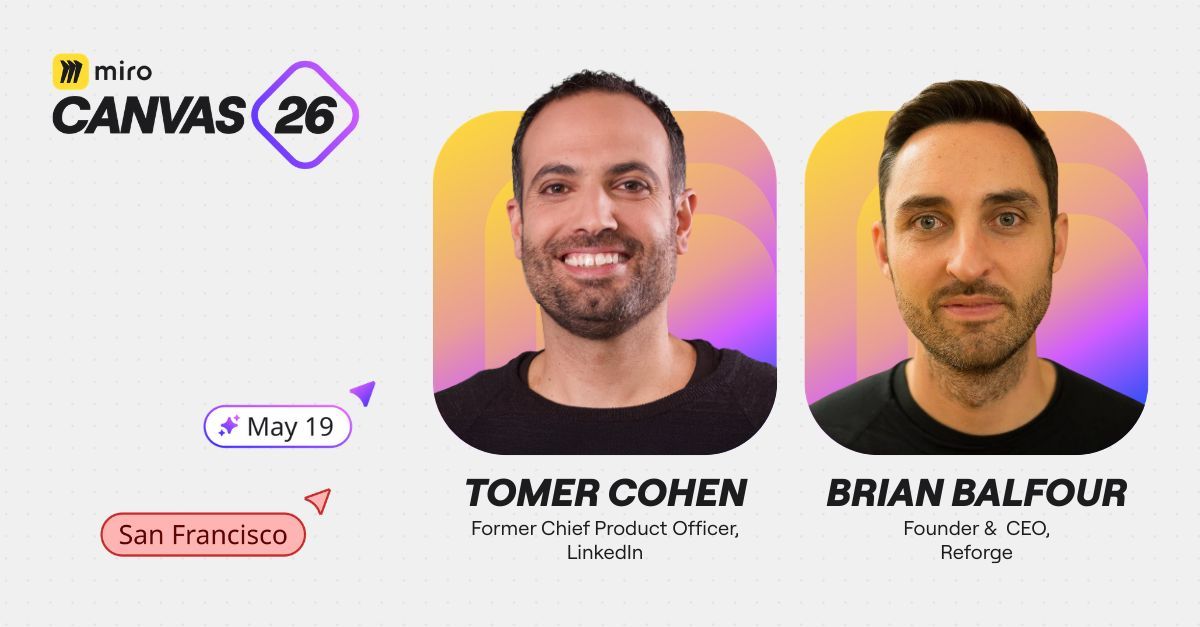
A year ago I published "The Next Great Distribution Shift." I'll be presenting an update at Canvas 26 in SF (free). What I got right, wrong, and what comes next... Tomer Cohen (Former CPO at Linked…

I spent the last 3.5 years at Underdog, growing from Chief of Staff to VP of BizOps to Chief Product Officer, leading a 250-person org across product, engineering, design, and data. But the last 12 m…
A heartfelt congrats to Steven Eidelman and the Modern Animal team on the acquisition by Chewy from me and George (our french bulldog). Steve is one of the most genuine people I know. Someone you ju…

2.0 posts/week
Posts / Week
4
Total Posts Analyzed
MEDIUM
Posting Frequency
515.8%
Avg Engagement Rate
STABLE
Performance Trend
250
Avg Length (Words)
HIGH
Depth Level
ADVANCED
Expertise Level
0.9/10
Uniqueness Score
YES
Question Usage
0.85%
Response Rate
Writing style breakdown
<start of post>
I’ve spent the last decade obsessed with how teams build. From early-stage startups to scaling Reforge, the pattern is always the same: we spend 80% of our time on the "how" and only 20% on the "why."
But the world just shifted.
Last week, I sat down with a group of founders to look at how they’re integrating AI into their daily workflows. It wasn't just about automation. It was about a fundamental change in the stack.
So I decided to run an experiment.
I took our internal documentation—years of product specs, strategy memos, and user feedback—and ran it through a custom agent built on Claude.
The results were startling.
It didn't just summarize the text. It identified three major gaps in our Q4 roadmap that we had completely overlooked because we were too close to the problem.
A redundancy in our onboarding flow that was costing us 15% in drop-off.
A misalignment between our marketing copy and the actual feature set of our latest release.
A "ghost" persona we were still designing for, even though the data showed they had churned months ago.
These weren't things a human couldn't see. They were things a human didn't have the bandwidth to look for while shipping at 100mph.
This is the "Full Stack Builder" era Tomer Cohen talks about. It’s not about doing more with less. It’s about doing things that were previously impossible because the cognitive load was too high.
We’re just scratching the surface of what this means for product management.
If you’re building in this space, I’d love to hear what you’re seeing. Are you using agents for strategy, or just for code?
Come join the conversation at Canvas 26 next month. I’ll be sharing the full breakdown of our experiment and the prompts we used to get there. Link in comments.
Joe, Sarah, Mike, Elena, and the rest of the crew—thanks for the push on this one. ⚡
<end of post>
Sign in to unlock the full writing analysis
Free tools to help you write, score, and benchmark in the same style.
Other creators worth studying alongside Brian Balfour.
Stefano Puntoni
Wharton Professor - AI & Behavioral Science
41 Viral Score
Olivier Sibony
NYT best-selling author, strategy professor, keynote speaker
20 Viral Score

Madison Leonard ☀️
Fractional Product Marketer & Product Manager || AI and workflow nerd || Grew ClickUp from $20M to $200M ARR || Implemented product-led GTM @ Vanta || Sharebird Product Marketing Mentor & 4x PMA Top PMM
55 Viral Score
Emre Varol
CEO of A2SV - Africa to Silicon Valley | Founder on a Mission | Empowering Africa’s Top Tech Talent | Building Digital Solutions & Connecting Graduates with Global Leaders
224 Viral Score
Wytze de Haan
AI for eventprofessionals ✨
217 Viral Score
David Allen
Founder, David Allen Company
28 Viral Score
ViralBrain plans, writes, and schedules your LinkedIn content — using official LinkedIn APIs so your account stays safe.
Write like Brian Balfour.