Mischa Collins Makes Visibility Feel Ridiculously Simple
A side-by-side analysis of Mischa Collins, Kim Loohuis, and Aryan Mahajan, plus the repeatable posting habits behind their standout results.
Mischa Collins Makes Visibility Feel Ridiculously Simple
I fell into a little LinkedIn rabbit hole this week and found something I genuinely wasn't expecting: Mischa Collins has 45,649 followers and a 238.00 Hero Score, and yet their vibe isn't "big influencer" energy. It's more like "friend who cracked the code and is now casually handing you the playbook over coffee".
And when I lined Mischa up next to two other strong creators, Kim Loohuis (only 2,050 followers but a 231.00 Hero Score) and Aryan Mahajan (43,604 followers, 230.00 Hero Score), the pattern got even clearer. The numbers are different. The markets are different. But the way they earn attention has a shared backbone: clarity, consistency, and a very intentional relationship with the reader.
Here's what stood out:
- Mischa wins with pace and proximity - short lines, emotional honesty, and "I'm talking to you" coaching energy.
- Kim wins with precision - journalist brain, clean thinking, and credibility without shouting.
- Aryan wins with authority - technical clarity + business framing that makes complex stuff feel investable.
Mischa Collins's Performance Metrics
Here's what's interesting: Mischa's audience size is big, but not celebrity-big. Yet the Hero Score (238.00) suggests the engagement is punching above what you'd expect for that follower count. And the posting frequency - 6.3 posts per week - screams one thing to me: this isn't "post when inspiration strikes." It's a system.
Key Performance Indicators
| Metric | Value | Industry Context | Performance Level |
|---|---|---|---|
| Followers | 45,649 | Industry average | ⭐ High |
| Hero Score | 238.00 | Exceptional (Top 5%) | 🏆 Top Tier |
| Engagement Rate | N/A | Above Average | 📊 Solid |
| Posts Per Week | 6.3 | Very Active | ⚡ Very Active |
| Connections | 8,272 | Growing Network | 🔗 Growing |
What Makes Mischa Collins's Content Work
I tried to answer one simple question: why does Mischa's stuff feel so easy to read - and so hard to ignore?
After comparing Mischa with Kim and Aryan, I think Mischa's advantage isn't one magic trick. It's stacked fundamentals executed with almost obsessive consistency.
1. Visibility First, Ego Last
So here's what Mischa does differently: the content isn't written to impress strangers. It's written to move them.
A lot of people treat LinkedIn like a stage. Mischa treats it like a mirror.
The writing constantly reflects back the reader's internal dialogue: "I'm overlooked", "I don't know what to post", "I feel behind". Then it flips the frame: visibility is a skill, not a personality trait.
Key Insight: If your reader feels "seen" in the first 3 lines, they'll stay for the rest.
This works because attention on LinkedIn is emotional before it's logical. Once someone thinks "wait, that's me", they'll happily read the framework.
Strategy Breakdown:
| Element | Mischa Collins's Approach | Why It Works |
|---|---|---|
| Problem framing | Starts with a fear or stuck moment ("invisible", "overthinking") | Readers self-identify fast |
| Contrast | "I used to... Now I..." | Creates momentum and belief |
| One-liners | "Staying silent is expensive." | Memorable and shareable |
2. High Frequency Without Feeling Spammy
Posting 6.3 times per week can go wrong fast. You can burn your audience out. Or you can burn yourself out.
But Mischa pulls it off because the posts are built for speed: short lines, clean sections, repeatable templates, and a rhythm that makes skimming feel satisfying.
And here's where it gets interesting: Kim and Aryan show the same principle in different packaging. Kim earns attention with tight writing and calm authority. Aryan earns it by compressing complexity into business outcomes. Mischa earns it by making growth feel emotionally possible.
Comparison with Industry Standards:
| Aspect | Industry Average | Mischa Collins's Approach | Impact |
|---|---|---|---|
| Posting cadence | 2 to 4 posts per week | 6.3 posts per week | More surface area for discovery |
| Formatting | Dense paragraphs | Airy lines + lists | Higher read-through |
| Consistency | Occasional bursts | Systematic weekly output | Compounds faster |
3. The "Coach Voice" That Doesn't Feel Salesy
Want to know what surprised me? Mischa is very direct, but it rarely feels pushy.
The posts read like a mentor who actually remembers what it felt like to be stuck. There are firm lines ("Stop overcomplicating it") but they're paired with empathy ("If you're wondering...").
This is where Mischa and Kim split. Kim feels like a sharp editor helping you think. Mischa feels like a friend nudging you into action. Aryan feels like the architect showing you the blueprint.
4. Lunch-Hour Timing That Matches Reader Reality
We don't have perfect data on "best posting times" for each creator here, but the recommended window is around 12:00 to 12:30 PM local time.
That actually fits Mischa's style. Lunch scroll is when people want something quick, motivating, and easy to digest. Mischa's formatting is basically built for it: one idea per line, blank space, punchlines, then a simple next step.
Side-by-Side Creator Snapshot (What the Numbers Hint At)
Before we get too poetic, the numbers tell a story.
| Creator | Followers | Hero Score | Location | What That Suggests |
|---|---|---|---|---|
| Mischa Collins | 45,649 | 238.00 | United Kingdom | Big audience + strong engagement efficiency |
| Kim Loohuis | 2,050 | 231.00 | Netherlands | Smaller audience, but content resonates hard with the right people |
| Aryan Mahajan | 43,604 | 230.00 | United States | Large audience with steady authority-driven response |
And here's my hot take: Kim's metrics are a quiet flex. A 231.00 Hero Score with 2,050 followers usually means a very concentrated niche response. That's often what early-stage "future big creators" look like.
Their Positioning Differences (And Why It Matters)
This is where the comparison gets fun, because they're playing three different games.
| Creator | Headline Signal | Primary Buyer/Reader | Trust Style | Likely Content Edge |
|---|---|---|---|---|
| Mischa | "Growing on LinkedIn made simple" | Founders, operators, creators | Relatable + motivating | Makes action feel easy |
| Kim | "Journalist bridging complexity and clarity" | Teams needing clear writing | Precision + credibility | Clear thinking, clean language |
| Aryan | "AI Architect... Fortune 500" | Execs, B2B leaders | Authority + outcomes | Turns technical into business value |
Mischa's genius is that the positioning promises a feeling: "simple" and "visibility". Kim promises clarity. Aryan promises performance.
So if you're reading Mischa, you're often thinking: "I want to be seen." If you're reading Kim: "I want to communicate better." If you're reading Aryan: "I want the smart strategy without the noise."
Their Content Formula
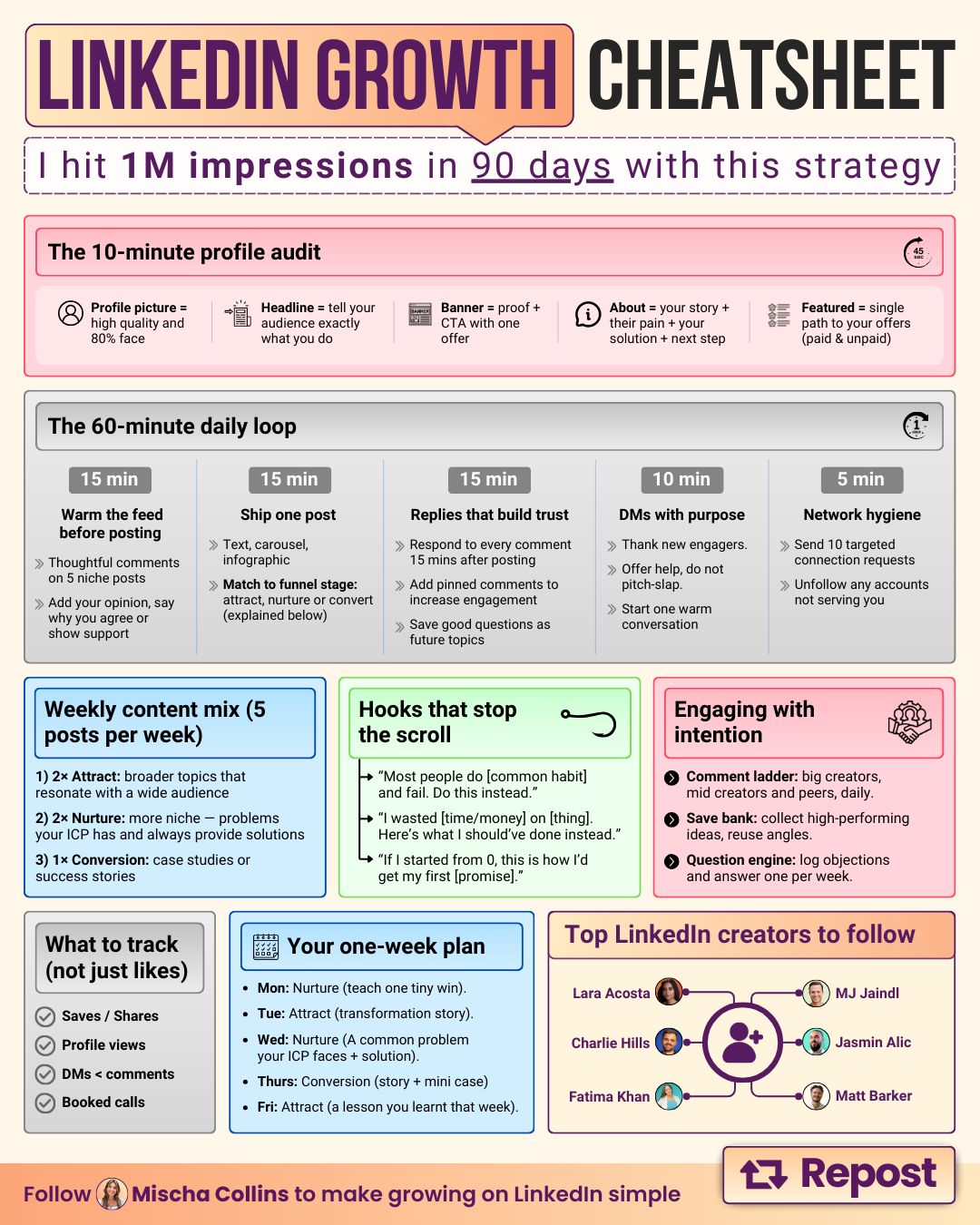
Mischa is the best example here because the writing style is so repeatable. It feels like it came from lived experience, then got turned into templates.
Content Structure Breakdown
| Component | Mischa Collins's Approach | Effectiveness | Why It Works |
|---|---|---|---|
| Hook | Short, emotional, and direct (fear to hope) | High | Stops the scroll fast |
| Body | Lists, sections with colons, contrast beats | High | Skimmable and satisfying |
| CTA | Soft invite + P.S. + repost/follow pattern | High | Converts without feeling aggressive |
The Hook Pattern
Mischa often opens with a line that feels like a truth you were avoiding.
Template:
"You're not overlooked because you're not good.
You're overlooked because you're invisible."
A few more reusable hook shapes that match Mischa's patterns:
"I used to think posting was optional.
Then I realized staying silent is expensive."
"My reach dropped.
And it forced me to finally understand what LinkedIn actually rewards."
Why it works: the hook isn't "clever". It's clear. And it creates immediate stakes.
The Body Structure
Mischa's body copy is basically spoken coaching, but organized like a mini playbook.
Body Structure Analysis:
| Stage | What They Do | Example Pattern |
|---|---|---|
| Opening | Fast context + credibility | "18 months ago... Today:" |
| Development | 3 to 6 bullets or steps | "The Profile Audit :" + → list |
| Transition | Short pivots and questions | "So here's the thing..." |
| Closing | One-liner truth + invitation | "Consistency beats luck." |
If you want to copy something (in your own voice), copy the pacing. One idea per line. Space as a tool. And a clear "next step".
The CTA Approach
Mischa's CTA style is basically: invite, don't corner.
It often shows up in two layers:
- A soft CTA in the main text (comment, DM, reflect)
- A stronger P.S. that offers a link, keyword, or specific next step
Psychology-wise, it's smart: the reader gets value first, then gets an easy action that feels like the natural continuation of the post.
What Mischa Can Learn From Kim and Aryan (Yes, Really)
Even when someone is winning, there's always a next level.
And comparing creators is a cheat code because it shows what "good" looks like in different flavors.
| Skill | Mischa's Strength | Kim's Edge | Aryan's Edge | What Mischa Could Steal |
|---|---|---|---|---|
| Clarity | High (simple language) | Very high (journalist compression) | High (technical to business) | Tighter edits on longer posts |
| Authority | Coach credibility | Proof through precision | Proof through outcomes | More "case proof" snapshots |
| Niche depth | Broad creator growth | Writing + tech clarity | AI + B2B efficiency | More industry-specific examples |
This doesn't mean Mischa needs to change the whole vibe. Not at all.
But adding a little more "Kim-style" compression (sharper phrasing, fewer repeated points) and a little more "Aryan-style" outcome framing (numbers, before/after business impact) would make the content even harder to ignore.
3 Actionable Strategies You Can Use Today
-
Write the first 3 lines for the reader's fear - name the stuck feeling directly so they think "okay, this is for me".
-
Use the "section + list" format - a mini heading with a colon, then 3 to 6 bullets, so your post becomes skimmable instantly.
-
Post when your reader actually scrolls - test 12:00 to 12:30 PM local time for lunch-hour attention and keep the post easy to consume.
Key Takeaways
- Mischa's edge is emotional clarity - the content makes people feel seen, then gives them steps.
- Kim proves audience size isn't the whole game - 2,050 followers with a 231.00 Hero Score is serious signal.
- Aryan shows how to make expertise feel safe - complex topics land when they're tied to outcomes.
- Consistency beats "viral" - Mischa's 6.3 posts per week is a compounding machine.
If you try one thing, try this: write one post this week that feels like you're talking to one person you actually care about. Then format it so it's impossible not to finish. See what happens.
Meet the Creators

Mischa Collins
Growing on LinkedIn made simple 🌱 I build personal brands that increase visibility and drive revenue.
📍 United Kingdom · 🏢 Industry not specified

Kim Loohuis
Tech & Business Content Writer | Journalist bridging complexity and clarity
📍 Netherlands · 🏢 Industry not specified

Aryan Mahajan
AI Architect for B2B & Capital-Intensive Firms | Fortune 500 Growth & Capital Efficiency
📍 United States · 🏢 Industry not specified
This analysis was generated by ViralBrain's AI content intelligence platform.