Harro Schwencke and the Moment Validation Arrived
What Harro Schwencke's minister visit reveals about startup growth, manufacturing, retail momentum, and telling the story well.
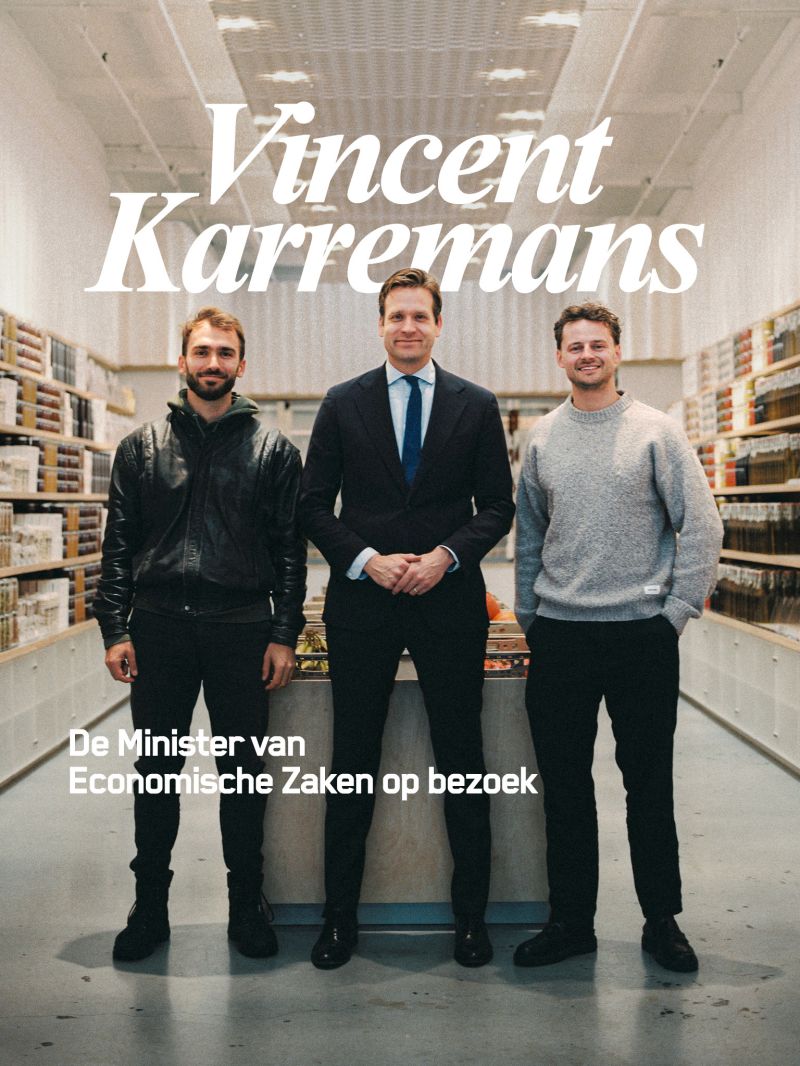
Harro Schwencke recently shared something that caught my attention: "Hoog bezoek uit Den Haag 🤝
Deze week mochten we de minister van Economische Zaken, Vincent Karremans, verwelkomen op de Upfront Campus." That short opener says a lot. Not just about a minister dropping by, but about a startup crossing an invisible line: from being a scrappy outsider to being taken seriously by institutions.
When Harro adds that Karremans called Upfront a "frisse wind" and that it "laat zien dat het wél kan in Nederland," you can hear the mix of pride and disbelief. I get it. Metrics are one thing. Recognition from someone who represents the economic agenda of the country hits differently.
"Omzetcijfers, grote hoeveelheden bestellingen en likes op social zijn gaaf. Maar het feit dat hetgeen wat we aan het bouwen zijn wordt gezien en erkend door de minister van Economische Zaken is wel echt een heel nieuw niveau."
Below, I want to expand on what Harro is really pointing at: why external validation matters (even if we pretend it does not), what Upfront’s 2025 milestones signal about execution, and how founders can communicate progress in a way that builds trust with customers, retailers, and yes, government.
The hidden milestone: being seen by the system
Startups often measure progress in revenue, retention, and growth. Those are essential. But there is another milestone that is harder to quantify: legitimacy.
A visit from a Minister of Economic Affairs is not just a photo moment. It is a signal that your company has become part of the broader economic conversation. That can unlock second-order effects:
- Credibility with partners who are risk-averse (landlords, banks, enterprise suppliers)
- More serious attention from large retailers and distributors
- Easier hiring because candidates perceive stability and ambition
- A louder platform to influence policy that affects your category
Harro framed it honestly: the likes are nice, the numbers are nice, but this felt like "een heel nieuw niveau." I read that as: Upfront is moving from "interesting brand" to "relevant actor." Many founders chase this without naming it.
Why the Upfront story resonates right now
Upfront sits at the intersection of a few timely themes in the Netherlands and across Europe:
- Re-industrialization and local production
- Health and skepticism toward ultra-processed food
- Retail consolidation where shelf space is brutally competitive
- Consumer demand for brands with clear values and simple product logic
When a company manages to operate in both e-commerce (fast feedback loops) and retail (mass distribution, slow negotiations), while also investing in manufacturing (capex, operational complexity), it becomes an economic story, not only a marketing story.
That helps explain why a minister would be curious. Founders who build real infrastructure tend to create jobs, supplier networks, and export potential. Governments notice that.
2025 as a case study in execution
Harro said 2025 felt almost normal because they live it every day, but then listed what is actually an unusually dense set of wins. Let’s unpack each one and what it implies.
1) Opening a product facility (30% of volume)
Producing 30% of your volume in your own facility is not a vanity milestone. It changes your control over:
- Quality and consistency
- Iteration speed (new SKUs, reformulations)
- Margin structure and cost predictability
- Supply chain risk
It also increases the operational burden. Manufacturing forces discipline: forecasts, QA, compliance, shift planning, maintenance, waste control. Many consumer startups avoid it because it is hard. But when your brand promise is linked to ingredient integrity and trust, owning parts of production can be a strategic moat.
The message I take from Harro’s milestone: the brand is becoming an operation, not just a label.
2) The Upfront-supermarket: 185 products, no ultra-processed food
A supermarket with only 185 products is a radical constraint. Most retailers optimize for choice, promotions, and category depth. Upfront is optimizing for clarity.
This is more than a retail experiment. It is a statement about curation. Consumers are tired of ingredient lists they cannot parse and aisles engineered for impulse.
By going "fully free of ultra-processed food," Upfront is also stepping into a contested definition space. People debate what counts as ultra-processed, and different classification systems exist. That is exactly why the concept works as a conversation starter: it forces education, not just transactions.
If I were advising another founder reading Harro’s post, I would highlight this: a strong point of view creates a filter. A filter reduces complexity for the customer, and reducing complexity is a form of value.
3) 800,000 online orders in sports nutrition
800,000 orders is operational excellence. It means customer acquisition, repeat purchase, fulfillment reliability, customer support, and supply chain stability at scale.
It also means Upfront has a direct line to the market. E-commerce is not just a channel, it is an R and D engine:
- You see which products convert and which do not
- You can test bundles, pricing, and messaging quickly
- You can build community and brand rituals
Those learnings compound when you enter retail, because you already know what sells.
4) Fastest growing brand in retail (Albert Heijn and Jumbo)
Being the fastest growing brand by percentage in major retailers suggests two things:
- The product is moving off shelf fast enough to earn more facings
- The brand is resonating beyond the early adopter bubble
Retail growth is often misread as purely a sales achievement. It is also a trust achievement. Retailers are conservative because shelf space is scarce and mistakes are expensive. Growth at AH and Jumbo is a vote that the unit economics and consumer pull are real.
The founder-government conversation most people avoid
Harro mentioned they discussed "de punten waar wij als ondernemers tegenaan lopen" now and in the future. That line matters because founders often complain about policy but rarely engage it constructively.
A minister visit creates a rare opportunity to translate day-to-day friction into policy-relevant language. Examples that often matter in practice:
- Food labeling rules and how they affect transparent brands
- Permitting and compliance burden for facilities
- Labor market constraints for production and logistics roles
- Access to financing for capex-heavy growth
- Retail dynamics and fair competition in supply chains
The best founders do not just ask for help. They explain trade-offs clearly and show how removing friction benefits the broader economy: healthier consumers, local jobs, more resilient supply chains.
A content lesson hiding in plain sight
This post went viral because it blends three ingredients well:
- A human moment ("onwerkelijk")
- Proof (a clean list of concrete milestones)
- Values ("Wat echt is wint")
"Dat we na zes jaar bouwen de minister van Economische Zaken op bezoek krijgen voelt onwerkelijk. Maar stiekem ook als bevestiging dat wat we aan het doen zijn nu echt serieus genomen wordt."
That is a founder narrative others can learn from: do not only report results. Share what the results mean emotionally and strategically.
If you want to apply Harro’s approach to your own updates, try this structure:
- Start with the moment (what happened this week)
- Add one line of meaning (why it matters beyond vanity)
- List specific proof points (numbers, launches, operational milestones)
- Close with gratitude and forward motion
It reads as confident without being arrogant, because the proof does the work.
Final thought: "What’s real wins" is a business strategy
Harro ended with "Wat echt is wint." I interpret that as more than a slogan. In categories like food and nutrition, "real" is a competitive advantage if you operationalize it: ingredient standards, manufacturing control, transparent claims, and consistent delivery.
The minister visit is symbolic, but the underlying story is practical: Upfront built tangible things. A facility. A curated supermarket. A high-volume e-commerce operation. Retail velocity.
And when tangible things stack up for long enough, the world starts to meet you where you are.
This blog post expands on a viral LinkedIn post by Harro Schwencke, Founder Upfront. View the original LinkedIn post →