

A Brutally Honest Guide to Content Marketing for Startups
A practical guide to content marketing for startups that drives growth. Learn the strategy, channels, and metrics that actually matter.
Let's be honest. Most content marketing from startups is expensive cosplay. Founders write generic blog posts. They throw random updates on social media. They cross their fingers and hope something sticks. That is not a strategy. It is a slot machine. It rarely works because it is a box to check, not a growth engine.
Automate your LinkedIn for 30 days
Why Your Startup's Content Marketing Is Failing
If you feel like you're spinning your wheels with content, you probably are. It is common to burn time and cash on activities that produce vanity metrics. You see a spike in likes or a few shares, but revenue does not move. That is not a marketing plan. It is hope as a strategy.
The real issue is a disconnect between effort and results. We are all told we need to "do content". So we write articles nobody is looking for. We share them into the social media void. This approach is doomed. It skips the two most critical parts, distribution and audience intent.

You Make Content Nobody Wants
The biggest mistake is creating content based on guesswork. You write about your product's new features. You write about your company's funding journey. I hate to break it to you, but almost no one cares. Your potential customers care about one thing, solving their own problems. They are not Googling your solution. They are Googling their pain.
Good content marketing starts with understanding the customer's world. What problems keep them up at night? What frustrations do they vent about on Reddit or in LinkedIn comments? Your content needs to answer those questions, not pitch your idea.
You Ignore Distribution Entirely
The second deadly sin is the "if you build it, they will come" idea. You spend days writing the perfect blog post. You hit publish and wait for traffic. It never comes.
Creating the content is maybe 20% of the work. The other 80% is getting it in front of the right people. If you do not have a plan for distribution, you do not have a content plan.
Without a system to promote your work, you are shouting into an empty room. Random marketing acts get zero results. You need consistency in what you create and how you share it.
The Expensive Gap Between Potential and Reality
The data tells a painful story. Content marketing can generate 3x more leads than traditional ads. It can do it for 62% less cost. Startups with active blogs get 67% more leads on average.
And yet a huge 66.5% of marketers struggle to figure out where to put resources. This shows the gap between what is possible and what most people do. If you want more details, check out these content marketing trends and what they mean for you.
This is not about a huge budget. It is about a lack of focus. Most startups fail at content because they try to do a little of everything. They end up accomplishing nothing. They spread themselves too thin across too many channels. They create mediocre content for all of them. The only way forward is to stop making these expensive mistakes and build a focused system.
Building a Content Strategy That Actually Works
Most content strategies are junk. They are full of complex frameworks and buzzwords. They look great in a slide deck but fall apart in practice. For a startup, a content strategy that works does two things. It finds a specific audience and solves their problems.
Forget fluffy user personas. You know the ones. "Sarah is 35, enjoys yoga, and lives in the city." That information is useless for creating content that drives sales. You need to know what frustrates Sarah at her job every day. You need to know the tedious tasks she hates and the outcomes she wants. That is the foundation of content marketing that makes money.
Find Their Real Problems
Here is a secret. Your customers are already telling you what content to create. You just have to listen. The best ideas are not found in brainstorming meetings. They are found where your audience complains, asks for help, and shares struggles.
Your job is to become an expert listener in these communities.
- Look at Reddit and Quora. Find the subreddits and topics where your people hang out. Pay attention to threads with tons of comments where users describe their problems.
- Talk to your actual customers. If you have them, interview them. Ask about the biggest headaches they face. Record those conversations. They are pure gold.
- Analyze support tickets and sales calls. These are direct lines into your audience's pain points. What questions appear over and over? That is your content calendar.
For example, look at this post from Reddit.
This single post is a goldmine. It shows the user's goal (tracking marketing leads). It shows their current failed system (a spreadsheet). It shows the exact features they want (automation, integration). You could turn this one person's problem into multiple articles, videos, or guides. We explain how to do this research in our guide on hero discovery methods.
Map Content to Business Goals
Once you understand your audience's problems, every piece of content needs a job. A solid way to think about this is the AARRR funnel, also known as Pirate Metrics. It gives you a simple map of the customer's journey. It goes from when they first hear about you to when they give you money.
Your content's job is not to get likes. Its job is to move a potential customer from one stage of the funnel to the next. That is it.
This framework is powerful. It forces you to tie every article, video, and social post back to a business outcome.
- Acquisition. This is your top of funnel content. It is about grabbing attention by answering broad questions. Think "How-To" guides or articles that break down a common industry problem.
- Activation. This content helps a new user get that first "aha" moment with your product. Think clear onboarding guides, step by step video tutorials, or helpful checklists.
- Retention. The goal here is to keep your existing customers happy and engaged. You can go deeper with advanced strategy guides, customer case studies, or updates on new features.
- Referral. This content encourages your biggest fans to spread the word. You can create sharable success stories or useful templates they will want to send to friends.
- Revenue. This is for people who are about to buy. We are talking pricing page breakdowns, honest comparison articles, and case studies that show a clear ROI.
By giving every piece of content a job in this funnel, you stop random acts of content. You start building a system. You are no longer just making noise. You are building a machine that attracts, converts, and delights customers.
Choosing Your Channels and Winning on LinkedIn
As a startup, you cannot be everywhere. Trying to create content for every social media platform leads to mediocrity and burnout. If you spread yourself too thin, you will be average on all channels and great on none.
The goal is not to make noise everywhere. It is to make an impact somewhere. For most B2B startups, that somewhere is LinkedIn. It is where 80% of B2B leads from social media come from. This makes it the best place to find your ideal customers. You have to ignore other platforms. Focus your limited resources where they will move the needle.
Why LinkedIn Is Your Best Bet
LinkedIn is not just another social network. It is a professional context machine. People show up with a business mindset. They are looking for insights, solutions, and connections that can help their companies. This makes them more receptive to what you say compared to when they are scrolling through vacation photos.
One of the most powerful and underused assets a startup has is the founder's personal brand on LinkedIn. People connect with people, not logos. When you share valuable insights, you build trust and authority with your target audience. Think of it as speaking at a major industry conference, but you can do it every day from your laptop.
This simple decision tree lays out a clear path for your content.
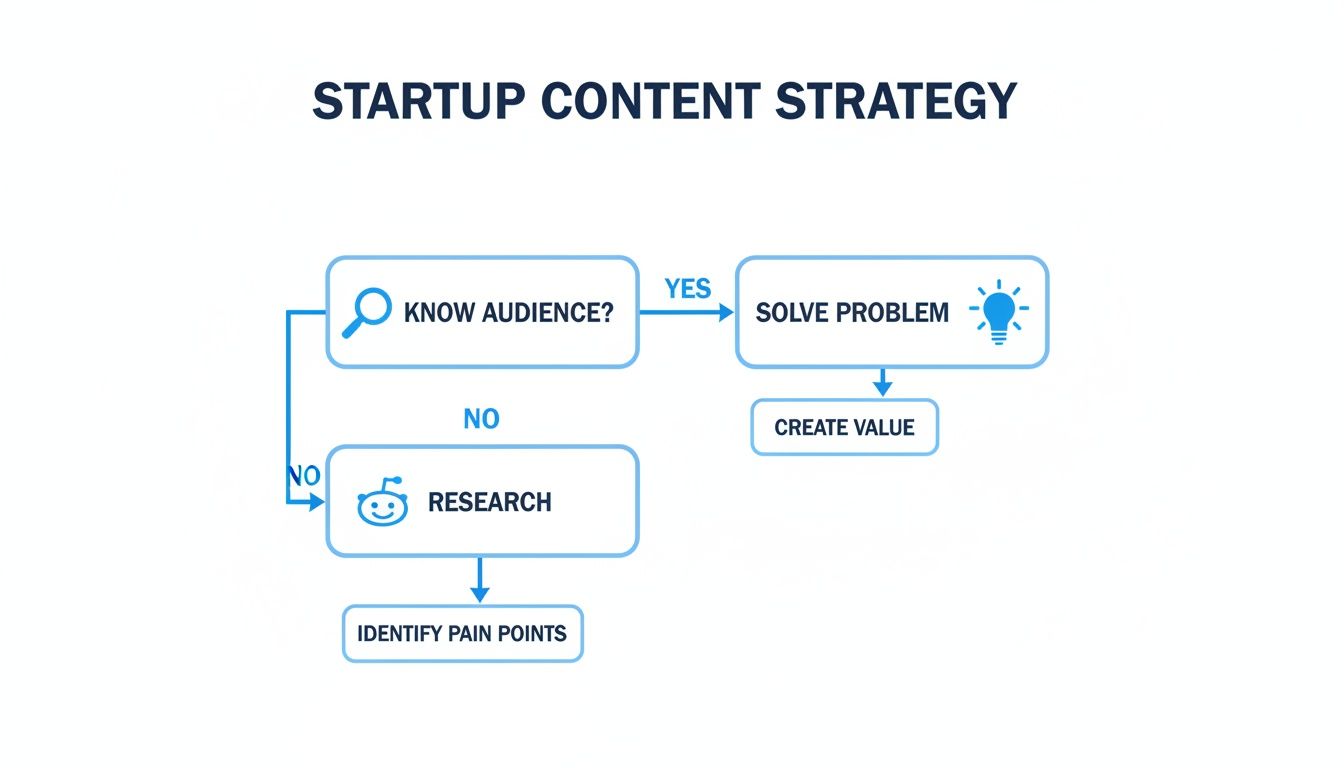
As you can see, it all starts with understanding your audience and solving their specific problems.
Turn Your Founder Profile into a Lead Magnet
Your LinkedIn profile is not a resume. It is a landing page. Most profiles are just a boring list of job titles. A great founder profile is optimized to attract and convert your ideal customer. It needs to speak directly to their pain points. It should position you as the expert who can solve them.
Here is how to fix it.
- Banner Image. Your banner is a free billboard. Use that space to state your value proposition. Who do you help and how?
- Headline. Do not just list your title. Your headline should be a mini pitch. Instead of "CEO at StartupX," try something like, "I help B2B SaaS companies cut customer churn by 30%."
- "About" Section. This is your sales page. Tell a story. Start with the problem your audience faces. Explain the painful consequences of not solving it. Then introduce your solution. Use simple language and short paragraphs.
- Featured Section. This is where you pin your best content. It could be a link to a case study, your most popular blog post, or a video explaining your approach. This section acts as a portfolio, proving your expertise.
Deciding Where to Focus
While LinkedIn is great for B2B, it is helpful to see how it compares to other channels. Where you spend your time depends on your goals, your audience, and your team's bandwidth. This table breaks down the essentials.
B2B Startup Channel Focus Comparison
| Channel | Primary Goal | Effort Level | Best For |
|---|---|---|---|
| Lead Generation, Brand Authority | Medium | B2B networking, high-value leads, founder-led marketing. | |
| Company Blog/SEO | Inbound Leads, Education | High | Building long-term organic traffic, owning a topic, evergreen content. |
| Twitter (X) | Community Building, Real-Time Engagement | High | Tech audiences, quick updates, joining industry conversations. |
| Email Newsletter | Nurturing Leads, Building Relationships | Medium | Direct communication with a warm audience, driving conversions. |
The takeaway? Start with one channel, likely LinkedIn. Master it before adding another. Trying to launch a blog, newsletter, and Twitter all at once is a recipe for failure.
Work Smarter with Content Repurposing
Coming up with original, high quality content every day is exhausting. The smarter approach is to take one core idea and repurpose it into multiple formats. This is how you maintain consistency and quality without burning out.
One deep dive blog post can be broken down into an entire week's worth of LinkedIn content.
Think of it like this, one long form article is your "pillar" content. From that pillar, you can carve out dozens of smaller "micro" pieces of content for different channels.
For example, say you write a 2,000 word blog post on "The Future of AI in Sales." You can turn that one asset into,
- Text Only Posts. Pull out a few key statistics or controversial opinions from the article. Share them as short, punchy text posts. Always end with a question to get comments.
- Image Carousels. Turn the main sections of your blog post into a visual carousel. Each slide can highlight one key takeaway, making complex information easy to digest.
- Short Videos. Record a quick video of yourself summarizing the most important point from the article. These "talking head" videos feel personal and build a stronger connection.
By focusing on LinkedIn and mastering repurposing, you build a content engine that is effective and sustainable. You can stop chasing every new platform and start building a real, engaged audience where it counts.
Automate your LinkedIn for 30 days
5. Your Simple Content Creation & Scheduling System
Ideas are cheap. Execution is everything. A brilliant content strategy gathering dust is useless. The real challenge is creating and publishing consistently, week after week.
The good news? You do not need a complex project management suite or a massive content team. You need a simple, repeatable system that will not burn you out. Let's build that system now.
You can run your entire content machine from a basic Google Sheet or a free template from a tool like Notion. Seriously, that is it. The goal is consistency, not complexity. A messy but consistent process will always beat a perfect but sporadic one.
The heart of this system is something called content pillars.
Think of a content pillar as a huge, central topic. It is one of the core problems your audience wants to solve. It is the main trunk of a tree. From that single trunk, you can grow dozens of smaller branches. These are your individual pieces of content like blog posts, LinkedIn updates, or short videos.

This example shows how a simple Notion board can help you visualize everything. It gives you a single source of truth, so you are never left wondering, "What are we posting this week?"
Building Your Content Pillars
Your content pillars should come directly from your audience research. What are the 3 to 5 biggest, most painful problems your customers have? Those are your pillars. No need to overthink it.
Let's imagine you are a B2B SaaS startup that builds project management software. Your pillars might look like this,
- Pillar 1, Team Productivity & Workflow
- Pillar 2, Project Planning Frameworks
- Pillar 3, Better Client Communication
- Pillar 4, Managing Remote & Hybrid Teams
Just from that first pillar, "Team Productivity," you can create a mountain of content. You could write a deep dive article on asynchronous communication. You could design a LinkedIn carousel on delegation tactics. You could shoot a quick video on running meetings that do not suck. Each piece ties back to the core theme, reinforcing your expertise.
Your No-Frills Editorial Calendar
Your editorial calendar is your battle plan. It turns your abstract ideas into a concrete schedule. At a minimum, it just needs to track a few key things for each piece of content,
- Topic/Title. What is the piece about? (e.g., "5 Ways to Cut Meeting Time in Half")
- Content Pillar. Which core topic does it support? (e.g., "Team Productivity")
- Format. Is it a blog post, carousel, or video?
- Status. Is it an idea, in progress, or published?
- Publish Date. When is it going live?
That is all you need. This simple structure keeps you organized without drowning you in admin work. It is the secret to maintaining a steady stream of content, which is how you win the long game.
Using AI as Your Assistant, Not Your Ghostwriter
Okay, let's talk about AI. It can be a massive shortcut for a lean startup, but only if you use it correctly. Think of AI as your super smart intern. It is there to speed things up, not to replace your brain.
The brutal truth is that 100% AI generated content is usually generic, soulless, and obvious. It does not build trust or authority. Use AI to make you faster and better, not to write for you.
Here is a practical way to use it.
-
Brainstorming on Steroids. Feed your content pillar into an AI tool. Ask for 20 different angles or headlines. Most will be duds, but a few will be gold. This beats staring at a blinking cursor. For inspiration on what works, you can check out these high-performing LinkedIn patterns.
-
Structuring Your Thoughts. Once you have a topic, ask the AI to create a detailed outline. This gives you a solid skeleton to build from, saving you planning time.
-
Refining Your Draft. After you have written your draft, and this is key, you write it. Then use AI to punch it up. Ask it to simplify complex sentences, check for grammatical errors, or suggest a better hook.
AI can be a huge advantage for startups. Some data shows marketers can save around 3 hours per piece of content by using it. But do not forget the other side of that coin. Human led content still gets, on average, 5.44x more traffic. The sweet spot is blending AI for speed with your authentic, human voice. That is what people actually want to read.
Measuring What Matters and Ignoring Vanity Metrics
Likes and shares feel good. They give you a little dopamine hit. They make it seem like your content marketing is crushing it. But let's be blunt, those numbers do not pay the bills.
Obsessing over vanity metrics is one of the fastest ways for a startup to burn cash. It is like judging your health by how many compliments you get on your workout gear. Sure, it is nice, but it tells you nothing about what is actually happening.
Your content’s job is not to be popular. Its job is to grow your business. Period.
This means you have to connect every single piece of content back to a real business goal. Are you trying to book more demos? Lower your customer acquisition cost (CAC)? Those are the numbers that matter. If your content is not moving those needles, something is broken.
The good news? You do not need a complex analytics suite to figure this out. You can get started with free tools you probably already use, like Google Analytics. The trick is to focus on metrics that show a clear path from someone reading your content to them becoming a customer. Everything else is just noise.
Ditching Vanity for Actionable KPIs
Let's make this simple. Most of what you see on social media analytics dashboards is designed to keep you on the platform, not to help your business. You need to train yourself to ignore the fluff. Zero in on the signals that show real intent from potential customers.
Here is a quick look at what to track versus what to ignore.
Startup Content Marketing KPIs
It is crucial to distinguish between metrics that make you feel good and metrics that drive growth. This table breaks down the difference.
| Metric Category | Vanity Metric (Ignore) | Actionable KPI (Track) |
|---|---|---|
| Website Traffic | Total Pageviews | Traffic from target accounts, pages per session, time on page |
| Lead Generation | Social Media Followers | Email newsletter signups, demo requests, content downloads |
| Sales Impact | Likes and Shares | Marketing qualified leads (MQLs), pipeline influenced by content, customer acquisition cost (CAC) |
Getting this right is a big deal. A single demo request from a piece of content is infinitely more valuable than a thousand likes from people who will never buy from you. Your goal is to attract potential buyers, not just a casual audience.
Stop celebrating likes. Start celebrating leads. A high follower count with zero sales is a hobby, not a business.
Internalizing this mindset changes how you create content. You will stop writing for broad appeal. You will start writing to solve the specific, expensive problems of your ideal customer. Your content will become sharper, more focused, and a lot more effective.
Running Small, Fast Content Experiments
As a startup, you do not have the budget to bet big on a content strategy that might fail. The answer is not to launch massive campaigns. Instead, you should run a series of small, fast experiments to see what resonates. It is all about making smart, data driven decisions without risking your entire marketing budget on a hunch.
The process is straightforward.
- Form a Hypothesis. Start with a clear, testable idea. For example, "I believe a blog post comparing our product to our top competitor will generate 20% more demo requests than our typical how-to guides."
- Run the Test. Create the content and promote it to a specific segment of your audience. Give it a set amount of time to run. Maybe two or three weeks is enough to get a signal.
- Measure the Results. Go back to your actionable KPIs. Did that competitor comparison post actually lead to more demo requests? How did its conversion rate compare to your other content?
- Learn and Iterate. If the experiment worked, great. Double down on that content format or topic. If it did not, you learned a valuable lesson without wasting months of effort and money.
This experimental approach is perfect for startups. It lets you adapt quickly and put your limited resources behind the tactics that are proven to work. It takes the guesswork out of content marketing and replaces it with a system for continuous improvement. Build a simple dashboard to track these experiments. You will quickly see what is driving real growth and what is not.
Real-World Examples of Startup Content That Works
Theory is great, but let's look at what is actually working. I want to walk you through a couple of examples of companies executing these principles and seeing real results.
This is not just a high level overview. We will break down specific posts. The hooks, the structure, and the secret sauce that makes them work. You can steal these ideas for your own content. They are proof you do not need a massive budget to make a serious impact.
How a B2B SaaS Startup Does It Right
One of my favorite examples comes from a small startup that sells project management software. Instead of talking about their features, they have focused on their audience's biggest headaches. Their content is a masterclass in solving problems, not just selling a product.
Their blog is a goldmine of articles like "How to Run a Team Meeting That Doesn't Suck" or "A Simple Framework for Prioritizing Your Q3 Projects." See what they did there? The titles are direct. They promise a clear outcome. They tap into a very real, common frustration. That is problem solving content at its finest.
But they do not stop there. They take these big ideas and slice them into perfect, bite sized pieces for LinkedIn.
- Carousel Posts. They turn their blog post frameworks into simple, visual carousels. Each slide is one clean, digestible step, making a complex idea simple to grasp in 60 seconds.
- Text Posts. The founder gets personal. He shares raw stories about his own productivity blunders and lessons learned. These posts are brutally honest, and the engagement is huge because people see themselves in his struggles.
This strategy does more than just get likes. It builds deep authority and trust. By the time their audience is in the market for project management software, who do you think they will remember? The company that has already proven they get it.
The Solopreneur Who Built a Brand on LinkedIn
Here is another one for you, a freelance consultant who helps startups nail their pricing. He is a one man show with a small budget. But he has built a powerful personal brand by showing up and sharing valuable insights on LinkedIn.
His entire strategy is built on a few simple, repeatable content formats. He will drop short, punchy text posts that challenge conventional wisdom. He often starts with a hook like, "You're thinking about pricing all wrong." It immediately stops the scroll and makes you think.
He gives away 99% of his knowledge for free, right out in the open. It feels counterintuitive. But this radical generosity makes potential clients trust him implicitly. They are practically lining up to pay for that last 1%.
He also creates simple graphics to break down complex pricing models. These visuals are magnets for shares. They position him as the expert who can make tough subjects feel easy. The real key, though, is his consistency. He posts once a day, every single day. This keeps him on the radar of his ideal clients.
When you are looking for fresh ideas that have a proven track record, it is smart to analyze trending content patterns from other top creators to see what is working right now.
Frequently Asked Questions
Let's cut to the chase. Founders and small teams have a lot of questions about content marketing. They usually circle back to the same things, time, money, and whether this whole thing is worth it.
Here are some straight up answers to the questions I hear most often.
How Much Should a Startup Spend on Content Marketing?
There is no magic number here, but the right answer is not zero. If you are just starting out, think about setting aside a small, dedicated slice of your marketing budget.
What matters more than the total dollar amount is consistency. A modest, steady investment each month will beat a big, one off campaign every time. Focus your budget on smart tools that buy you back time or on paid promotion to get your best content in front of more of the right people. The goal is a solid return, not a giant expense line.
How Long Does Content Marketing Take to Show Results?
Think of content marketing as a long term investment, not a lottery ticket. You are not going to go viral overnight. If you expect that, you are setting yourself up for disappointment. You will likely see some early signals on social media within the first 1 to 3 months. An uptick in engagement or a few more clicks back to your site.
But for the big stuff, like SEO and organic traffic from your blog, you need to be patient. It can take 6 to 12 months before you see a real, sustainable flow of visitors. Along the way, keep an eye on leading indicators like keyword ranking improvements and new email signups.
Stop looking for a shortcut. The reason content marketing has such a high payoff is because most people do not have the patience to see it through. Your consistency is your competitive advantage.
Can a Founder Without a Marketing Background Do This?
Absolutely. In fact, founders often create the best content. Why? Because nobody understands the customer and their problems better than you do. You do not need a fancy marketing degree. You just need empathy for the people you are trying to help.
Your authentic voice is your single greatest asset, so do not be afraid to use it. Lean on the simple frameworks in this guide. Let tools handle the more technical bits. Start small, learn as you go, and make "being genuinely helpful" your North Star. You will be amazed at how far that takes you.
Ready to stop guessing and start creating content that actually connects? ViralBrain analyzes what top creators are doing and turns their successful patterns into repeatable templates for you. Build your authority on LinkedIn without starting from scratch. Get started at https://www.viralbrain.ai.
Automate your LinkedIn for 30 days
ViralBrain plans, writes, and schedules your LinkedIn content, using official LinkedIn APIs so your account stays safe.
- Official LinkedIn APIs, no risk of ban
- You approve every post before it goes live
- Cancel anytime
Keep reading
7 Best LinkedIn Ghostwriting Services & Agencies (2026)
Compare the 7 best LinkedIn ghostwriting services and agencies in 2026. Honest breakdown of what they do, who they serve, engagement models, pricing, pros, and cons.

How to Get Connections on LinkedIn That Actually Matter
Learn how to get connections on LinkedIn with a practical plan for fixing your profile, engaging smartly, and sending requests that people actually accept.

How to Grow on LinkedIn Without Selling Your Soul
A brutally honest guide on how to grow on LinkedIn. No fluff, just practical advice and real data on profile optimization, content, and engagement that works.