

10 Brutally Honest Content Marketing Practices for 2026
Stop guessing. Here are 10 content marketing best practices based on data, not fluff. Learn what works for B2B brands and creators on LinkedIn.
Most content marketing advice is useless. You've heard it all before. Create valuable content, be authentic, post consistently. These are results, not instructions. They tell you what to do but not how to do it. This leaves marketers knowing the goal but lacking a system to get there. The result is generic content, poor performance, and burnout. This article is different. It is a blueprint.
We will skip the vague advice. We will focus on specific, repeatable frameworks. These are the systems successful B2B marketers use to build audiences and drive revenue. This guide focuses on the mechanics behind high performing content for platforms like LinkedIn. We will cover actionable content marketing best practices you can use immediately.
You will learn how to use data to find what works. You will learn to write hooks that stop people from scrolling. And you will learn to repurpose one idea into ten different assets. We will also cover building a real community, establishing thought leadership, and aligning every piece of content with a business goal. These are not just tips. They are operational workflows. They are the details that separate creators who get results from those who just make noise. If you want to move beyond generic advice, this guide will show you how.
Automate your LinkedIn for 30 days
1. Data-Driven Pattern Recognition and Analytics
Stop guessing what works. The best content marketers don't rely on luck. They rely on data. This approach has two steps. First, reverse engineer successful content from others. Second, track your own performance. You identify proven formulas for hooks, structures, and topics from top creators. Then you use analytics to see what connects with your audience. It is a system for stealing like an artist and measuring the results.
HubSpot's marketing team reverse engineered competitor blog posts. They found structural patterns that improved their click through rates by 34%. Creators on LinkedIn use platforms like ViralBrain to find engagement patterns from top performers. This saves them hours of research. This isn't about copying. It's about extracting the psychological triggers that make content work. You can find examples of these blueprints by studying ViralBrain's library of content patterns.
How to Implement This
- Build a Pattern Library. Analyze 10 top creators in your niche. Document their 3 to 5 most common hook types, post structures, and calls to action. Update this library monthly.
- Track Your Core Metrics. Set up a spreadsheet to track engagement rate, reach, impressions, CTR, and follower growth for every post. Review it weekly.
- A/B Test One Variable. Do not change everything at once. Test one thing at a time, like the hook style or posting time. Do this for at least a week to get clean data.
- Identify Your Top 20%. Find your top performing 20% of content after a month. See what those posts have in common. Do more of that. This is one of the most practical content marketing best practices you can adopt.
2. Hook Optimization and Scroll-Stopping Openings
The first line of your content decides if the rest gets read or ignored. Good content marketing isn't about the best ideas. It's about the best presentation of those ideas. That starts with the hook. A great hook creates a curiosity gap, challenges a belief, or promises instant value. It is the most important variable for stopping the scroll.

This principle is proven everywhere. Lenny Rachitsky opens his newsletters with surprising data points. Russell Brunson built an empire on hooks like "I spent $50K learning this one thing...". These hooks blend curiosity with a clear value promise. On LinkedIn, contrarian hooks like "Most founders get this backwards" signal expertise and filter for a specific audience. This is not just clickbait. It is connecting your core message to a powerful psychological trigger.
How to Implement This
- Build a Hook Library. Scroll your feed for 30 minutes. Screenshot and document 50 hooks from top creators in your niche. Categorize them by type, like contrarian, curiosity gap, or value promise.
- Test Hook Variations. Write 3 to 5 different hooks for every core idea. Test the hooks by posting them as comments on other content to see initial reactions before writing a full post.
- Keep It Short. Aim for hooks under 15 words. Mobile users have limited screen space. Your opening line must be concise to be seen without clicking "see more".
- Use Specific Numbers. Hooks with numbers, like "$50K mistake" or "3 mindset shifts", create concrete images. They can increase engagement. Adding specificity is one of the simplest content marketing best practices.
3. Strategic Tone Personalization and Voice Consistency
Content based on patterns often feels robotic. Strategic tone personalization fixes that. It injects your authentic voice into proven structures. This means you keep a distinctive voice across all content. But you adapt your tone for the audience, context, and platform. It is the difference between a high performing template and content that feels like you.
Your voice is your personality. Your tone is the emotional inflection you use. For example, Naval Ravikant keeps a philosophical, concise voice on podcasts and on Twitter. His tone might shift slightly. The core voice remains unmistakable. The same is true for Andrew Huberman’s educator voice, which balances hard science with accessibility. This consistency builds trust and a memorable brand.
How to Implement This
- Define Your Core Values. Write down 3 to 5 core values that filter your perspective. These inform your unique take on any topic. They are the foundation of your voice.
- Document Your Voice. Create a simple tone guide. Define your formality level, humor style, and technical depth. Include preferred phrases. For instance, use "I've found" instead of "research shows" for a personal feel.
- Record First, Write Second. Before writing, record a voice note explaining your take on a topic. This captures your natural phrasing. You can then translate it into your writing.
- Humanize AI Drafts. If you use AI, your primary job is editing. Add personal anecdotes, specific examples from your experience, and adjust the language to match your voice.
- Read It Aloud. The best way to catch inconsistencies is to read your posts aloud. If it sounds unnatural, rewrite it. This is one of the most effective content marketing best practices for staying authentic.
4. Multi-Platform Content Repurposing and Distribution
Stop creating content from scratch for every platform. Smart creators build a foundational piece of content once. Then they reshape it for different channels. This method maximizes your reach and ROI. It adapts a core idea to the format, audience, and algorithm of each platform. You aren't just copy pasting. You are re-engineering the same message to work everywhere.
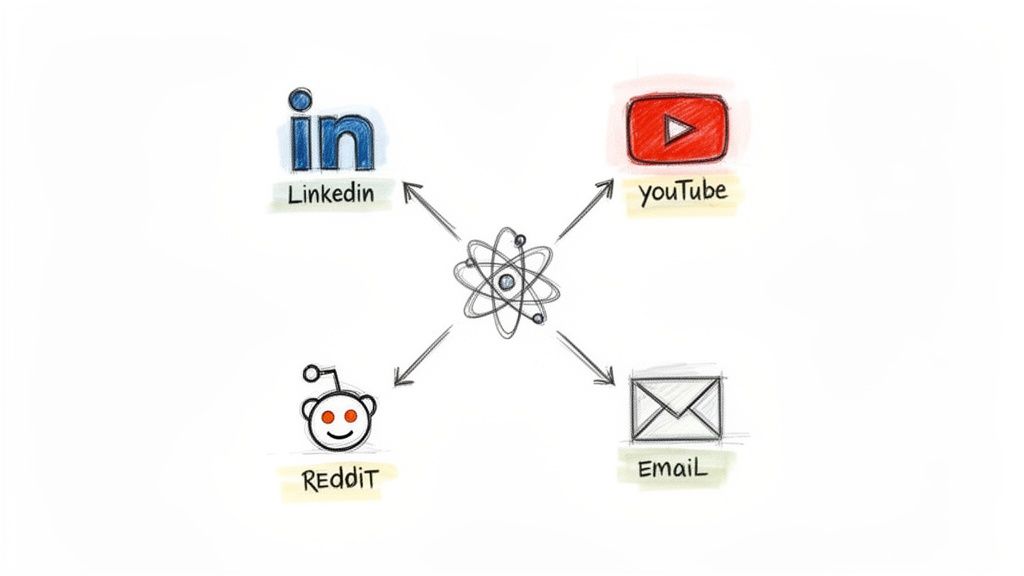
This practice is common. Pat Flynn turns a single podcast episode into blog posts, Twitter threads, and YouTube Shorts. HubSpot converts blog posts into webinars, emails, and infographics. The goal is to extract one core insight. Then build platform specific variants around it. A long form blog post becomes a LinkedIn story, a Reddit thread, and a series of educational emails.
How to Implement This
- Create Content 'Atoms'. Break your core content into modular units, like a key statistic, a powerful quote, or a single tip. These atoms are the building blocks for smaller posts.
- Build a Repurposing Matrix. Create a simple chart. List your primary content format in the first column. In the next columns, map out how it will be adapted for 3 secondary platforms.
- Adapt to the Platform. Don't just reshare. On LinkedIn, focus on storytelling with strong hooks. On Reddit, be conversational. For email, be direct, educational, and align your CTA with the funnel stage.
- Batch Your Repurposing. Dedicate a block of time each week to this process. Take your one hero piece of content and convert it into 5 or more repurposed assets. This is one of the most efficient content marketing best practices for scaling your output.
5. Consistent Posting Cadence and Strategic Timing
Random content doesn't build an audience. Consistency builds trust. It trains the algorithm and your followers to expect your content. This practice is about a predictable publishing schedule. It should align with when your audience is most active. It signals reliability, keeps your brand visible, and provides a baseline for testing. It is the difference between shouting into the void and having a scheduled conversation.
This is a proven growth lever. Naval Ravikant built a following of over two million on Twitter with consistent, early morning posts. Lenny Rachitsky's predictable weekly LinkedIn articles have created a loyal audience that anticipates his content. You do not need to post daily. Paul Graham built influence with monthly essays. The cadence just needs to be predictable. For B2B on LinkedIn, internal data shows that 5 to 7 posts per week is optimal for reach.
How to Implement This
- Establish a Sustainable Cadence. Start with what you can maintain. For a personal brand on LinkedIn, 3 posts per week is a good starting point. A business account should aim for 5 to 7.
- Identify Your 'Golden Hours'. Post when your audience is online. A solid baseline for B2B is Tuesday through Thursday, from 8 to 10 AM in your target audience's timezone. Track your engagement by time for a month and adjust.
- Build a Content Buffer. Create a 2 to 4 week buffer of scheduled posts. This eliminates the pressure of daily creation. It gives you flexibility for timely content.
- Batch Your Content Creation. Dedicate one or two days a month to create 4 to 8 weeks of content. This is one of the most effective content marketing best practices for maintaining consistency. You can use AI draft generation tools to accelerate this.
6. Engagement-First Strategy and Community Building
Stop treating your audience like a broadcast target. The best creators know that content is a conversation starter, not a monologue. An engagement first strategy prioritizes real interaction in comments, replies, and DMs. It's more than passive views or likes. You build a community that feels heard. This in turn amplifies your content through comments and shares. It creates a two way street where value is exchanged, not just delivered.
This method moves the focus from content creation to community cultivation. Writer David Perell invests time replying to every meaningful comment on his posts. This fosters a loyal readership. Lenny Rachitsky's deep engagement on LinkedIn, where he asks questions and responds in the comments, has built a powerful community that accelerates his content's reach. This is not just about being polite. It is a core growth lever that trains the algorithm to favor your work.
How to Implement This
- Block Engagement Time. Set aside 15 to 30 minutes every day for engaging in your comments and with other creators' content.
- Master the First Hour. The algorithm weighs early engagement heavily. Reply to every relevant comment within the first hour of posting to maximize its initial push.
- Ask Clarifying Questions. Instead of just saying "thanks," reply to comments with clarifying questions. This sparks deeper discussion, increases comment count, and gathers audience feedback.
- Engage Outbound Daily. Do not just wait for comments. Spend time leaving thoughtful replies on 5 to 10 posts from other creators in your niche every day. This builds reciprocity and visibility. This is a fundamental part of any modern content marketing best practices playbook.
Automate your LinkedIn for 30 days
7. Thought Leadership Through Contrarian Perspectives and Takes
Most content is noise. It repeats the same safe ideas. True thought leadership comes from challenging those norms, not echoing them. This means developing unique, sometimes contrarian, viewpoints backed by solid reasoning. It is about saying what others are afraid to say. But you do it with evidence, not just for shock value. This generates curiosity, debate, and shareability. It positions you as an original thinker.
A contrarian take, grounded in expertise, is a powerful tool. Naval Ravikant built a massive following by questioning traditional ideas about wealth and happiness. Andrew Huberman applies scientific evidence to challenge common health fads. He earns trust through his data backed perspectives. This isn't about being argumentative. It is about providing a fresh lens on a familiar topic. This is one of the most effective content marketing best practices for cutting through the noise.
How to Implement This
- Earn the Right to a Take. Spend at least two years immersed in your field before developing strong contrarian stances. Expertise is your license to challenge the status quo.
- Ground It in Reality. Your perspective must be supported by data, personal experience, or a logical framework. Never base it on opinion alone. Share the specific case studies or evidence that led you to your conclusion.
- Balance Your Content Mix. Not every post should be a bold, controversial take. A good rule is a 70/30 split. 70% educational, consensus content and 30% contrarian perspectives.
- Welcome the Debate. A genuine contrarian view will attract disagreement. Welcome it. Responding to thoughtful criticism and engaging in debate drives visibility and strengthens your position.
- Anticipate Counterarguments. Before you publish, think about the most likely objections to your point. Address them directly within your content to show you've considered other angles.
8. Story-Based Content and Narrative Arc Construction
Facts don't sell. Stories do. Humans are wired for narrative, not for data. This approach uses personal anecdotes, case studies, and classic story structures to make your content memorable. An effective story follows a simple setup, conflict, and resolution arc. This structure triggers an emotional response and builds a connection with your audience. It is the difference between a lecture and a conversation.
This method is everywhere once you see it. Lenny Rachitsky shares product management lessons through the origin stories of successful founders. Derek Sivers packages business advice into short, punchy parables that stick in your mind for years. On LinkedIn, vulnerability and “before after” narratives outperform dry, corporate updates because they feel human. They show the struggle, not just the highlight reel. The key is to find the hero in your audience and guide their journey. You can learn more about how to structure these narratives by exploring the Hero-Discovery Framework.
How to Implement This
- Use the Before After Arc. Frame your story around a transformation. "I used to believe X, then Y happened, now I know Z." This is a simple structure for showing growth and sharing a lesson.
- Start with a Scene. Do not start with an abstract concept. Start in the middle of the action. "The Zoom call ended and my heart sank." This grounds the reader in a specific moment and makes them want to know what happens next.
- Describe the Problem Vividly. Build tension by detailing the conflict or struggle. Before you offer the solution, make the audience feel the pain of the problem. This makes the resolution more satisfying.
- End with a Clear Takeaway. A story without a point is just a diary entry. Connect the narrative back to a single, actionable insight your audience can apply. This is one of the most effective content marketing best practices for turning personal experience into audience value.
9. Trending Topic Integration and Timely Content Relevance
Stop creating content in a vacuum. The internet moves fast. Algorithms reward creators who join real time conversations. This practice involves connecting current events, industry news, or viral discussions to your area of expertise. It is about finding the intersection between what people are talking about now and what you know. This gives you an immediate attention boost. This is not about forced tie ins. It is about providing a relevant expert perspective on a developing story.
When OpenAI released its GPT models, creators across tech, marketing, and productivity surged by explaining its impact. When the 2023 tech layoffs hit, HR and career experts gained visibility by providing timely advice. This approach works because it taps into existing audience curiosity. You are not creating demand. You are meeting it. Creators like Lenny Rachitsky do this well by analyzing trending startup news through his product management lens.
How to Implement This
- Monitor Key Sources. Check 3 to 5 relevant news sources daily. This could be Twitter, industry subreddits, Product Hunt, or specific newsletters. You need to know what's happening.
- Use a Trending Angle Formula. Create a simple framework. [Current Trend] + [Your Niche Expertise] = [A Unique Content Angle]. This helps you quickly generate ideas that are both timely and authentic.
- Act Quickly. The window for maximum impact on a trending topic is short, often just 4 to 12 hours. Create "quick response" templates for common events in your industry like funding news or product launches.
- Track Performance Separately. Trending posts often get a short term, high velocity engagement boost. Track these separately from your evergreen content to understand their impact. Expect a 2x to 3x increase in reach, but the long term value might be lower. This is a core part of modern content marketing best practices.
10. Clear Call-to-Action (CTA) Alignment with Business Objectives
Your content is pointless without a clear next step. A good Call to Action guides your audience from passive consumption to active engagement that helps your business. It connects the value you just provided in your post to a specific outcome. That could be an email signup, a profile visit, or a direct message. Effective CTAs are not afterthoughts. They are strategic tools.
This practice is about precision. Instead of a generic "what do you think?", you ask a question that drives a business result. Lenny Rachitsky asks followers to DM him for a Substack link. This directly converts high intent readers. SaaS founders skip the broad "visit our site". They instead offer a personalized demo via DM, qualifying leads immediately. The goal is to make the audience's next action obvious, easy, and valuable for both sides. It turns passive readers into active leads.
How to Implement This
- Match CTA to Post Value. If your post is educational, ask people to save it for later. If it’s a problem solution piece, ask them to DM you for the full guide. The CTA must feel like a natural extension of the content.
- Use Specific Verbs. Avoid vague requests. Instead of "reply below", try "Reply with the biggest challenge you face with X". Specificity gets better results.
- Align to Your Funnel. Use different CTAs for different stages. An awareness post might ask for a share. A consideration post could offer a free tool. A decision stage post should drive a sales conversation.
- Test and Measure. Track which CTA types generate the most conversions. A simple spreadsheet can show you what works. This is one of the content marketing best practices that directly impacts your bottom line.
10-Point Content Marketing Best Practices Comparison
| Strategy | Implementation complexity | Resource requirements | Expected outcomes | Ideal use cases | Key advantages |
|---|---|---|---|---|---|
| Data-Driven Pattern Recognition and Analytics | High — data pipelines and analytics setup | Large datasets, analytics tools, data expertise, dashboards | Predictable engagement gains, faster iteration, validated formulas | Scaling creators, stakeholder-backed strategies, A/B testing | Removes guesswork, enables predictive optimization |
| Hook Optimization and Scroll-Stopping Openings | Low — easy to test and iterate | Creative time, small-scale testing, hook library | Immediate lift in attention and CTR | Short-form posts, lead-ins for long content, mobile-first audiences | High impact for low effort; transferable across topics |
| Strategic Tone Personalization and Voice Consistency | Medium — requires documentation and editing workflows | Time for voice work, tone guide, editorial review | Stronger audience loyalty, clearer brand recognition | Personal brands, long-term audience building, templated content | Differentiation and authenticity; preserves trust |
| Multi-Platform Content Repurposing and Distribution | Medium — mapping formats and workflows | Platform knowledge, repurposing matrix, scheduling tools | Higher ROI per asset, broader reach, reduced workload | Cross-channel growth, limited creation resources, marketing funnels | Efficiency and amplified reach across channels |
| Consistent Posting Cadence and Strategic Timing | Low–Medium — scheduling and analysis | Content calendar, batching time, timing analytics | Improved visibility, algorithmic favor, sustained growth | Building predictable audience, experimentation with timing | Algorithmic trust, reduced decision fatigue |
| Engagement-First Strategy and Community Building | Medium–High — ongoing management and moderation | Significant time for replies, community tools, team at scale | Stronger loyalty, organic amplification, idea generation | Community-focused creators, customer relationship building | Deep relationships and sustained advocacy |
| Thought Leadership Through Contrarian Perspectives and Takes | Medium — needs careful positioning and evidence | Research, domain expertise, risk management | High engagement, memorability, PR and authority opportunities | Establishing authority, sparking debate, media attention | Differentiation and high shareability |
| Story-Based Content and Narrative Arc Construction | Medium — craft-focused, narrative skill required | Personal anecdotes, time to draft and edit, editorial polish | Greater memorability, emotional connection, higher comments | Brand storytelling, explaining complex ideas, trust-building | Memorable messaging and stronger parasocial bonds |
| Trending Topic Integration and Timely Content Relevance | Medium–High — fast monitoring and rapid creation | Real-time monitoring tools, quick production capability | Short-term visibility spikes, accelerated audience growth | Capitalizing on news cycles, timely thought leadership | Algorithmic boosts and heightened relevance |
| Clear Call-to-Action (CTA) Alignment with Business Objectives | Low — straightforward to add and test | Funnel alignment, tracking links, conversion metrics | Higher conversions, measurable business outcomes | Lead generation, product trials, funnel-driven posts | Directly drives measurable business results |
Stop Talking, Start Doing
You now have a map of ten powerful content marketing practices. We covered using data to find patterns and writing scroll stopping hooks. We covered repurposing content and building a real community. Each practice is a lever you can pull to get more from your efforts. But reading about them is not the same as doing them. The gap between knowing what to do and doing it is where most people fail.
The goal isn't to implement all ten ideas by tomorrow. That approach leads to burnout, not breakthroughs. The smarter path is to be honest about your process. Where is the biggest bottleneck? If your content calendar is empty, focus on a consistent posting cadence. If your posts get likes but no comments, work on your engagement strategy. Pick one or two areas that are your greatest weakness. Commit to mastering just those.
From Theory to Tangible Results
The core theme connecting these practices is intentionality. Great content doesn't happen by accident. It is the result of a deliberate system. It comes from understanding your audience deeply, crafting a unique perspective, and distributing your message effectively. It means treating every post as a strategic asset designed to achieve a specific goal.
Your content should work for you, not the other way around. Following these content marketing practices moves you from a creator who publishes to a strategist who builds. You stop chasing trends. You start creating a library of valuable assets that attract your ideal audience and build your authority over time. This is how you create a brand people trust. This is how you turn followers into customers.
Your Action Plan Starts Now
The difference between successful creators and everyone else is discipline, not talent. It's commitment to a process. The ideas in this article provide the framework. You must supply the execution.
Here is your immediate action plan:
- Choose Your Focus. Review the ten practices. Select the one area that would have the biggest effect on your growth right now.
- Set a Small Goal. Do not try to overhaul everything. Set a simple, measurable goal. For example, “I will write and test five new hooks this week” or “I will repurpose one piece of content into three different formats.”
- Execute and Measure. Put in the work. Track your results. Did the new hooks increase your view count? Did the repurposed content reach a new audience? Use the data to refine your approach.
This methodical process is the engine of content marketing success. It is not about finding a magic bullet. It is about making small, consistent improvements that compound over time. The principles are simple. The execution is what separates you from the noise. You have the guide. Now, it is time to build.
Ready to apply these practices faster? ViralBrain analyzes top performing content in your niche, identifies the patterns that work, and helps you generate drafts based on proven hooks and formats. Stop guessing and start creating with data at ViralBrain.
Written with Outrank tool
Automate your LinkedIn for 30 days
ViralBrain plans, writes, and schedules your LinkedIn content, using official LinkedIn APIs so your account stays safe.
- Official LinkedIn APIs, no risk of ban
- You approve every post before it goes live
- Cancel anytime
Keep reading

What Is Engagement Rate and How to Actually Improve It
Everyone talks about it, but what is engagement rate? Learn the real formula, what a good rate is, and get honest tips to increase it.

What Is Brand Voice? A Guide That Actually Works in 2026
Learn what is brand voice and why it matters. This guide shows you how to build a consistent voice that connects with people, with real templates and examples.

How to Post a Carousel on LinkedIn the Right Way
Learn how to post a carousel on LinkedIn with this guide. Get direct tips on PDF creation, uploading, and writing captions that get noticed in 2026.