
The biggest risk isn't failure. It's looking back in 10 years and realizing you never tried. That idea you keep pushing off? That change you're waiting to make? That leap you know you need to take?…
1.8K45514311 viral
Career Advice10 months ago

LinkedIn Content Strategy & Writing Style
LinkedIn & B2B Marketing Whisperer | Helped 600+ Founders & Execs Build Influence
2 people tracking this creator on ViralBrain
Will McTighe positions himself as a high-velocity growth architect who bridges the gap between corporate executive presence and the "build in public" creator economy. His content strategy centers on the psychology of speed and the elimination of friction, frequently using tactical "how-to" guides for AI automation and LinkedIn growth to advocate for bias-to-action. What makes him notable is his ability to deconstruct the emotional barriers to visibility, transforming the "messy middle" of entrepreneurship into a repeatable system for influence. He thrives at the intersection of productivity engineering and personal branding, often pairing vulnerable stories of founder burnout or parental skepticism with highly technical automation workflows to prove that modern authority is built through both humanity and efficiency.
422.1K
9.4K
1.2K
8.8
43
1
The biggest risk isn't failure. It's looking back in 10 years and realizing you never tried. That idea you keep pushing off? That change you're waiting to make? That leap you know you need to take?…
Right now, you have a problem. Maybe it's career-changing big. Maybe it's daily frustration small. But instead of solving it, you get stuck in loops. Running through endless scenarios. Researching…
"You'll look stupid." "No one cares what you think." "What do you have to teach anyone?" We've all heard this. Maybe you heard those exact words. Maybe you heard subtle digs. Either way, you talk yo…
After writing 1,000+ LinkedIn posts, here’s the best system for getting started: Most people start with excitement, fresh ideas and endless motivation. Then the excitement wears off... and they re…
Everyone is starting to sound like ChatGPT. The same robotic tone. Five top tips posts. The “You won’t believe this…” posts. You can almost guess the next line before you read it. No value. No textu…

Society is losing it. Everything is destroying our focus. Most people waste 5 full workweeks A YEAR toggling between apps. (Source: Harvard Business Review) It's so easy to get distracted, look a…
8.8 posts/week
Posts / Week
0.9 days
Days Between Posts
1
Total Posts Analyzed
HIGH
Posting Frequency
0%
Avg Engagement Rate
STABLE
Performance Trend
350
Avg Length (Words)
HIGH
Depth Level
ADVANCED
Expertise Level
0.82/10
Uniqueness Score
YES
Question Usage
0.5%
Response Rate
Writing style breakdown
Overall tone: conversational, motivational, and practical with a strong copywriting influence.
Voice: confident, direct, and authoritative, but framed as a helpful peer/mentor rather than a distant expert.
Style: punchy and high-clarity. Prioritizes simplicity over complexity. Little jargon unless necessary, and any technical bits are quickly grounded in concrete examples.
Energy: high-energy and forward-moving. Posts feel like a friendly but firm push to act, not a slow reflection.
Goal: blend inspiration + specific tactics, often anchored in personal experience or a concrete case study.
Semi-casual but professional.
Uses contractions heavily (it’s, don’t, you’ll).
Occasionally uses light slang or informal phrasing: “AI slop”, “looks like a crime scene”, “losing it”, “shock”.
Avoids academic or overly formal wording; repeats simple, everyday language.
Action-oriented, encouraging, and slightly urgent.
Frequently names and normalizes common fears (fear of looking stupid, fear of failure, fear of posting).
Balances empathy (“We’ve all been there”) with challenge (“Start working like your career depends on it… because it does.”).
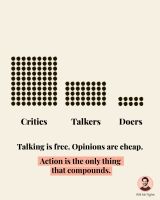
Uses tension as a core emotional driver: fear vs. courage, critics vs. doers, distraction vs. focus, planning vs. action.
Rhetorical questions (“So what’s actually going on?”, “Think about it:”).
Short, stacked lines for rhythm.
They wait. / They worry. / They pause.
Stop researching. / Stop preparing. / Stop planning.
Most people…” vs. “The most successful people…
Critics talk. / Talkers hesitate. / Doers do.
Lists of 3s and 4s for rhythm and memorability.
desktop that looks like a crime scene
clean, perfectly polished, empty AI slop
Here’s one way you can cut through the noise:
Here’s how to write one that actually feels real:
Here’s the system I recommend to everyone starting out:
Strong use of second-person (“you”) to make it feel directly addressed.
Short personal anecdotes.
Authority framing (“After writing 1,000+ LinkedIn posts…”).
Specific experiences as credibility.
Occasional third-person references to “most people,” “they”, “critics”, “winners”, to create a contrast with “you”.
Just start building.
Stop wasting time on things that don’t move the needle.
Start moving.
Here’s the system I recommend…
Make yours feel unique by writing like you’re talking to a friend.
Direct but empathetic.
Motivational without being overly hypey.
Practical, grounded, and reader-focused.
Designed to feel like a high-performing friend/mentor talking straight to you.
Sign in to unlock the full writing analysis
Free tools to help you write, score, and benchmark in the same style.
Other creators worth studying alongside Will McTighe.

Morten Bie
Engagement Partner | M Talent 2025 | Co-Host of Social Ads Conference, AI Marketing Conference & Marketing Bio | Digital Marketing Specialist
168 Viral Score
Alex Hormozi
Founder Acquisition.com, Co-Founder Skool.com. Get your free scaling roadmap👇
30 Viral Score

Anthony Miller
Founding something special | Logistics Tech & AI | Creator of Wiser Logtech - Supply Chain’s Most Direct Newsletter | Transforming How Companies Think About Their Logistics and Supply Chains | Let’s Connect🚀
158 Viral Score

Agnius Bartninkas
Operational Excellence and Automation Consultant | Power Platform Solution Architect | Microsoft Biz Apps MVP | Speaker | Author of PADFramework
61 Viral Score

Andriy Burkov
PhD in AI, author of 📖 The Hundred-Page Language Models Book and 📖 The Hundred-Page Machine Learning Book
6 Viral Score

Benjamin Rogojan
Fractional Head of Data | Tool-Agnostic. Outcome-Obsessed
11 Viral Score
ViralBrain plans, writes, and schedules your LinkedIn content, using official LinkedIn APIs so your account stays safe.
Write like Will McTighe.