
Businesses don't just lose deals to competitors. They lose them to silence. Here’s how that happens. A lot of effort goes into generating leads. As you optimise your process: → Data improves. →…

204130160 viral
Sales10 months ago

LinkedIn Content Strategy & Writing Style
Building unstoppable pipelines | Get free sales opportunities with our no-cost, no-risk pilot campaign | Founder @ C17 Lab
2 people tracking this creator on ViralBrain
Enzo Carasso positions himself as a high-conviction architect of revenue infrastructure, moving far beyond the typical lead generation agency model to focus on the structural foundations of growth. His content strategy centers on the "boring consistency" of GTM systems, frequently dismantling the myth that better copy can fix a broken offer or a lack of founder-led strategy. He is notably different for his radical transparency and risk-reversal, lead-gen with a "no-cost pilot" that forces his methodology to prove its ROI before a contract is even signed. Carasso’s work sits at a sharp intersection of sales psychology and operational discipline, where he treats outbound marketing not as a creative experiment, but as a predictable utility that must be engineered to survive the scrutiny of a CFO.
12.2K
9.6K
217
2.4
300
3
Businesses don't just lose deals to competitors. They lose them to silence. Here’s how that happens. A lot of effort goes into generating leads. As you optimise your process: → Data improves. →…
I'm a Top 1% sender on Smartlead - by volume AND performance Last month alone: → 2.7M cold emails sent → Average 20% positive reply rate across millions of cold emails → 4,100+ leads generated →…

Everyone agrees marketing should be an investment. The problem starts when someone asks: “Okay, what are we actually getting back?” That’s where things get uncomfortable. Not because leaders don’t…

Getting leads matters. But leads don’t create growth on their own. What separates teams that scale from teams that stall is what happens after the lead shows up. Most companies don’t waste leads in…

I've seen dozens of good businesses fail over the years. Almost all were ran by founders making the same mistake. The #1 clue? How often they say "yes" VS how often they say "no". I've seen this…

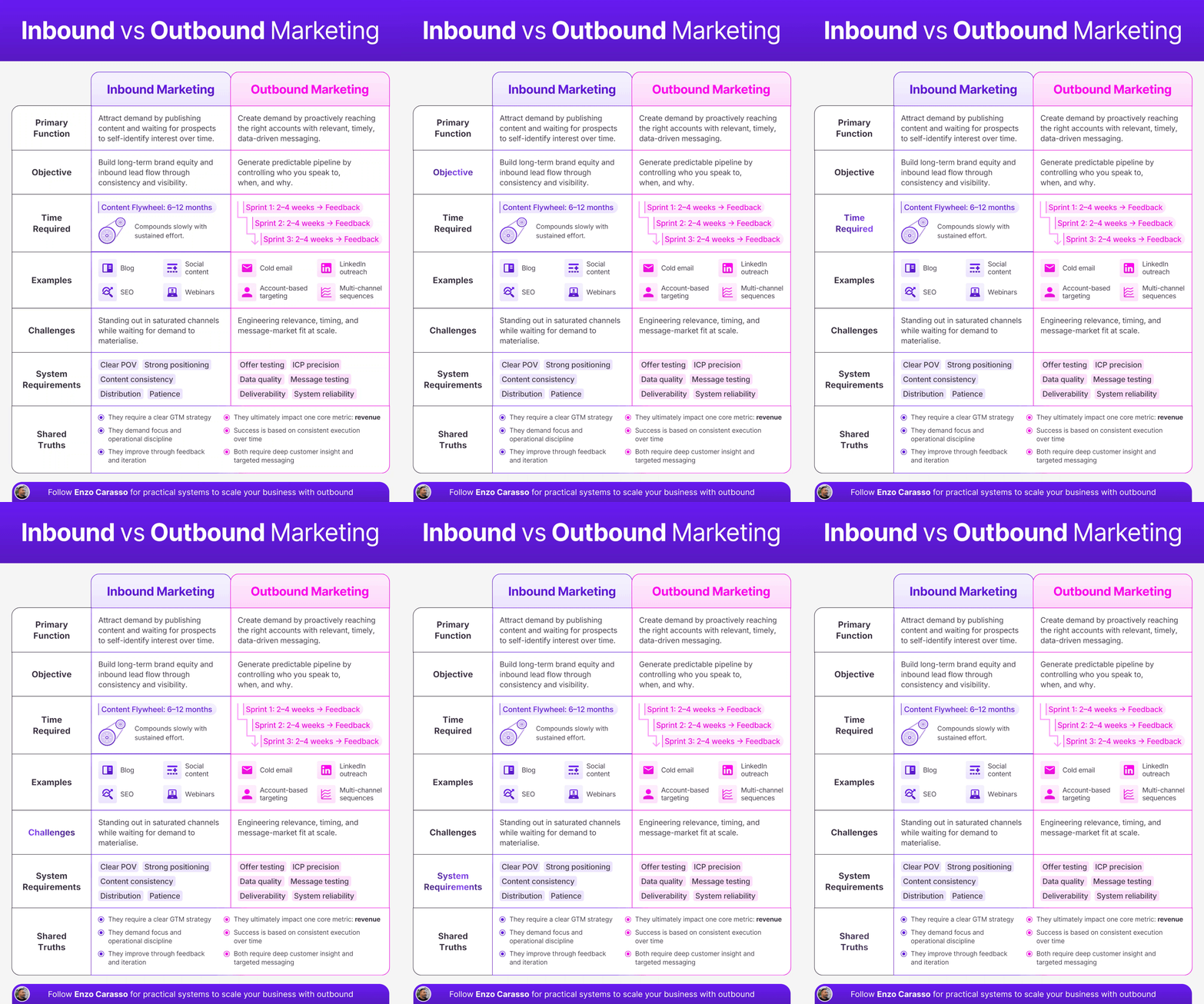
Inbound and outbound do very different jobs. Understanding both is key to a strong GTM strategy. Inbound marketing is about attracting demand. You publish content, build visibility, and wait for b…
2.4 posts/week
Posts / Week
3.4 days
Days Between Posts
3
Total Posts Analyzed
MEDIUM
Posting Frequency
0%
Avg Engagement Rate
STABLE
Performance Trend
350
Avg Length (Words)
HIGH
Depth Level
ADVANCED
Expertise Level
8/10
Uniqueness Score
YES
Question Usage
0.4%
Response Rate
Writing style breakdown
The voice is professional, clear, and grounded in practical business insight.
It is conversational but not chatty; concise but not minimalist.
Informative and explanatory (breaking concepts down simply).
Persuasive (subtly moving the reader toward a viewpoint or CTA).
Reflective/motivational (especially in posts about focus and discipline).
The writing feels methodical and engineered rather than free-flowing. Each sentence is deliberate and purposeful.
Mid-formal modern business tone.
Uses plain language and avoids jargon where possible, but accepts domain terms (GTM, SMB, pipeline, ICP, outbound, inbound, lead scoring, etc.).
No slang beyond everyday business phrasing.
No profanity or edgy language.
Calm, controlled, and confident.
Energy level is moderate: never hypey, never flat.
Emotion is channeled into clarity and conviction rather than enthusiasm.
Uses occasional emotive contrasts (e.g., growth vs stall, focus vs distraction, risk vs safety) to create tension without sounding dramatic.
Contrast and polarity (e.g., inbound vs outbound, speed vs predictability, focus vs distraction).
Three-step progressions (“X creates Y. Y leads to Z. Z breaks…”).
Short, punchy lines that act like beats (“Speed matters here.” “Because focus is the opportunity.”).
As a hook.
To prompt self-reflection near the end.
Metaphors are rare and light. The writing is more conceptual and literal than poetic.
Repeating structures with small variations (e.g., “Some channels create momentum. Some just stop working. Some create noise.”).
Direct audience engagement is common (posing questions, giving simple reflection tasks).
Primarily second person (“you”, “your team”, “your business”).
First person singular (“I”) appears mostly in reflective/personal posts (e.g., focus, discipline).
When referring to the company’s work with clients (“We’ll launch a real outbound campaign…”).
When describing shared understanding or behavior.
Uses soft directives wrapped in explanation: “If you want X, do Y”, “Pick 1-2 and treat them like rules, not tactics.”
Imperatives exist but feel measured: “Have a think and be honest with yourself.”
Rarely uses “must” or “need to” in a harsh way; preference is to frame consequences and let the reader infer necessity.
Sign in to unlock the full writing analysis
Free tools to help you write, score, and benchmark in the same style.
Other creators worth studying alongside Enzo Carasso 🧲.

Stephen Klein
Founder & CEO, Curiouser.AI | Berkeley Instructor | Building Values-Based, Human-Centered AI | LinkedIn Top Voice in AI
18 Viral Score

16 Viral Score

Matt Gray
Founder & CEO, Founder OS | Proven systems to grow a profitable audience with organic content.
19 Viral Score

Gary Vaynerchuk
Chairman – VaynerX, CEO – VaynerMedia, Creator – VeeFriends
1 Viral Score

Giovanni Beggiato
CEO at GentesAI, growth partner for b2c businesses
194 Viral Score

Othmane Khadri
Run your GTM from Claude Code
40 Viral Score
ViralBrain plans, writes, and schedules your LinkedIn content, using official LinkedIn APIs so your account stays safe.
Write like Enzo Carasso 🧲.