this is the closest i've ever felt to 'work' AGI... I'd even say this is potentially the best investment of your time when asked what's the 20/80 signal vs noise to focus on atm, I answer this: claud…
3163763757 viral
AI4 months ago

LinkedIn Content Strategy & Writing Style
Helping GTM Leaders & Founders Grow With GTM x AI | Fractional CxO | Building Linkedin Tools @ humanoidz.ai
28 people tracking this creator on Viral Brain
David Arnoux positions himself as a high-leverage systems architect for the AI era, moving beyond traditional consulting to build "operating systems" for GTM leaders and founders. His content strategy centers on the radical democratization of technical execution, frequently demonstrating how he uses tools like Claude Code and Replit to replace entire SaaS categories- such as Canva or dashboard platforms- with custom-built, automated workflows. He is notable for his "no-code builder" persona, proving that strategic thinking combined with agentic AI can outperform traditional headcount and expensive software suites. By intersecting fractional leadership with transparent technical playbooks, he offers a unique value proposition: he doesn't just advise on growth; he builds the autonomous infrastructure and then intentionally transfers ownership to the client.
38.4K
28.3K
466
—
4.7
144
14
this is the closest i've ever felt to 'work' AGI... I'd even say this is potentially the best investment of your time when asked what's the 20/80 signal vs noise to focus on atm, I answer this: claud…
this playbook should be illegal. Decks are the worst part of my job. so i automated branded deck creation. here's the problem: decks take forever. and keeping them on-brand is basically impossible w…
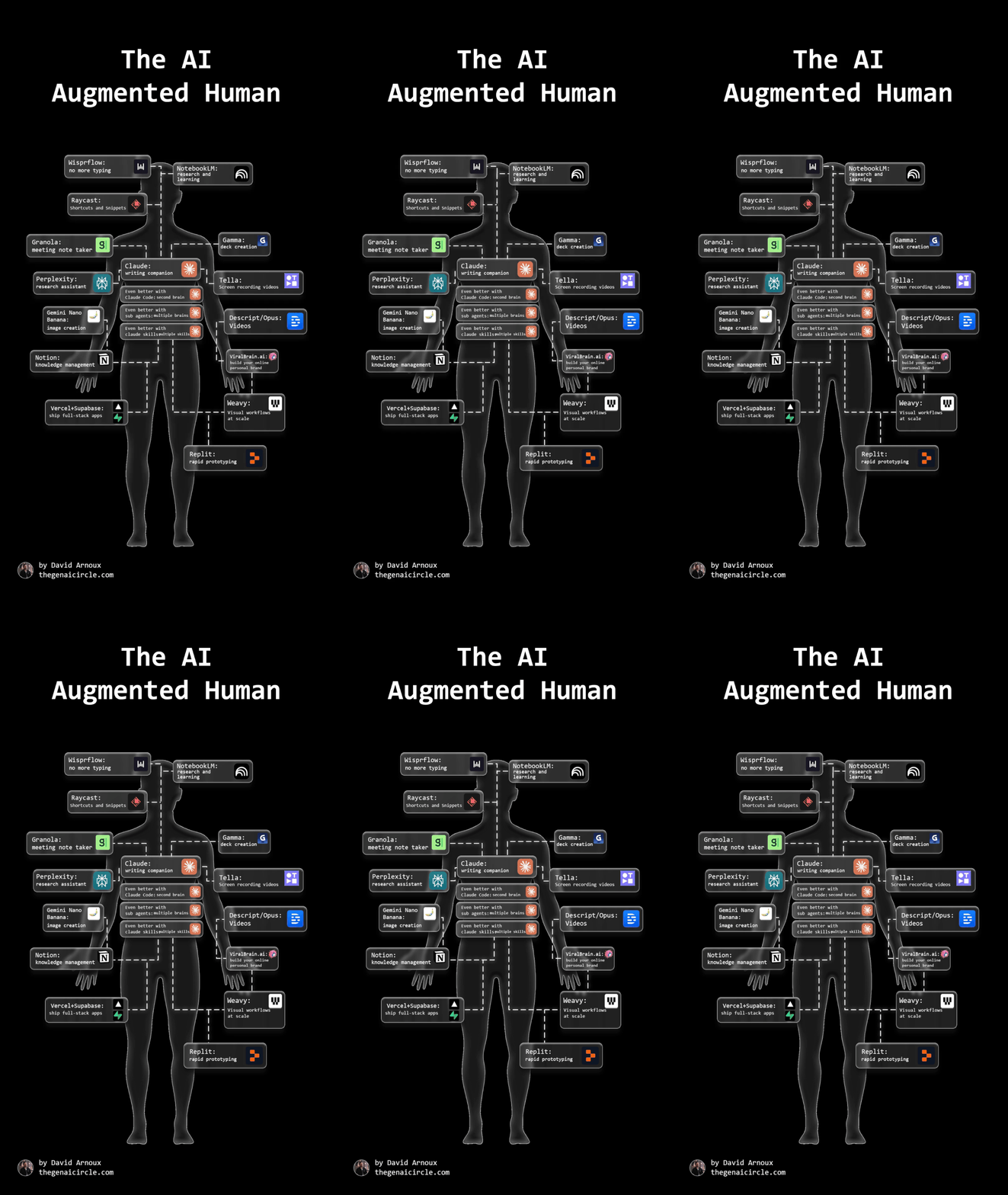
this stack is the fruit of 18 months of tinkering with 400+ AI nerds. but wait, there's more.... here's what each tool does: → granola: takes meeting notes so you can actually be present → wisprflo…
added mold and a maggot with nano banana does this mean i get an uber eats refund? but more seriously... how are delivery and ecommerce companies gonna deal with fake claims? ps: sorry for the pic

6 months, 3 months ago i'd never thought I'd be posting this But i did something last week i never thought i'd do. canceled my $200/month ChatGPT Pro account. 3-6 months ago you couldn't have paid…

everyone's learning cursor and lovable to build the next big saas meanwhile 'boring' processes are making people thousands per month without writing code. again, it's not about the tool you use or ho…

4.7 posts/week
Posts / Week
1.6 days
Days Between Posts
14
Total Posts Analyzed
HIGH
Posting Frequency
466.4%
Avg Engagement Rate
STABLE
Performance Trend
320
Avg Length (Words)
HIGH
Depth Level
ADVANCED
Expertise Level
9/10
Uniqueness Score
YES
Question Usage
0.5%
Response Rate
Writing style breakdown
Conversational but intellectually dense. Feels like a smart friend explaining complex ideas at a dinner table.
Professional in substance, casual in wrapping. Blends research, data, and theory with slang and internet-native phrasing.
Strongly informative and explanatory, with a persuasive layer. Not salesy in tone even when selling; more “here’s how the world works, and here’s what follows.”
Frequently contrarian or reframing: “2026 is the worst year…”, “This headline isn’t actually about jobs.”, “Our alphabet is ancient and broken / So I fixed it…”.
Curious and exploratory rather than absolute; still makes strong claims, but often with nuance or tongue-in-cheek disclaimers (“tongue in cheek of course”, “Jokes apart”).
Medium-to-high energy, but controlled. Not hypey.
Calm, confident, slightly playful. Humor through understatement rather than loud jokes.
Often reflective or philosophical underneath the practical advice (attention as substrate of wellbeing, inherited systems, signaling theory, demographic pressures).
Uses curiosity gaps explicitly: “You’ll never guess where…”, “here’s what you need to know…”, “here’s why…”, “let me explain…”.
Frequently sets up a bold or surprising thesis, then slowly unpacks it with data, history, and frameworks.
Heavy use of examples, data points, and named references (Harvard researchers, Pascal, Michael Spence, specific companies and metrics).
Uses analogy and framing (e.g., “Phoenician code”, “extended mind”, “Artificial Donkey-shed Intelligence”).
Light humor and self-awareness: “my arms as the human in the loop”, “still at MVP stage, but pushing to production”, “now, if you’ll excuse me, I’m gonna go back to scrolling LinkedIn.”
Dominantly second-person “you” when advising or including the reader.
First-person “I” for anecdotes, credibility, and opinions.
Rarely uses third-person except when describing researchers, companies, or “people in general”.
Frequent direct engagement: “let me explain…”, “who else is in?”, “ask yourself a hard question.”
Direct: “pick your 5 skills strategically.”, “rewrite your about section with intent.”, “stop the scroll”.
Soft / inclusive: “you know the drill:”, “ask yourself: what topics do i want to be known for?”, “most people skip this step”.
Sign in to unlock the full writing analysis
Nail your LinkedIn strategy with ViralBrain.
Analyze and write in David Arnoux's style. Grow your LinkedIn to the next level.