
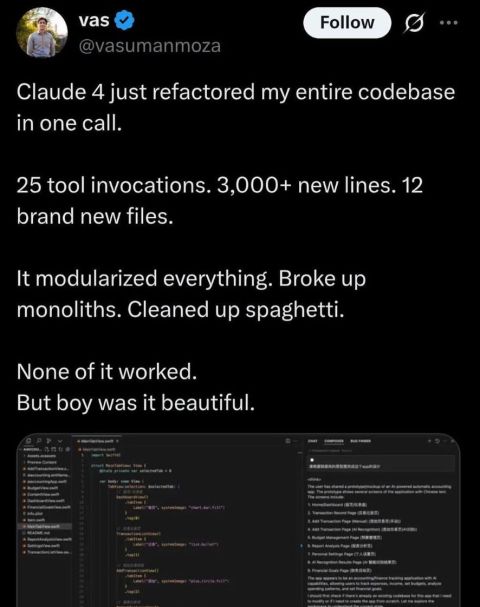
This is so relatable and funny! I love AI coding tools. They're fast, creative, and can make your code look like art. But the truth is, a lot of AI-generated code still doesn't work in production.…
2.3K11650100 viral
AI in Production12 months ago

LinkedIn Content Strategy & Writing Style
Co-Founder and CTO at Invofox (YC S22)
0 people tracking this creator on ViralBrain
Carmelo positions himself as a pragmatic architect of the AI era, bridging the gap between YC-backed innovation and the unyielding rigors of enterprise production. His strategy centers on a defense of engineering fundamentals, where he consistently deconstructs the "vibe-coding" hype to highlight the invisible infrastructure-latency, idempotency, and error boundaries-required for systems to survive the real world. He is notable for his refusal to romanticize AI, instead offering a "CTO’s reality check" that prioritizes operational discipline over novelty. This creates a compelling intersection of high-growth startup leadership and deep technical transparency, as he uses Invofox’s scaling challenges to teach a new generation of engineers that their value lies in solving ambiguity rather than writing syntax.
3.0K
2.5K
164
3.3
623
1
This is so relatable and funny! I love AI coding tools. They're fast, creative, and can make your code look like art. But the truth is, a lot of AI-generated code still doesn't work in production.…
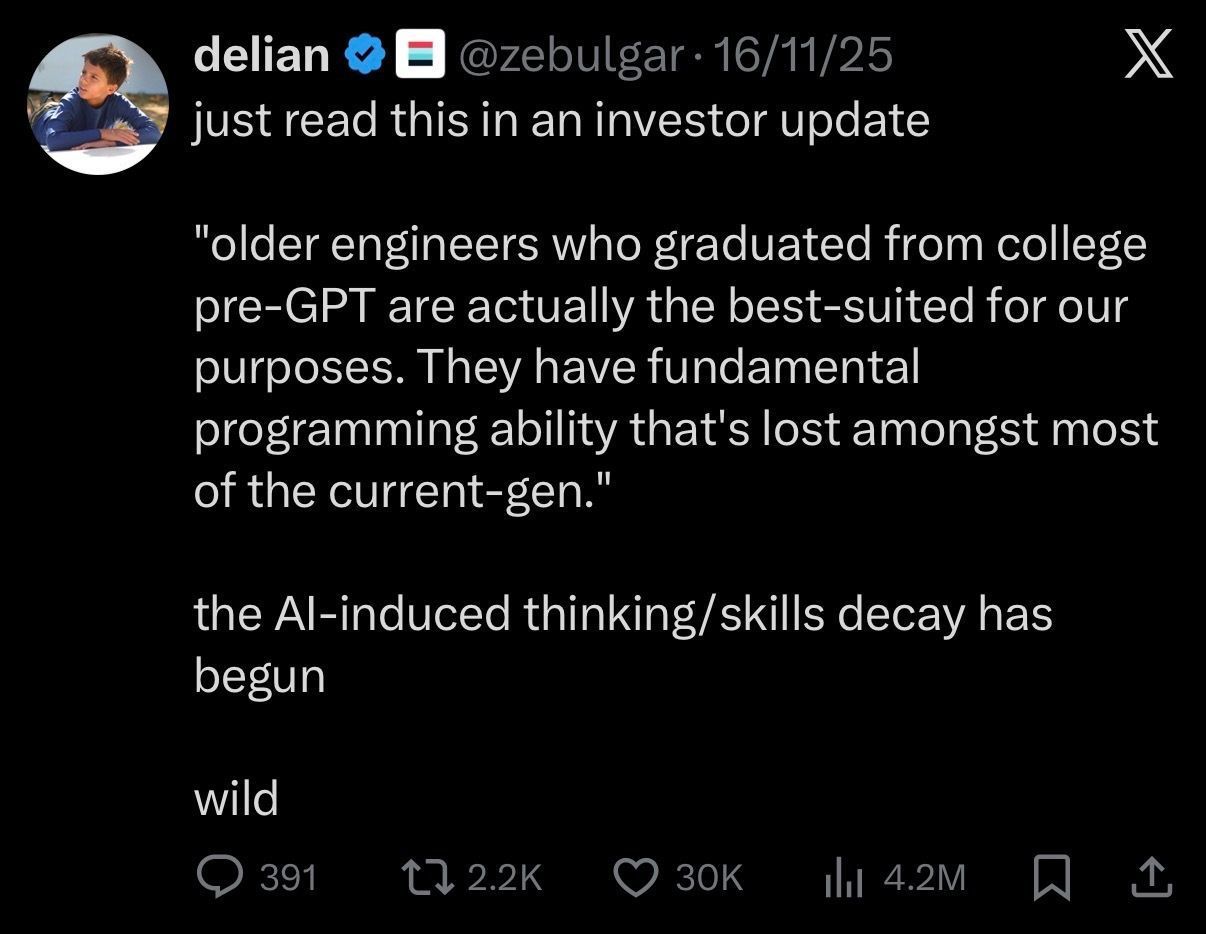
Honestly, this is one of the most accurate descriptions of what’s happening in tech right now. Some of the best engineers I’ve worked with are the ones who graduated before the GPT era because they w…
Developers are the most collaborative species on Earth. It’s why open source exists. Why AI is evolving faster than anyone predicted. And why a single repo fix in one corner of the internet can cha…

I see nothing wrong with this. But let’s be clear about one thing: This can never be deployed in production. That’s the only red flag that matters. Because 2025 engineering has a funny pattern: - A…

I don’t think using AI to code is bad. I think it actually makes us 10x more powerful. But it’s about how you use it. The best developers I know don’t use AI to avoid thinking. They use it to think…

Companies are slapping AI on everything, even when it makes zero sense. I saw a screen protector today labelled “Optimised for AI”. A screen protector. It perfectly explains what’s happening in te…

3.3 posts/week
Posts / Week
2.3 days
Days Between Posts
1
Total Posts Analyzed
HIGH
Posting Frequency
5%
Avg Engagement Rate
INCREASING
Performance Trend
230
Avg Length (Words)
HIGH
Depth Level
ADVANCED
Expertise Level
8/10
Uniqueness Score
YES
Question Usage
0.3%
Response Rate
Writing style breakdown
Tone is professional, conversational, and calm-authoritative.
It leans strongly informative and analytical, with persuasive undercurrents.
It is not poetic or flowery; the style is clean, minimal, and utilitarian.
It is direct but not harsh; critiques are framed as observations or clarifications, not rants.
There is light wit and dry humor, but never at the expense of clarity or seriousness.
Mid-register: professional but relaxed.
Uses contractions consistently (it’s, don’t, can’t).
Uses informal phrases occasionally (duct-tape, vibe-code, cool demo) to stay relatable to a tech audience.
Avoids slang-heavy or meme-heavy language; pop-culture tone is restrained.
Energy is medium: steady, controlled, not hyper.
mild concern (about AI misuse, production unreliability, illusion of competence),
pragmatic optimism (about engineers who do things right),
sober realism (about scaling, security, enterprise, reliability).
Humor is used as a hook or entry point, then quickly yields to seriousness: e.g. “I laughed way too hard at this because…” followed by “But jokes aside…”
Frequent use of contrast: X vs Y, “cool demo” vs “production-grade system,” “virality” vs “reliability.”
Fundamentals over shortcuts.
Reliability, production, and trust.
Scaling realities vs demo hype.
AI as leverage, not replacement.
The problem is production.
Production doesn’t care about your vibes.
The red flag is that no one…
Here’s the thing:
Here’s how it worked:
In short:
What this means:
What’s the most pointless ‘AI-enabled’ product you’ve seen so far?
Frequently uses parallel structures, especially in lists and contrasting sentences.
Mix of first-person singular (I), first-person plural (we, especially when speaking about Invofox), and second-person (you).
Second-person is used most when giving advice or calling out misunderstandings.
Third-person appears when describing companies, engineers, CEOs, or “most AI companies.”
Use AI as leverage. Keep the fundamentals alive.
Build whatever you want. Prototype however you want.
Here’s what I learned as CTO:” followed by directive-style lessons.
If you’re early in your career, focus less on syntax and more on learning how to think.
Sign in to unlock the full writing analysis
Free tools to help you write, score, and benchmark in the same style.
Other creators worth studying alongside Carmelo Juanes Rodríguez.

Scott Galloway
Professor of Marketing, NYU Stern | Bestselling Author | Founder, Section | Host #ProfGPod, #PivotPodcast
5 Viral Score

Walker Deibel
Buying businesses | Investing in private markets Founder, PE & RE Fund | Author of Buy Then Build 🧠 Learn more → walkerdeibel.com
43 Viral Score

Pascal BORNET
#1 Top Voice in AI & Automation | Award-Winning Expert | Best-Selling Author | Recognized Keynote Speaker | Agentic AI Pioneer | Forbes Tech Council | 2M+ Followers ✔️
9 Viral Score

Eve Maler
Digital identity futurist and strategist | Co-inventor of XML, SAML, and UMA | Privacy by Design Ambassador | Board member
54 Viral Score

Kaliya Young
“Identity Woman” | Event Designer & Facilitator | Decentralized / Self-Sovereign Identity Technology Expert | Non Hierarchical Governance Researcher and Practitioner
82 Viral Score

Greg Isenberg
CEO of Late Checkout, a portfolio of internet companies
26 Viral Score
ViralBrain plans, writes, and schedules your LinkedIn content, using official LinkedIn APIs so your account stays safe.
Write like Carmelo Juanes Rodríguez.