
Introducing Reforge Build: AI prototyping that starts from your product, not from zero. Try it here: https://reforge.com/build AI app builders are built for founders starting from scratch, not produc…
1.5K94615193 viral
AI11 months ago

LinkedIn Content Strategy & Writing Style
Founder/CEO @ Reforge, Advisor @ Long Journey Ventures, Previously VP Growth @ HubSpot
4 people tracking this creator on ViralBrain
Brian Balfour positions himself as the strategic architect of modern product management, bridging the gap between high-level growth theory and the messy reality of AI-driven execution. His content strategy centers on the transition from "0 to 1" creation to "1 to N" scaling, offering a sophisticated value proposition that prioritizes customer value over raw output. He distinguishes himself by rejecting the "AI hype" of simple app-builders, instead advocating for rigorous systems like data-first prototyping and "The Strategy Stack." The most compelling intersection in his work is the fusion of executive-level strategy with tactical tooling, where he uses his role at Reforge to build the very products that solve the high-level bottlenecks he identifies in the product ecosystem.
70.0K
21.3K
185
1.6
36
2
Introducing Reforge Build: AI prototyping that starts from your product, not from zero. Try it here: https://reforge.com/build AI app builders are built for founders starting from scratch, not produc…
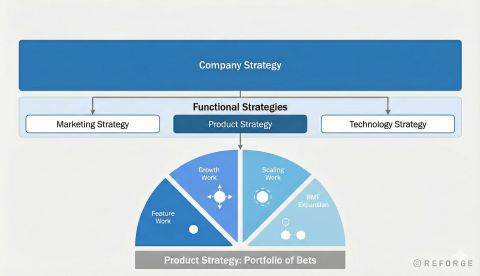
We are in the midst of finalizing our 2026 strategic bets for Reforge. I keep coming back to Company strategy vs Product Strategy. There is a difference and they get confused. Ravi Mehta defined thi…
Don't be like Dave...Dave made 47 prototypes last week, and none of them looked like his actual product. He spent 6 hours trying to get the navbar right. He yelled at the AI at 2 a.m. We had to hold…
Most great features start half-baked. A fuzzy idea from a customer call. A vague customer complaint. A gut feel about what's broken. A "what if" from your shower. But AI does best with clear direct…
Oof. I feel like I’ve been on an AI hamster wheel. 🐹 I think a lot of others have as well. I’m experimenting with a couple of ways to get out of it… The AI Hamster Wheel 1. New AI improvements come…

Kyle Ledbetter and Andy Keil (founders of Dreambase.ai) have built more product than any other 2 person team I've seen. I first heard them on a podcast a couple of months ago and was fascinated by…

1.6 posts/week
Posts / Week
5 days
Days Between Posts
2
Total Posts Analyzed
MEDIUM
Posting Frequency
185.25%
Avg Engagement Rate
STABLE
Performance Trend
350
Avg Length (Words)
HIGH
Depth Level
ADVANCED
Expertise Level
8/10
Uniqueness Score
YES
Question Usage
0.6%
Response Rate
Writing style breakdown
Professional, product-leadership tone with a conversational, human edge.
Informative and analytical at the core, but wrapped in accessible, everyday language.
Persuasive but not hypey; credibility comes from specificity, examples, and framing, not from superlatives.
Feels like a thoughtful senior PM / product leader talking to peers on LinkedIn.
Semi-formal: clear, polished, but not stiff.
Uses contractions frequently (don’t, I’m, it’s).
Mixes business jargon (PMF, portfolio, constraints, system) with casual phrases (“Oof”, “good ol’ days”, “bare-knuckle boxing match with the LLM”).
Medium energy; steady, confident, not frantic.
Reflective, almost essay-like sections (strategy, PMF, constraints).
More promotional/product sections (feature announcements) with a slightly higher energy.
Uses light humor and self-awareness (the “Dave” story, “hamster wheel”, being an “irrelevant 45-year-old in tech”).
Rhetorical questions (“Is getting your team to push those changes really going to help…?”).
Metaphors and analogies (“hamster wheel”, “bare-knuckle boxing match”, “half-baked”, “raw ingredients”, “cooking”).
Short, standalone punchlines (“Your prototypes will look like your product because they are your product.”).
Heavy use of specific, concrete examples (Reforge products, AI feature descriptions, customer feedback lines, metric drops, etc.).
Uses quotes to highlight key ideas from others, then interprets them (“Remember, it doesn't just have to be an insight…”).
Prefers explanation-by-contrast: “Most teams do X. Instead, you need to do Y.”
First person singular: “I think…”, “I’m experimenting…”
First person plural: “We are in the midst…”, “We wrote a full post…”
Second person: “You need…”, “You can capture…”, “How are you thinking…?”
Uses direct commands comfortably when instructive or promotional (“Drop your favorite baked good in the comments…”, “Start with the data…”).
Uses softer suggestion language in reflective or strategic sections (“I think you need dual tracks”, “I think you need to create a separate…”).
Often speaks to the reader as a peer (founders, PMs, designers, product teams), assuming some domain knowledge without over-explaining basics.
Sign in to unlock the full writing analysis
Free tools to help you write, score, and benchmark in the same style.
Other creators worth studying alongside Brian Balfour.

Reinier van Eijk
+60% actief AI-gebruik in je team, binnen 3 maanden
59 Viral Score

Marc Lou
Solopreneur shipping startups like a madman | $94,799/month
16 Viral Score
Gary Marcus
Scientist, author (6 books, including Rebooting AI (Forbes 7 Must Read Books About AI), and Founder (Geometric Intelligence. Acquired by Uber, and Robust.AI). Professor Emeritus, NYU.
94 Viral Score

Tas Bober
Paid ads landing pages for B2B SaaS | 400+ websites, 3x B2B Digital & Website leader | Co-host of Notorious B2B 🎙️
45 Viral Score

Martin Reichetseder
Prokurist & Director Legal, Compliance, Risk & Internal Audit I Co-Founder & CEO .LOUPE I Podcast-Host „Code of C“ I Author I international Keynote Speaker
109 Viral Score

Sheriff Shahen
Sales @ Deel
65 Viral Score
ViralBrain plans, writes, and schedules your LinkedIn content, using official LinkedIn APIs so your account stays safe.
Write like Brian Balfour.