
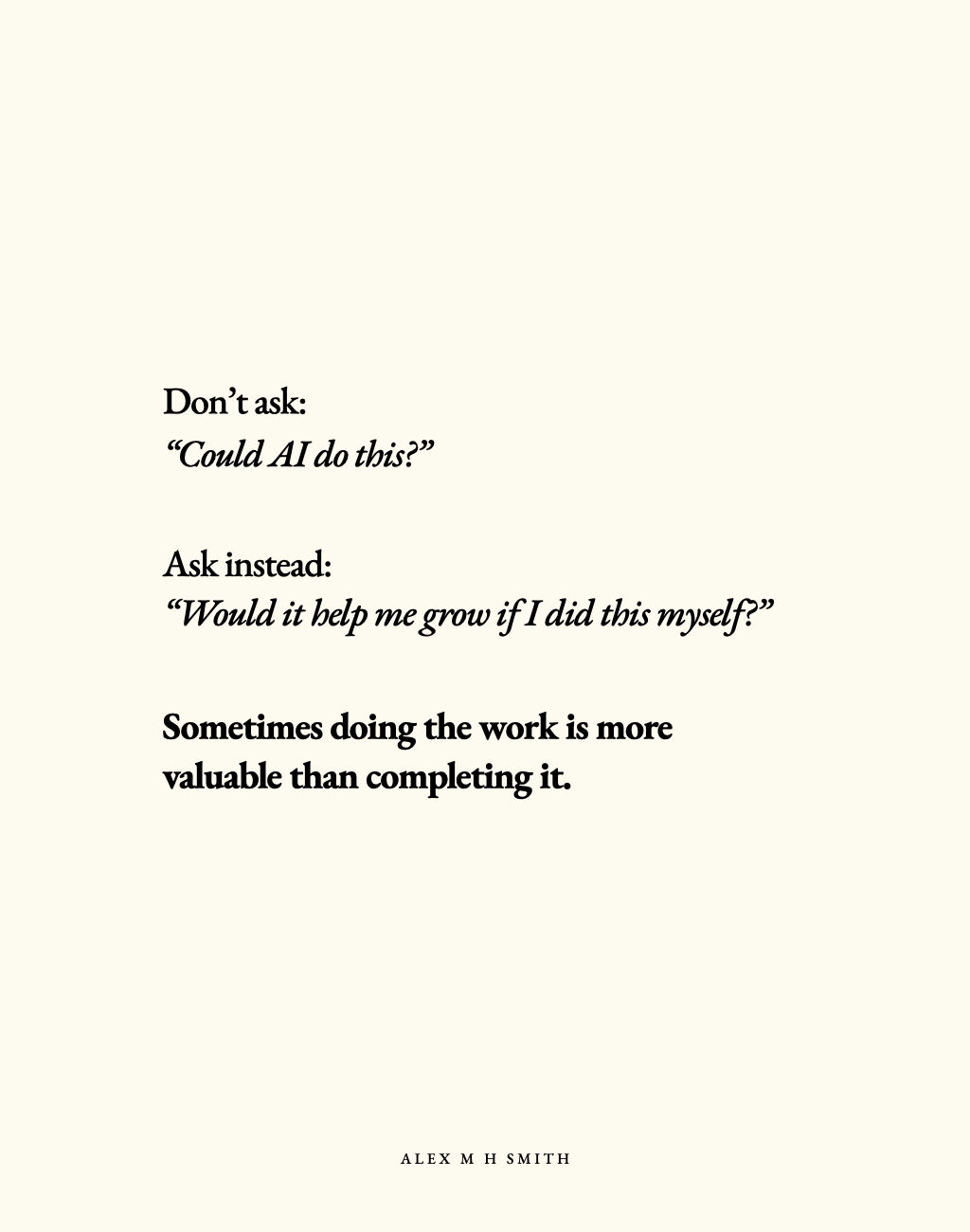
I could get AI to write posts for me. But I don't. I could get AI to compose client decks for me. But I don't. I could get AI to write emails for me. But I don't. I could get AI to judge strategies…
3405595 viral
AI10 months ago

LinkedIn Content Strategy & Writing Style
No Bullsh*t Strategy | Helping leaders make courageous decisions - and bring their people with them | Speaker | Author
1 person tracking this creator on ViralBrain
Alex M H Smith positions himself as a high-stakes provocateur who strips away the corporate "blather" to reveal the visceral, human core of business strategy. His content strategy centers on the psychological friction between formal planning and organizational belief systems, offering leaders "shortcuts" that prioritize decisive action over academic correctness. He is notable for his staunchly anti-AI, pro-craft philosophy, arguing that outsourcing thought to machines robs a leader of their only true asset: their own judgment and taste. By intersecting mythology and narrative structure with hard-nosed executive consulting, Smith transforms strategy from a dry document into a "propaganda tool" designed to jolt an organization’s collective subconscious into alignment.
126.3K
17.5K
273
4.1
27
1
I could get AI to write posts for me. But I don't. I could get AI to compose client decks for me. But I don't. I could get AI to write emails for me. But I don't. I could get AI to judge strategies…
Can you do a little thought experiment with me? I want you to look back on your career. All the jobs. All the meetings. All the bosses. All the teams. ...and ask yourself, can you remember one "str…
The reason they pay founders and ceos the big bucks? Because they aren't specialists. They aren't like consultants, or professionals, who have the privilege of nerding out on one thing. No, they nee…
Two years ago, I wrote a book. My thinking behind it was very simple: "Telling people I'm an author might help me charge more, but nobody's going to read it... so let's just pump out whatever I can…
Imagine an enlightened yogi, sitting on a Himalayan mountainside. Long beard. Flowing robes. Lotus position. The works. After many days’ hard trek, you finally scramble over the perilous rock face,…

I can vividly remember passing through all these stages. I can remember each penny-dropping moment. But unfortunately, I had to figure them all out for myself. So I figured why not write them down,…
4.1 posts/week
Posts / Week
1.9 days
Days Between Posts
1
Total Posts Analyzed
HIGH
Posting Frequency
272.5%
Avg Engagement Rate
STABLE
Performance Trend
300
Avg Length (Words)
HIGH
Depth Level
ADVANCED
Expertise Level
0.88/10
Uniqueness Score
YES
Question Usage
0.8%
Response Rate
Writing style breakdown
Overall tone: calm, grounded, reflective, slightly contrarian, but warm and human.
Register: professional yet conversational. Feels like a seasoned advisor talking plainly, without corporate jargon.
The writing is clear, direct, and distilled. It projects confidence and authority, but never shouts.
Style is methodical rather than free-associative. Each post has a clear, singular idea and moves towards it with intention.
Mid-level formality.
Uses contractions and plain speech: "don't", "gonna", "it's", "you'll", "wanna" rarely but naturally.
Uses occasional mild slang or informal phrasing: "lonnnng", "natch", "nerding out", "pump out", "from the hip", "gonna".
Avoids stiff corporate-speak; also avoids heavy internet slang.
Energy is measured but engaging. Not hyper; more slow-and-thoughtful with occasional punchy lines.
Posts often start with intrigue or tension, then resolve into a calm, wise takeaway.
Emotional palette: reflective, slightly philosophical, supportive, mildly provocative, never ranty.
Underlying vibe: "seasoned guide" rather than "hyped-up motivator".
Frequent rhetorical questions: "Why does this happen?", "Do you see what I mean?", "Anything spring to mind?"
Strong use of contrast and reversal: "People think X, but in fact Y."
Parallel sentences: "Work is not an obstacle. Work is not an inconvenience. Work is not something to get rid of."
Repeated clauses ("I could get AI to... But I don't.")
Heavy use of short standalone lines for emphasis, often single-sentence paragraphs.
Minimal metaphor density, but when metaphors appear, they are extended and vivid (the "myth" concept, the Himalayan yogi).
Direct audience engagement (addressing "you", inviting thought experiments, asking the reader to remember experiences).
Occasional self-deprecation used to disarm: "Maybe because I'm stupid. Maybe because I'm a luddite."
Mix of first-person singular ("I", "my") and second-person ("you").
The "we" pronoun appears when he wants to universalise human behaviour: "We will do EVERYTHING we can to be consistent with this myth".
The reader is cast as a peer or thinking partner: "Can you do a little thought experiment with me?"
I want you to look back on your career.
So please, don't give it away.
Hope you enjoy.
When more direct CTAs appear, they’re straightforward but not pushy: "To learn how to do it right, just go here", "make sure you follow and hit the notification bell".
Sign in to unlock the full writing analysis
Free tools to help you write, score, and benchmark in the same style.
Other creators worth studying alongside Alex M H Smith.

Alex Banks
Building a better future with AI
39 Viral Score
Julien Renaux
Software Engineer - AI guru
1,102 Viral Score

Eric Blaauboer
Schrijver van "Je Laatste: stoppen met roken, op weg naar nicotinix"
139 Viral Score

Stephanie Holland ⚡
GTM Engineer @ mgsh. | Brand-led GTM systems that turn data chaos into pipeline | Clay Solutions Partner | UK + EMEA
151 Viral Score

Alex Vacca 🧠🛠️
Co-Founder @ ColdIQ ($6M ARR) | Helped 300+ companies scale revenue with AI & Tech | #1 AI Sales Agency
124 Viral Score

Bjion Henry
I help agencies/consultancies grow without extra hires • AI Expert for Inbound/Outbound Sales • Ex-Google
64 Viral Score
ViralBrain plans, writes, and schedules your LinkedIn content, using official LinkedIn APIs so your account stays safe.
Write like Alex M H Smith.