Anton Osika and the Age of the Builder with Lovable
A deeper look at Anton Osika's Lovable funding milestone, why it matters, and what the "age of the builder" means for founders.
Anton Osika, "building the last piece of software," recently posted something that made me stop scrolling:
"Lovable just raised $330M at a $6.6B valuation.
It's been an iconic, insane, wonderful journey so far.
Thank you to everyone who made this possible:"
Those first lines set the tone for more than just a funding announcement. They capture a shift in how software is built, who gets to build it, and what it means to create a "generational company" in today’s AI-driven, no-code world.
In this post, I want to unpack what Anton Osika shared about Lovable’s $330M raise, why this $6.6B valuation matters far beyond one company, and what his closing line — "This is the age of the builder" — really implies for founders, operators, and anyone who has ever thought about turning an idea into a product.
A Funding Milestone That Signals a Movement
On the surface, Lovable’s news is impressive: a $330M fundraise led by CapitalG and Menlo Ventures' Anthology fund, at a $6.6B valuation. But as Anton Osika explained, the story isn’t just about the dollars.
Lovable sits at the intersection of AI, no-code, and the future of work. It started with individuals building tools, and now some of the world’s largest enterprises trust Lovable — and the apps built on it — with their data. In just the last six months, those apps have seen over half a billion visits combined.
That trajectory tells us three important things:
- The barrier to building software is collapsing. You no longer need a full-stack team and a year of runway to ship something meaningful.
- Enterprise trust is catching up to innovation. It’s not just hobby projects anymore; mission-critical workflows and sensitive data are moving onto platforms like Lovable.
- Distribution follows value. Half a billion visits in six months is not a fluke — it’s proof that if you make it radically easier to build and iterate, users will show up.
From Solo Builders to Global Enterprises
Anton Osika pointed out that Lovable "started with individuals building tools" and has grown into a platform that enterprises rely on. That evolution mirrors a bigger shift across the software world.
In the early days of no-code, the stereotype was side projects and internal dashboards. Useful, but not necessarily transformative. What Lovable’s trajectory shows is that this stereotype is outdated.
When millions of people build with Lovable, you get:
- A long tail of niche solutions serving very specific workflows.
- A middle layer of serious side projects that evolve into revenue-generating products.
- A top tier of enterprise-grade applications that meet the bar for scale, security, and reliability.
This is where his line really hits:
"Now with Lovable, anyone can build million-dollar companies and products trusted by the world's largest enterprises."
That’s not just marketing language. It’s a thesis: the ability to create valuable software is decoupling from the ability to write every line of code yourself.
Democratizing Million-Dollar Products
If anyone can build million-dollar products, what changes?
- More founders, fewer gatekeepers. You don’t need permission from a VC or a dev team to validate your idea. You can build an MVP yourself.
- Faster iteration loops. When the person with the problem can also be the person building the solution, the feedback loop shrinks dramatically.
- A new type of career path. "Builders" aren’t limited to engineers. They can be operators, designers, sales leaders, or domain experts who understand a problem deeply.
Lovable’s funding round is a bet that this democratized builder class will shape the next wave of software.
The People and Capital Behind a Generational Company
Anton Osika didn’t just thank users. He highlighted two other pillars: the Lovable team and the investors backing them.
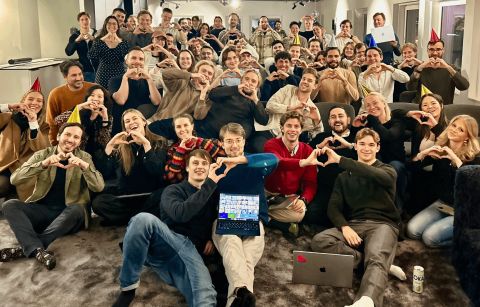
He described the Lovable team as "120 of the most talented people I've ever met," including people who moved across the world to help build a generational company from Europe. That phrase — generational company — is important. It signals intent: this isn’t about chasing a quick exit; it’s about building enduring infrastructure for how software gets created.
On the capital side, the investor list reads like a who’s who of the future-of-work ecosystem:
- CapitalG and Menlo Ventures' Anthology fund leading the round
- NVentures (Nvidia)
- Salesforce Ventures
- Databricks Ventures
- T. Capital (Deutsche Telekom)
- Atlassian Ventures
- HubSpot Ventures
- Joined by Khosla Ventures, DST Global, EQT Growth, Kinship Ventures, and returning backers Accel, Creandum, and Evantic
Why These Investors Matter
This isn’t just a big round; it’s a strategically constructed one. Look at who’s at the table:
- Nvidia (NVentures) represents the AI infrastructure layer.
- Salesforce, Atlassian, HubSpot represent the cloud SaaS and productivity layer.
- Databricks represents data and analytics at scale.
Their presence is a tacit endorsement that Lovable is part of the infrastructure for the next generation of work tools. If Lovable is successful, a growing share of business workflows, data flows, and customer experiences will be built on top of it.
In other words: this round isn’t just about Lovable growing; it’s about the ecosystem agreeing that the "age of the builder" is real and investable.
"This Is the Age of the Builder"
Anton Osika closed his post with a simple line:
"This is the age of the builder."
I think that’s the part worth sitting with.
For years, the narrative in tech focused on the age of the founder, or the age of the engineer, or more recently the age of AI. What’s different about the "age of the builder" is that it blurs those boundaries.
- You can be a builder without being a traditional engineer.
- You can launch a product without being a traditional founder.
- You can harness AI without being a machine learning expert.
Tools like Lovable compress the distance between idea and execution. They don’t make engineering obsolete, but they do change what engineering time is spent on: hard problems, differentiation, and scale, rather than boilerplate and scaffolding.
What This Means for You
If you’re reading Anton Osika’s announcement and wondering what to do with it, here are a few practical takeaways:
- Stop waiting for perfect conditions. If "anyone can build million-dollar companies and products," the limiting factor is less about access and more about execution. Start small, ship something, and let users help you refine it.
- Lean into your domain expertise. The most valuable products often come from people who deeply understand a problem space. Platforms like Lovable let you turn that understanding into working software.
- Think in systems, not single tools. As more enterprises trust platforms like Lovable with their data, opportunities open up around integrations, workflows, and multi-app ecosystems.
- Invest in builder skills. Whether you’re a founder, operator, or individual contributor, learning to prototype and ship products on platforms like Lovable is becoming a career accelerant.
Beyond One Viral Post
Anton Osika’s announcement resonated — over 11,000 likes, hundreds of comments, and wide sharing. But the virality isn’t just because the numbers are big. It’s because the story taps into something many people feel:
- Traditional ways of building software are too slow for the pace of change.
- Talent is everywhere, but opportunity is not.
- The next generation of iconic companies will be built by people who can move quickly from insight to implementation.
Lovable’s raise is one data point, but it’s a powerful one. It validates the idea that if you give builders the right leverage — AI, opinionated tooling, and a trustworthy platform — they can create products that once required an entire company to ship.
And that, more than the valuation headline, is what makes this moment exciting.
This blog post expands on a viral LinkedIn post by Anton Osika, building the last piece of software. View the original LinkedIn post →