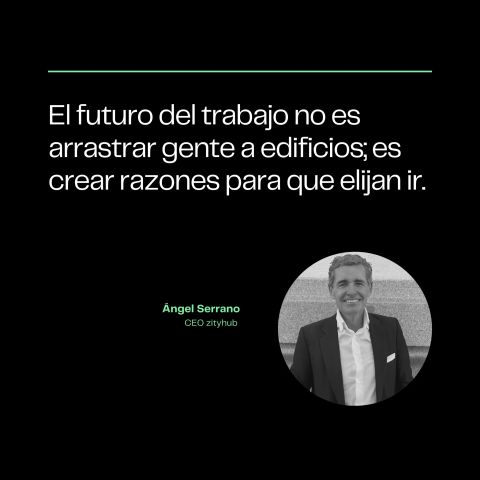
Angel Serrano Ceballos and the Rise of Liquid Offices
A deeper take on Serrano Ceballos’s viral post: offices as intentional experiences, powered by technology for hybrid flexibility.
Angel Serrano Ceballos recently shared something that caught my attention: "La noticia que incomoda al mundo corporativo: El futuro del trabajo no es llenar oficinas. Pasamos de "cuándo volver" a "¿para qué ir?"".
That short shift—from debating when we return to asking why we go—captures the real inflection point in the future of work. For years, many organizations treated the office as a default destination and remote work as a temporary exception. But as Ángel points out, expectations changed while companies were still negotiating occupancy percentages and badge policies.
In other words: we can mandate presence, but we can’t mandate meaning.
The uncomfortable truth: presence isn’t the product
Ángel Serrano Ceballos framed it bluntly: the future of work is not about filling offices. I agree—and I’d take it one step further. Filling offices is a metric. Work is an outcome.
When leadership teams optimize for presence, they usually end up optimizing for control:
- Fixed days, fixed seats, fixed schedules
- One-size-fits-all rules for very different roles
- Office time spent on heads-down tasks people could do better elsewhere
The result is the paradox so many employees feel: "I’m back, but I’m not better." Commuting to do video calls from a noisy open plan isn’t collaboration; it’s friction.
"No se trata de fichar. Es conectar."
That line matters because it reframes the office as a tool for human connection, not an attendance requirement.
From "return to office" to "return on office"
When Ángel writes, "Hoy, ir a la oficina no puede ser sinónimo de presencia obligatoria. Tiene que ser una experiencia que valga la pena", he’s outlining a practical test every workplace strategy should pass:
If the office experience isn’t worth the trip, people will comply at best—and disengage at worst.
So what makes it worth it?
A clear purpose for being together
A modern office should be designed around intentional moments:
- Team alignment and decision-making
- Mentorship and career development
- Customer work, whiteboarding, and creative sessions
- Social cohesion: the informal conversations that build trust
If a team can’t articulate what improves when they are co-located, then the office becomes a very expensive habit.
An experience designed, not assumed
Many organizations treat the office like infrastructure: electricity, desks, Wi‑Fi. But Ángel is arguing for something closer to hospitality and product design.
Think about the difference between:
- A space that looks good on a floor plan
- A space that helps people do the right kind of work at the right time
The second requires choices: zones for collaboration, quiet focus areas, reliable rooms that actually work, and norms that reduce interruptions. Most importantly, it requires choreography: who should be together, when, and for what.
"No se trata de llenar espacios. Es darles sentido."
The core challenge: offices don’t transform by themselves
Ángel Serrano Ceballos notes that leaders are starting to see the real challenge isn’t refilling buildings, but transforming them into places where work flows, connections activate, and talent wants to be.
That last phrase—"quiere estar"—is the hardest KPI of all. Desire can’t be mandated. It’s earned.
In practice, “transformation” usually means moving from static, assigned, repetitive office usage to dynamic, intentional, and measurable usage. And that’s where many companies get stuck:
- They don’t know who is coming in and why
- They can’t coordinate cross-functional interactions
- They rely on spreadsheets, Slack messages, and hope
- They optimize square meters, but ignore experiences
Why workplace technology becomes the lever
Ángel says the shift happens "gracias a la tecnología"—not as a gimmick, but as the operating system for flexible work.
This is the part many executives underestimate. Hybrid work isn’t just a policy; it’s a coordination problem. You’re trying to synchronize people, spaces, and moments with incomplete information and changing constraints.
The right workplace technology helps in three concrete ways:
1) It turns intent into planning
Instead of asking, "Who’s in on Tuesday?", you ask, "What do we need to accomplish this week, and which interactions matter?" Then the system supports planning around those interactions.
2) It reduces the micro-frictions that kill adoption
If it takes 20 minutes to find a room, book a desk, or locate teammates, people stop trying. Good tools make the basics effortless:
- Where should I sit for the work I’m doing?
- Is my team nearby?
- Are there spaces that match the meeting type?
- Can I rely on the environment (quiet, equipment, capacity)?
3) It creates visibility for leaders (without surveillance)
There’s a big difference between measuring utilization to control people and measuring patterns to improve the experience. If data is used to redesign spaces, improve scheduling, and support teams, it becomes trust-building.
"Espacios líquidos": a useful mental model
In zityhub, Ángel calls this idea "espacios líquidos"—and I like the metaphor because it suggests adaptability. Liquid takes the shape of what’s needed.
He defines it with contrasts that are worth unpacking:
"Donde no te controlan, te conectan."
A liquid office isn’t about policing attendance; it’s about enabling the right collisions. It asks: who should meet, and what’s the easiest path to make that happen?
"Donde la tecnología no impone, acompaña."
The best workplace tech is invisible when it works. It guides decisions (where, when, with whom) without turning the office into a bureaucratic maze.
"Donde cada m2 se activa cuando genera valor."
This is the move from real estate as cost center to workplace as value engine. A meeting room isn’t valuable because it exists; it’s valuable because it enables decisions, learning, creativity, and speed.
"Donde eliges dónde trabajar según lo que tienes que hacer."
This line is the bridge between flexibility and performance. Choice isn’t randomness; it’s matching environment to task.
What this looks like in real organizations
To make this concrete, imagine three common scenarios:
Scenario A: The project kick-off
A team comes in for a two-hour kick-off. The office supports it by reserving a collaboration zone, ensuring a room with the right setup, and seating the project stakeholders nearby for quick follow-ups.
Scenario B: Manager coaching day
A manager schedules 1:1s in-office for deeper conversations. The space provides privacy, predictable quiet, and the ability to transition into informal mentoring moments.
Scenario C: Customer co-creation workshop
Instead of squeezing guests into a generic meeting room, the office becomes a curated experience: wayfinding, hospitality, workshop tools, and a space designed for creative work.
In each scenario, the question isn’t "Are we in the office?" It’s "Did the office make the outcome better?"
A simple framework to apply Ángel’s idea
If you’re leading workplace strategy, I’d translate Ángel Serrano Ceballos’s post into four practical questions:
- What are the highest-value interactions for our teams?
- Which of those interactions are currently hard to coordinate?
- What spaces best support those interactions (and what’s missing today)?
- What technology and operating rhythms will make this repeatable?
Answer those, and you stop arguing about "return" and start designing purpose.
Closing thought: the office as a platform, not a place
Ángel writes: "Porque la oficina del futuro no es solo una dirección. Es una plataforma de recursos y experiencias." That’s the key. An address is static. A platform is something people use, benefit from, and choose again.
If we get this right, the office stops competing with remote work and starts complementing it—by specializing in what co-location does best: connection, creativity, speed, and culture.
This blog post expands on a viral LinkedIn post by Angel Serrano Ceballos, Co-Fundador & CEO zityhub | Top Voice. Future of Work | zityhub, la tecnología que facilita a las empresas la gestión de la flexibilidad y la experiencia del profesional. Activista de la Revolución Flexible. Maratoniano.. View the original LinkedIn post →